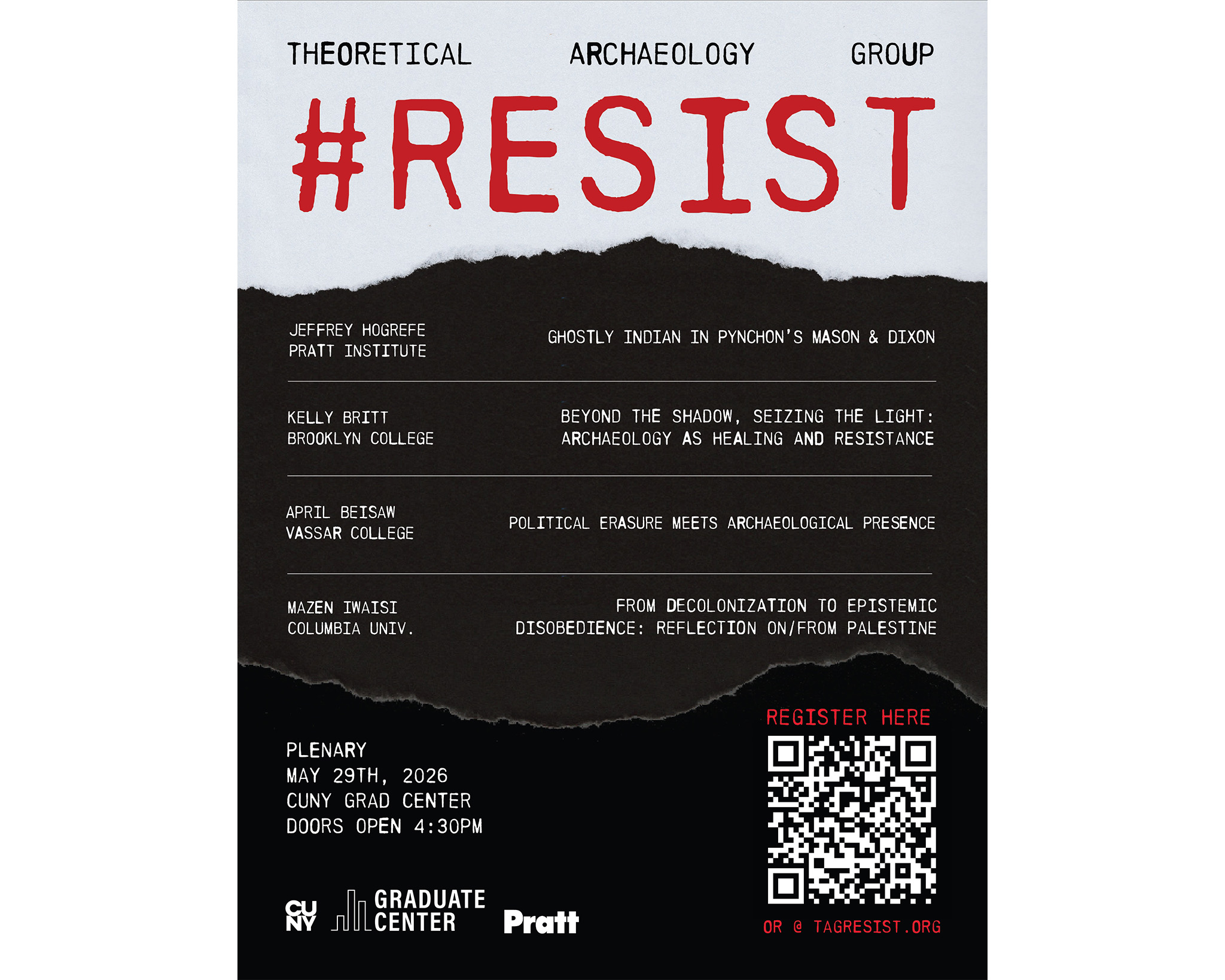
School of Architecture faculty Jeffrey Hogrefe presents a plenary paper entitled “The Ghostly Indian in Mason Dixon,” at theAnnual Meeting of the Theoretical Archaeology Group (TAG) on Friday, May 29, 2026. The program is free to attend.
“At the conclusion of Thomas Pynchon’s Mason & Dixon, Mason finds Dixon buried in an unmarked Quaker grave and hears his voice as he settles into a practical life of surveying land. The haunting of the landscape of Mason & Dixon by the specter of the radical Dixon beseeching the scientific Mason is interesting to regard in response to the imagined future of the storied line as a sign and signifier of north and south, free and slave, in the years leading up to the Civil War and in what Saidiya Hartman refers to as the “aftermath of slavery.” Located on the contested edge of the Mason Dixon Line, the Enlightenment project in cartographic certainty that became the sought after destination for the self-emancipated slave, the Potomac River Valley forms at the intersection of the Shenandoah River and the Potomac River in the upland area that supported the John Brown 1859 revolutionary act at Harpers Ferry that precipitated the Civil War and the 1862 Battle of Antietam that led to the Emancipation Proclamation freeing four million slaves in one of the most radical documents in the history of human rights. This erasure of the memory of the African and indigenous American past in the landscape that actively supported the abolition of slavery has happened largely by the deliberate effects of the reordering of capital formations into new and arguably as insensitive labor bodies in a global space that has been informed by revisionist histories and other processes of knowledge production that have had the effect of freezing past events in crystalline moments that privilege the position of those with sufficient capital to erect the monuments. The Abolitionist Landscape Project, a remapping of the Potomac River Valley, sets out to provide an imaginative presentation of the landscape as a complex social and symbolic structure informed by the ghostly presence of the Indian in terms laid out by literary theorist and Choctaw person Jodi Byrd. The surveying of the line, the abolition of slavery and landscape are all eighteenth-century Enlightenment concepts. Abolitionist and Landscape have been pushed together in an unlikely pairing to create the project, which sets out, through the assembly of an archive of performance, activism and literary production to reinterpret the landscape of the Potomac River Valley as uniquely situated as a habitus for such an important event as the abolition of slavery. Critical terms that will be applied in the paper include monument, subsystems, systems, codes, hautology, erasure, nomadic and settled spaces, networks, space and place, rhizome, and Afrosurrealism.”