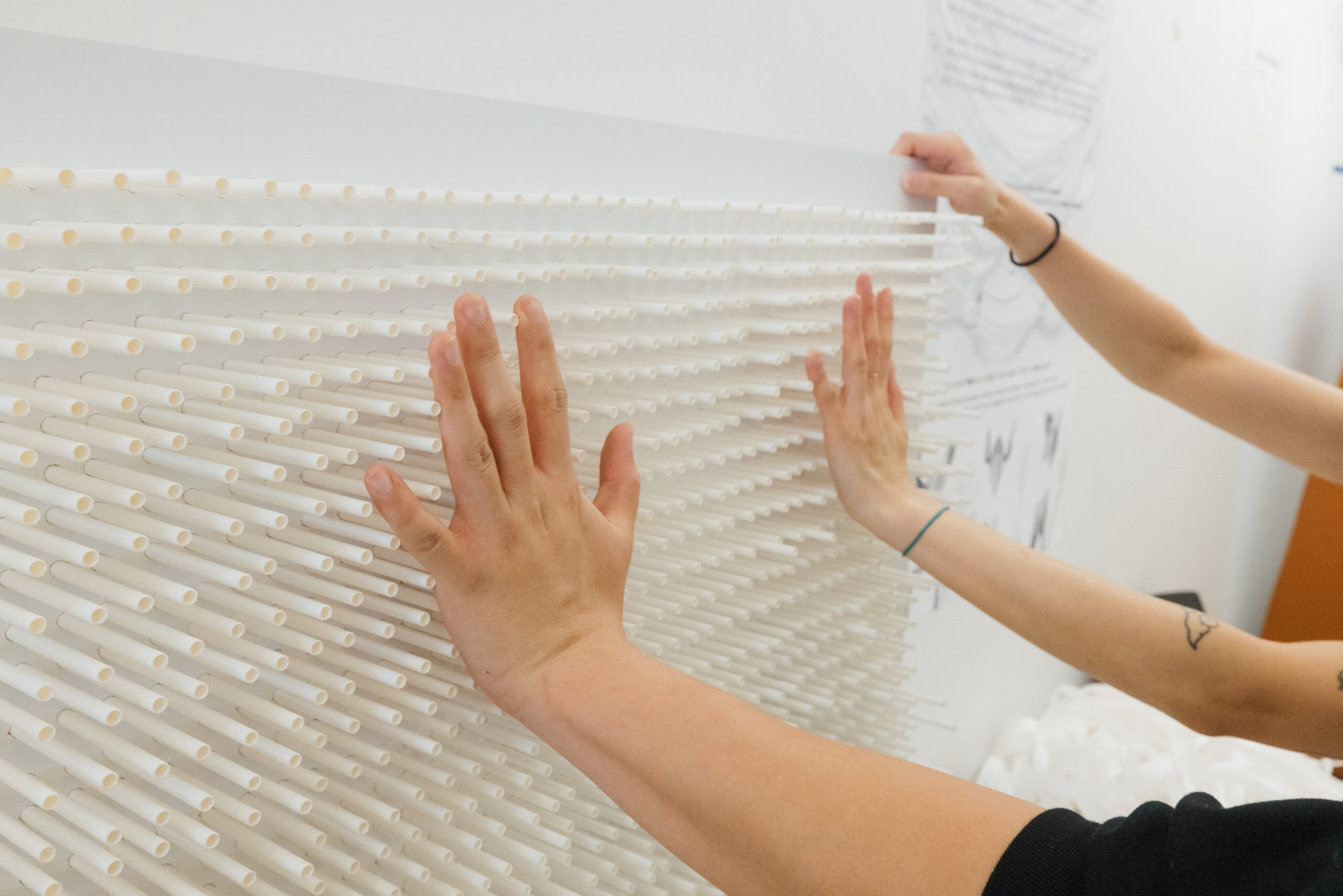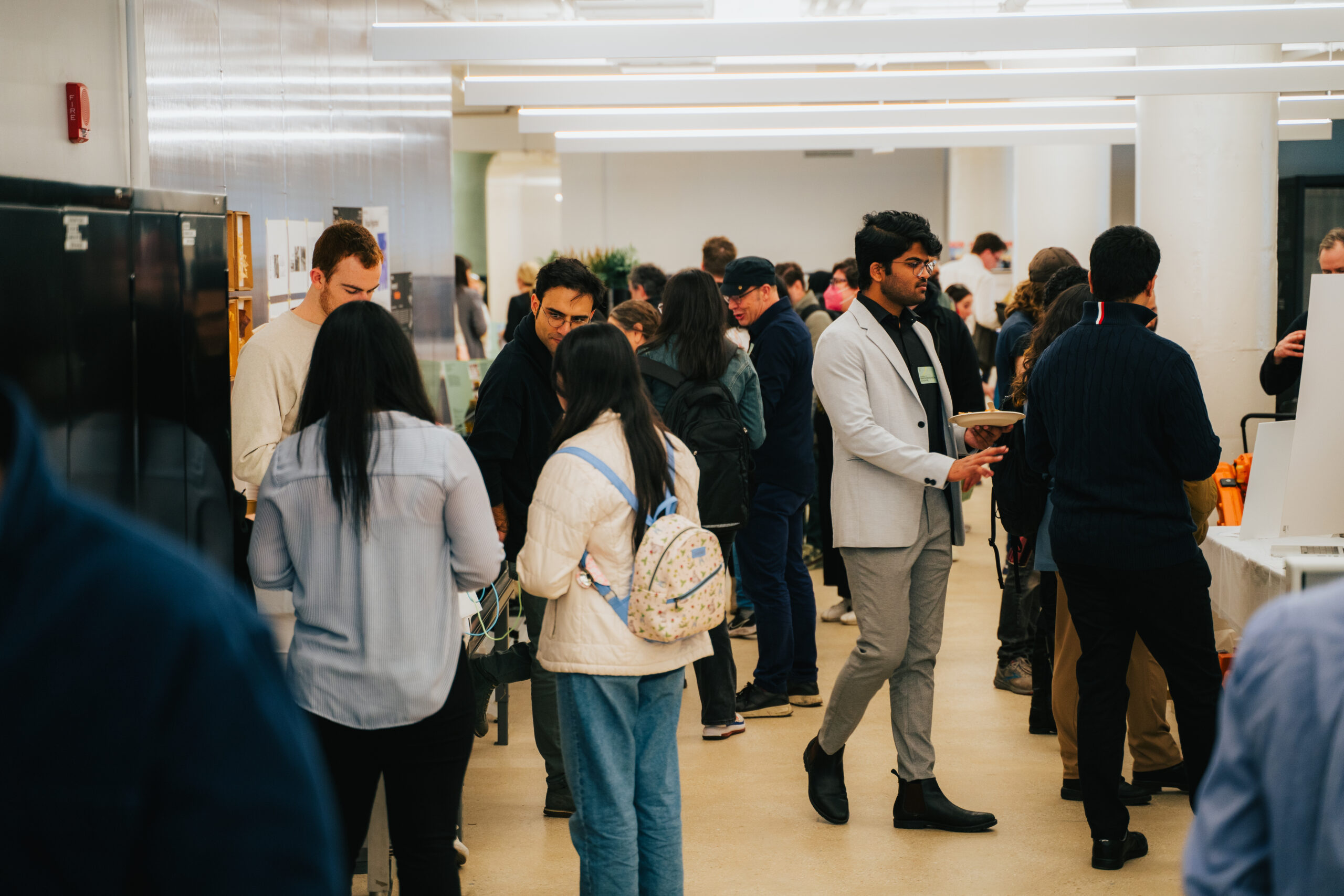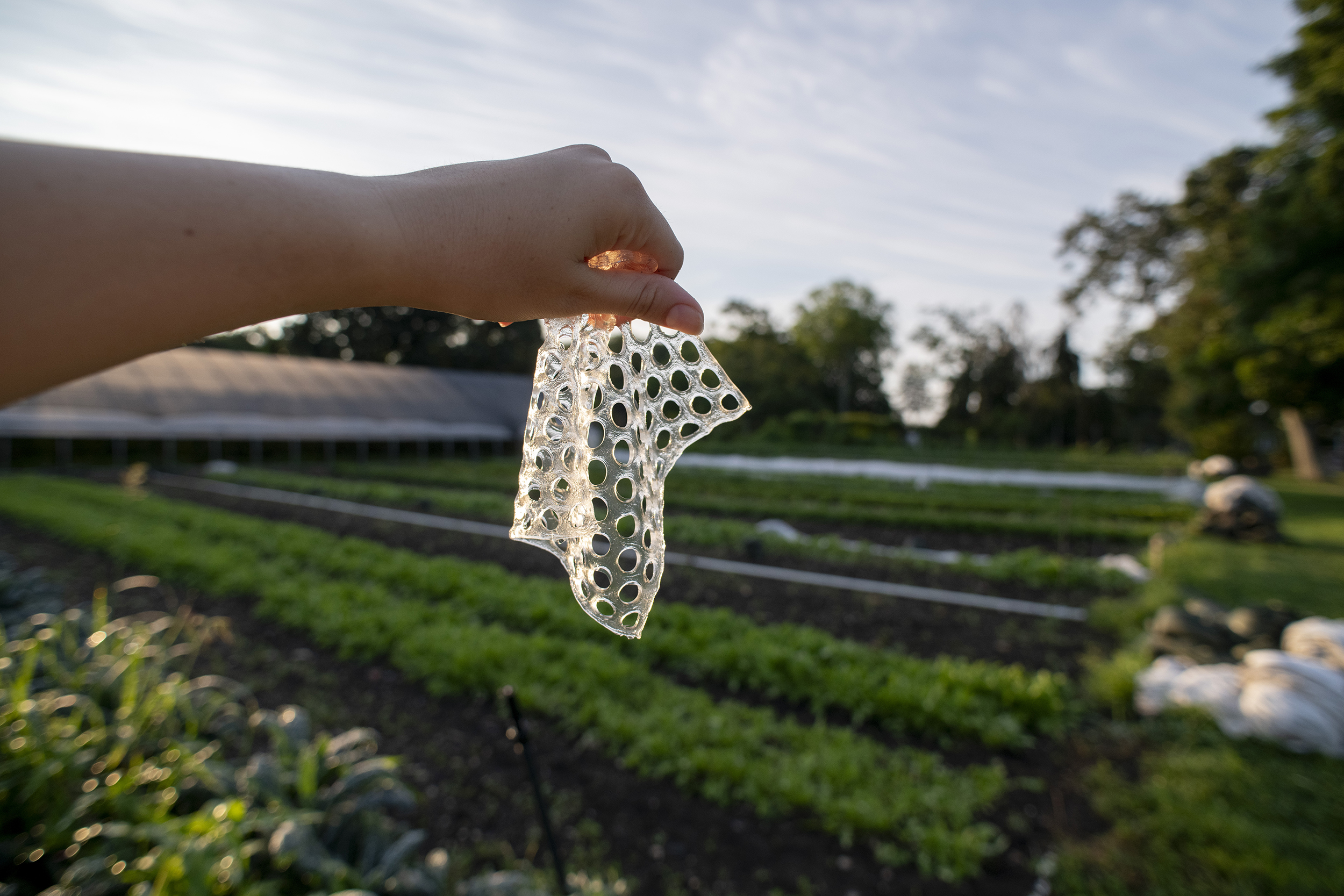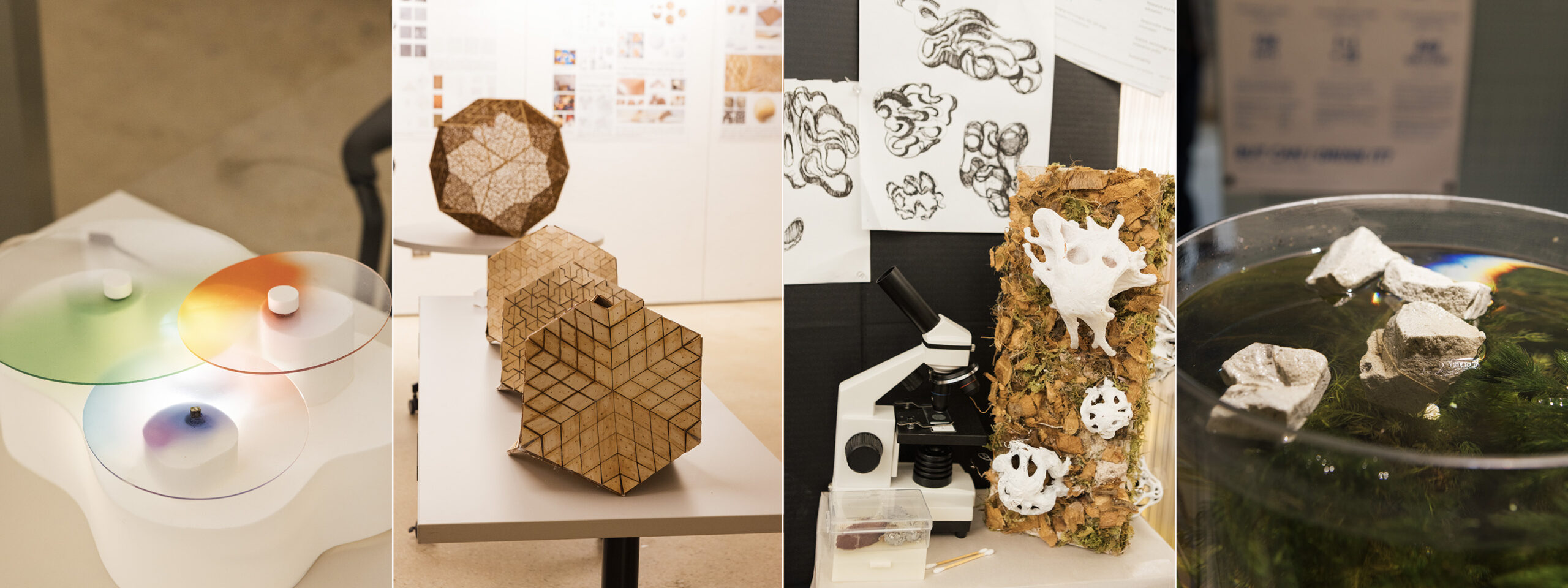
Hundreds of visitors recently gathered at Pratt Institute’s Research Open House 2026 as students, faculty, and visiting researchers shared work that crossed scales and sectors, from material experimentation and public policy to emerging technologies and climate resilience.
Combining installations, research exhibitions, and panel discussions, the annual event in the Research Yard continues to grow in both scope and reach. This year’s Research Open House brought together participants from across Pratt alongside researchers from other institutions of higher education, as well as partners from industry and nonprofit organizations. The result was a dynamic exchange of ideas reflecting Pratt’s expanding role within a broader research ecosystem.
“We are educators, we are researchers, we are advocates, and we have to do this together,” Pratt President Frances Bronet said at the event’s closing ceremony. “When you see this room filled with nearly 1,000 visitors, it means something. The community is here, other universities are here, corporate entities are here. We are all here. And it is in collaboration that we will succeed and be able to hold onto our voices and actually make a difference.”

Four Areas of Inquiry
Pratt’s Research Open House has been organized by the Office of Research and Strategic Partnerships in the Provost’s Office since 2018 to showcase the breadth and variety of research taking place at Pratt, including the work of Pratt’s Provost’s Centers and the IDC Research Accelerator Hub. Having started as a tour of a handful of research demonstrations, the Research Open House has since grown to this year’s assembly of more than 100 exhibitions.
Planned around four thematic areas—Art and Public Spaces, Technology and Ethics, Materials and Fabrication, and Planning and Policy—the event offered a framework for understanding how design research operates across disciplines while addressing urgent global challenges.
“The ambition for this year’s event was to provide Pratt researchers with a platform to feature, advance, and disseminate their work amongst their peers,” said Vice Provost for Research and Strategic Partnerships Eliana Abu-Hamdi. “It also helped researchers seek and secure opportunities for collaboration with university counterparts, industry partners, and community shareholders. Research Open House 2026 exceeded all expectations and demonstrated the strength and agility of Pratt faculty and students to adapt to a shifting landscape. The event was filled with energy and ambition, demonstrating the capacity and values of Pratt Institute.”
Numerous projects stemmed from collaborations with local communities. Fine Arts Civic Engagement Fellow Alex Strada presented Public Address, a citywide public arts installation featuring the lived experiences of people impacted by housing insecurity. Tara Duvivier, senior researcher at the Pratt Center for Community Development, presented research into the changing landscape of New York City’s night life sector, while Swati Piparsania, assistant professor of industrial design, presented the latest iteration of her project Climate Stories, an educational platform developed through participatory engagement with NYC schools that won last year’s Research Open House Community Engagement Award and received a Taconic Fellowship.
“We go to their classes and talk with teachers and we change our topic to fit their current curriculum,” said Climate Stories research assistant Marina Lei, BID ’26. “Then we bring our toys and cart to the school and we have a collaborative course where we watch them play and see if there are any tricky parts or things they don’t understand [so we can make adjustments].”

Another project, FLOW: Energy Autonomy and Regenerative Infrastructure for Floating Communities, examined how design can support circular systems of energy and water use in Red Hook.
“We’re looking at a facade system where algae would be cultivated to clean gray water,” explained research assistant Elizabeth Lynch, BArch ’26. “The goal is that the system could return energy, water, and heat to a 500-unit building—creating a closed-loop system.”
Other projects involved international research. Uzma Rizvi, professor of social science and cultural studies, and Greg Sheward, production facilities manager and robotic operations manager in the School of Architecture, displayed prototypes of mudbricks based on archaeological excavations in Pakistan. The bricks, capable of withstanding flooding and other climate impacts, were formed with the robotic arm in Pratt’s Pi-FAB facilities, and now a team of researchers is exploring the potential to manufacture the bricks at scale for use in the building sector.

As faculty and students build partnerships in New York and beyond, Michael Kelly, adjunct professor-CCE of communications design, has led a multi-year exploration and discussion of initiatives that develop empathy for communities, cause-driven organizations, or larger societal issues through direct engagement with a group outside of Pratt’s gates.
For Christina Chi Zhang, assistant professor of architecture at Lehigh University, who shared her research around disability care at the event, the commitment to real-world impact resonated.
“It’s always exciting to see really creative forms of research,” she said. “There are a lot of place-driven projects and new technologies that I wanted to come and see.”
A Culture of Collaboration
For faculty, the collaborative process often begins in the classroom.
“I think by far the most beneficial thing I’ve experienced as a researcher at Pratt is working with our graduate students,” said John Lauermann, associate professor in the School of Information and co-lead of the National Gentrification Intensity Map. “They’re just so good at what they do. In many cases, they push me in ways I hadn’t considered.”
Carl Zimring, professor of social science and cultural studies, echoed this sentiment, noting that his historical research is often spurred by the ideas students pursue in his Nature and Technology in History class.
“I’m not an architect or an industrial designer, so I learn so much from my students,” said Zimring, who displayed research on voluntary and regulatory measures shaping design strategies. “I learn about automobile design, floating buyback schemes, batteries, all sorts of things because I see what students are working on in their studio practice that I wouldn’t otherwise encounter.”
The Mobile Refuge Room, a short-term transitional housing prototype developed in collaboration with Designing Justice + Designing Spaces (DJDS), is an example of how academic and civic partnerships can bring research into the public realm. Installed in the Research Yard, the project serves as both a teaching tool and a prototype for broader application.
“From the beginning, we understood that the pathway to success was reliant on collaboration and partnerships,” said Allan Co, community development consultant for DJDS and visiting instructor in the Graduate Center for Planning and the Environment (GCPE). “To stand up a pilot like this in a city as complex as New York, you need advocates across institutions.”

Courtney Knapp, chair of GCPE, added that the project’s presence on campus created new opportunities for engagement.
“Having it in a central space allowed multiple classes to convene and root their work in the project,” they said. “It became a centerpiece for bringing people together and expanding educational engagement.”
Research as a Collective Effort
For students, the Research Open House represents a culture of shared inquiry where research is rarely conducted in isolation.
“I think the best thing about Pratt is the community,” said Tinatin Egiashvili, MID ’26, who presented LEAF TO MATTER, an exploration of biomaterials. “If you’re working on research, people suggest different faculty, different students—everyone gets involved. You get connected to the right people and the right direction.”

That sense of continuity is also evident in projects that evolve over time. Saddqa Bahidrah, BArch ’27, returned to the Research Open House this year to build on earlier work exploring biomaterials.
“This started in my industrial design class,” Bahidrah said. “Last year I presented initial research, and this year I wanted to explore more of the potential of agricultural byproducts.”
Elsewhere, projects like Value Lanes, a toolkit for ethical decision-making in design, focused on equipping students with frameworks for navigating complex choices.
“It helps you ideate and think through your decisions—and how to make a case for something you believe in,” said Aayushi Bharadwaj, MSIXD ’26. “We wanted to explore how you learn that skill.”
Expanding the Reach of Design Research

As the Research Open House continues to grow, so too does its role as a platform for connecting ideas across disciplines and institutions.
Alongside the exhibitions, a series of panel discussions in conference rooms offered deeper insight into how research is translated into practice. Sessions ranged from conversations on climate justice and decarbonizing New York’s buildings to a fireside chat on intellectual property strategy.
Panels such as Equity Research & Public Practice, led by representatives from Gensler, examined how design can address systemic inequities, while Leading the Charge for Climate Justice highlighted community-driven approaches to environmental advocacy.
Other sessions emphasized global collaboration and knowledge exchange. The Shaping the City Forum, presented in partnership with the European Cultural Centre, brought together Pratt faculty and international collaborators to discuss urban futures, while the Sustainable Development Goals Local Learning Studio explored how academic institutions can align design education with global sustainability frameworks.
The launch of Pratt’s Center for Environmental Research, alongside presentations on United Nations collaborations, further reflected the Open House’s growing role as a hub for interdisciplinary dialogue, connecting local initiatives to global challenges.
Toward the end of the day, President Bronet announced this year’s winners for each of the thematic categories.
Research Open House 2026 Award Winners

Excellence in Community Engagement
Climate Stories
Swati Piparsania, Assistant Professor of Industrial Design
Piparsania’s project engages communities in conversations around climate change through participatory storytelling, creating accessible entry points for understanding and imagining solutions for the climate crisis.
Excellence in Innovation and Design
Cosmopolitan Plants: Fiber, Fabrication, and Ecological Design
Mariel Collard Arias, Assistant Professor of Graduate Architecture, Landscape Architecture, and Urban Design
This project explores the intersection of plant-based materials, digital fabrication, and ecological systems, proposing new approaches to sustainable design through experimental material practices.
Excellence in Industry Impact
The Post-Corporate Dwelling
Laura Salazar-Altobelli, Assistant Professor of Undergraduate Architecture
Salazar-Altobelli’s research reimagines contemporary housing models in response to shifting labor structures and post-corporate life, offering design strategies that respond to evolving patterns of work and living.
Excellence in Research
Data Textiles: Exploring Data Physicalization in Quilts, Embroidery, and Fiber Arts
Nancy Smith, Associate Professor in the School of Information
Smith’s work translates data into tactile, textile-based forms, bridging craft and computation while expanding how information can be communicated through material and visual means.
Explore Research Open House, and learn more about research at Pratt.