The Museum of Modern Art (MoMA) in the heart of Midtown Manhattan welcomes thousands of visitors per day. But behind all that bustle of both local and traveling art lovers, the diverse collection of iconic art, and immersive contemporary exhibitions are the professionals working behind the scenes to make the museum experience as engaging, enriching, and accessible as possible.
Right now, this includes six Pratt students from the School of Information’s annual fellowship program, which provides students with exceptional professional-level experience in NYC’s world-class institutions. Plus, as fellow Simran Kaur explained, they get unmatched access “to the collection, to the building, to artist events, and to people across video, graphic design, and digital teams all working in the same creative orbit. It’s a creatively inspiring space.”
Let’s take a look at some of the work these students are doing to elevate the museum experience for all while learning about themselves and advancing their careers.
Improving the Search for Art

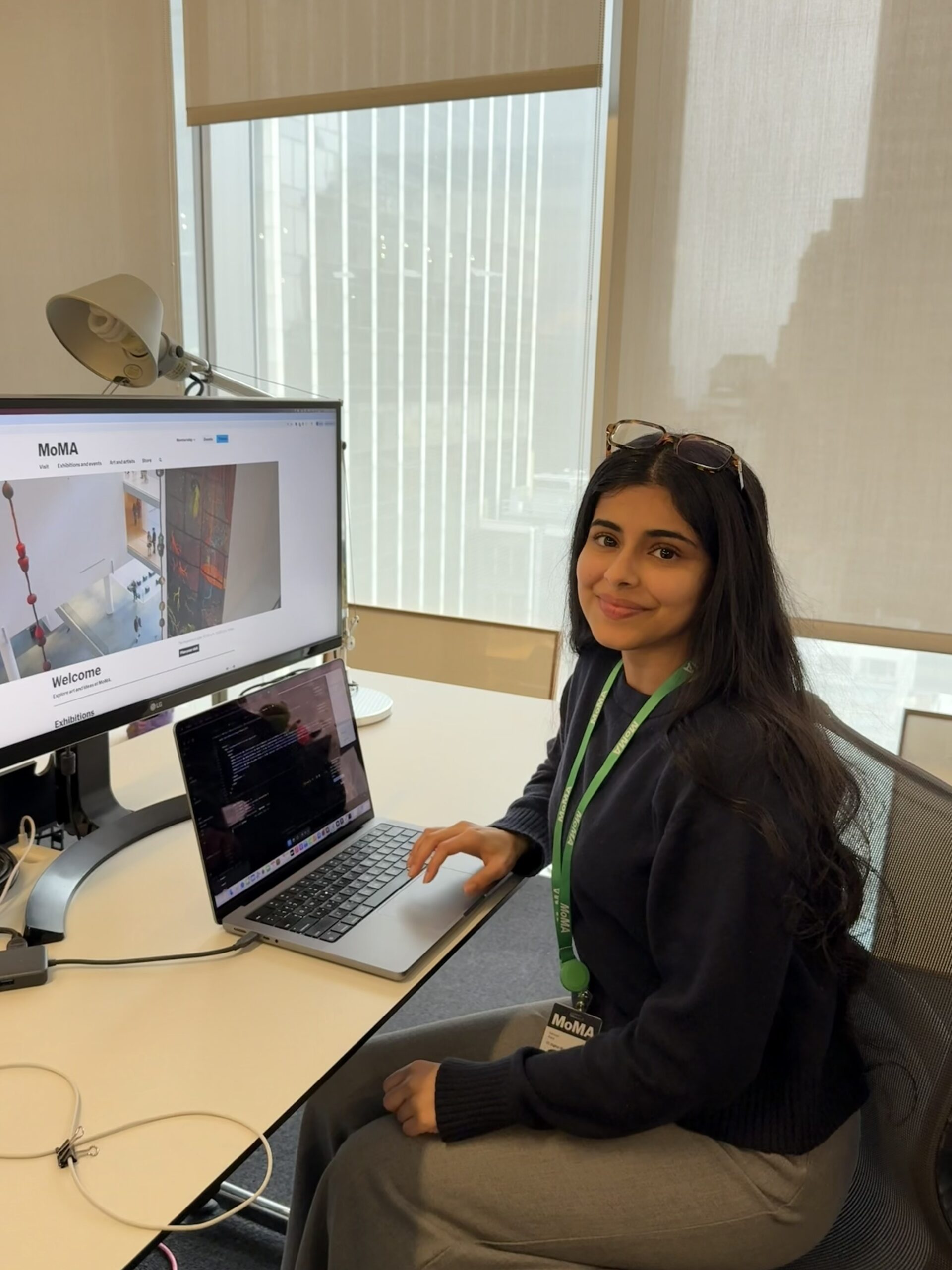
Shreesa Shrestha and Simran Kaur, both MS Information Experience Design ’26, are Digital Product Design Fellows at MoMA.
From the museum’s website to its digital screens and wayfinding around the building, the digital team at MoMA deals with many critical functional aspects of the museum experience. “In a lot of ways, they’re setting the tone before someone even walks through the door,” says Kaur. This work, she adds, matters for the artists, too. “How a piece is represented and surfaced on the website directly affects how discoverable it is and who gets to find it.”
As part of a larger project on improving the museum’s website, Shrestha and Kaur explored how the museum’s search functionality could be modernized and made more user-friendly with AI. MoMA’s digital archive houses over 106,000 works, so finding exactly what you’re looking for can be tricky. A big part of the problem, explained Shrestha, is that visitors are often searching broadly, rather than for specific titles, so their results don’t match their goals.
Building upon existing data, they conducted research, conducted competitive analysis, created new user flows, and used LLM-assisted coding tools to create their own prototypes for user testing. The new system surfaces more useful information within search results, adapting based on the type of query a user submits. “The goal was to help people move from vague curiosity to a confident visit without needing to switch between multiple pages,” explained Shrestha.
“Being a fellow at MoMA has been one of those rare experiences where the reality actually lives up to the dream.”
Simran Kaur
Students enter the fellowship with fundamental knowledge from their studies in the School of Information. From there, they learn about the specific needs of the museum. “Pratt gave me a solid foundation across research, design, and emerging tech—and the mix of client projects meant I wasn’t arriving at MoMA having only ever designed for hypothetical users. It prepared me to navigate ambiguity and work iteratively, which is very much how the fellowship operates,” said Kaur.
With its careful incorporation of LLMs, this project particularly suited Kaur’s research question: can AI “add meaning to experiences without quietly eroding human agency?” By utilizing these tools, this fellowship marked an important step in her career. “I’m leaving with a much clearer sense of what I want my work to be about—and a deep gratitude for the people who made that possible.”
Kaur has accepted a product design position at Microsoft, which she will start after graduation.
Supporting Research at the Art Library
In addition to the vast collection of artwork, MoMA is also home to a research library. Akua Amponsah, MSLIS and MA History of Art and Design ’28, is a fellow in the museum’s library, where she helps staff unpack deliveries, check out books to patrons and museum staff, and complete shifts at the reference desk. “A lot of patrons are museum staff who are doing research for upcoming exhibitions. Many are from other institutions, and many are students working on thesis projects,” she said.
Amponsah is also working on her own project during the fellowship, which will be on view during the 2026 Info Show this spring. In her fellowship, she draws on knowledge from her Art Librarianship class and other coursework. She notes how her academic work translates to a professional setting, while also acknowledging the unique processes distinct to the museum: “It’s really cool to see the concepts we learned play out,” she said.
Beyond her responsibilities in the library, Amponsah has met with other departments and visited MoMA’s exhibitions to gain a more comprehensive sense of what working at an art museum could look like. “I have definitely gained a stronger sense of the contributions museum libraries make to the overall operations of the museum,” she said.
Past Events
-
Pratt Shows 2026