Enrique Lanz Oca
Adjunct Associate Professor - CCE
- Department
- Math and Science
- School
- School of Liberal Arts & Sciences
- elanzoca@pratt.edu
- Phone
- 718.636.3764
Work Samples
-
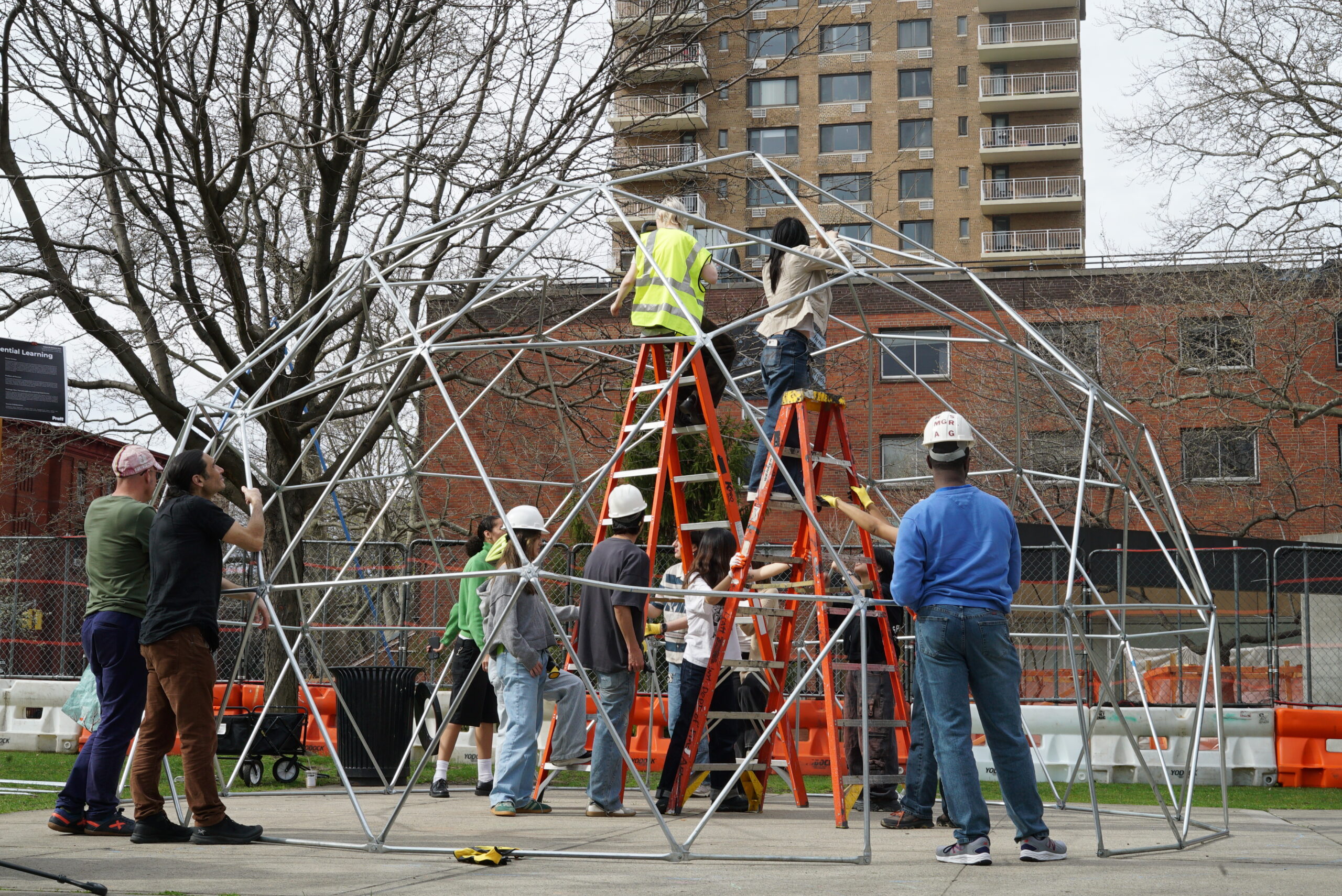
![A group of nine people is assembling a large geodesic dome structure in an outdoor setting. Some individuals are on ladders attaching parts, while others are on the ground holding components. Nearby, there are trees without leaves, and a multi-story building in the background. Construction signs and safety barriers are also visible in the area.]()
Pratt Public Sphere: A Living Laboratory for Sustainability and Community Resilience
The Pratt Public Sphere is an ongoing research and action-based initiative advancing sustainability, climate justice, and community resilience through spatial experimentation and transdisciplinary pedagogy. Housed within a 20-foot geodesic dome, the project operates as a flexible, mixed-use classroom and civic platform embedded within the urban fabric of New York City.
Originally installed outside Dekalb Hall in November 2022, the dome has evolved into a living laboratory for applied ecological practice. Developed in dialogue with artist Mary Mattingly’s civic engagement framework and expanded through the thesis work of Daniel Pravit Fethke (MFA Fine Arts, Integrated Practices ’23), the structure continues to support collaborative research at the intersection of art, design, and environmental systems.
Each semester, the Pratt Public Sphere hosts student-led geodesic dome build studios from the courses of MSCI-271 Ecology of Architects, SES-631 Sustainable Communities, MSCI-411P Resilience Thinking, SSWI-222G
Making/Faking Nature and MSCI-451/651 Climate Change & Communities run by Professors Rafael de Balanzo Joue, Enrique Lanz and Darini Nicholas , where participants prototype rainproofing systems, solar protection strategies, and low-impact material assemblies. Beyond construction, the dome functions as a platform for community-based programming, including resilience-thinking workshops, walkshops, mutual-aid initiatives, food justice gatherings, and interdisciplinary dialogues among artists, architects, designers, and environmental practitioners.The project positions the dome as both symbolic and operational infrastructure. Drawing on Indigenous spatial traditions and the experimental legacy of Buckminster Fuller’s deployable housing models, the structure is recontextualized as a contemporary civic prototype: lightweight, collaborative, and adaptable. In contrast to the scale and rigidity of much of New York City’s built environment, the dome foregrounds flexibility, collective authorship, and ecological responsiveness.
As a research platform, the Pratt Public Sphere investigates how temporary, low-cost spatial interventions can catalyze long-term cultural and environmental change. It fosters systems thinking, supports cross-disciplinary collaboration, and enables students and community members to co-create actionable responses to climate and social challenges.
At its core, the project asks: how can creative education move beyond awareness to activate resilience in practice? By integrating making, dialogue, and mutual aid within a shared space, the Pratt Public Sphere models an educational ecosystem where sustainability is not only taught—but collectively enacted.
-
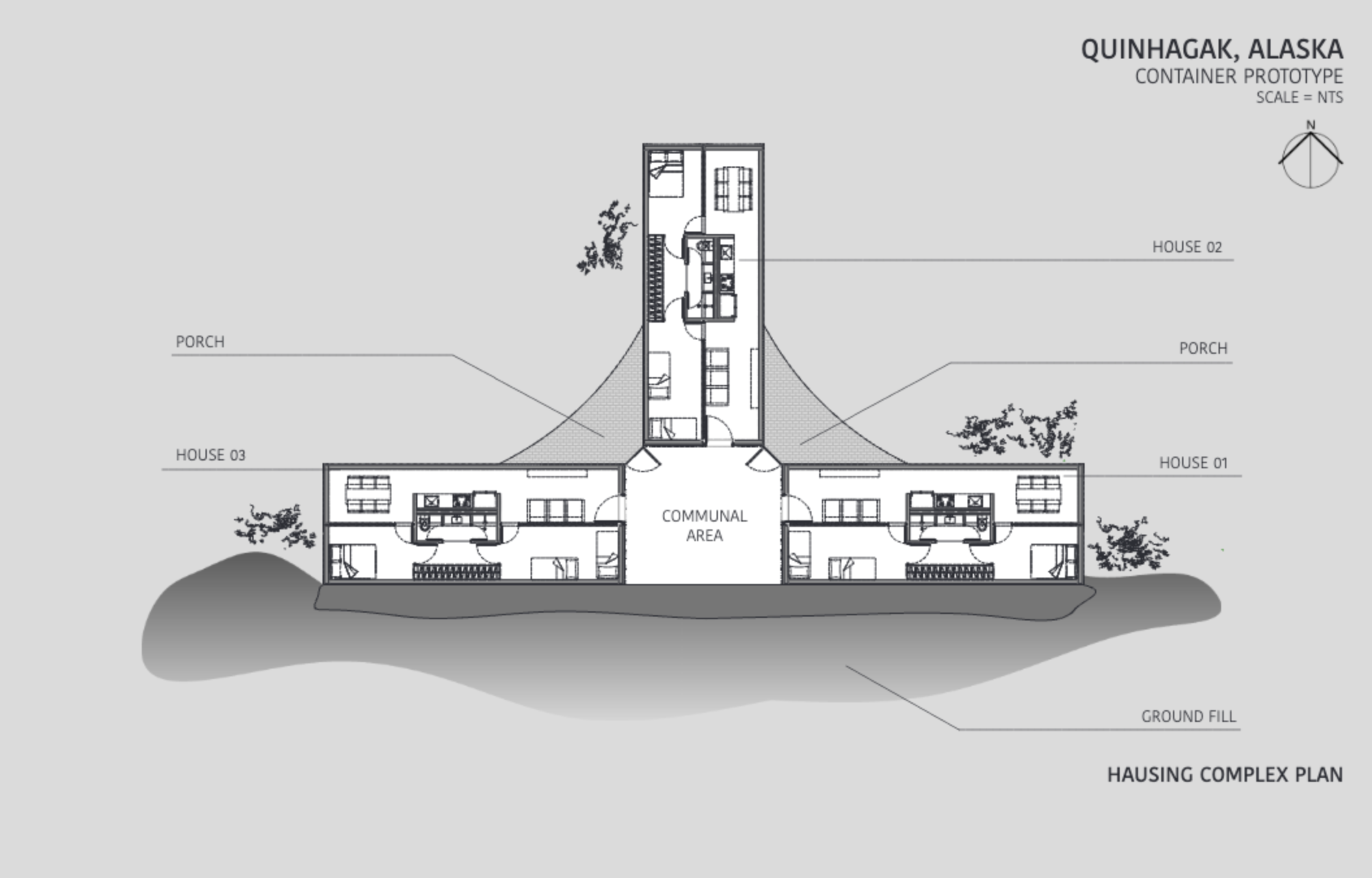
![A floor plan for a housing complex in Quinahak, Alaska, featuring three houses (House 01, House 02, and House 03) surrounding a central communal area. Each house has areas designated for porches. The layout includes indications for ground fill and a directional compass. The design emphasizes shared living spaces.]()
The EcoCultural Design Studio: A Trans-Disciplinary Exploration of Human Cohabitation within Natural Systems in the Context of Acute Climate Change
Accelerating global temperature increases are threatening the survival of communities worldwide through rising sea levels, extreme weather events, and permafrost thaw. This collaborative project advances interdisciplinary research, pedagogy, and community-engaged design through a comparative study of two communities on the front lines of the climate crisis: Quinhagak, an Alaska Native village in the Yukon–Kuskokwim Delta, and the liveaboard community at Garrison Bight Marina in Key West, Florida.
While Quinhagak faces permafrost degradation, coastal erosion, and food insecurity, Key West confronts sea-level rise, hurricanes, storm surge, and increasing pressure on affordable housing. The project has as the main objective the design of two climate-adaptive habitat prototypes that integrate architecture, interior and industrial design, environmental science, and indigenous/community knowledge.
Using salvaged and locally available materials—such as shipping containers, industrial vessels, and reclaimed waste streams—faculty and students will engage in participatory action research, citizen science, and co-design workshops with community members, local tradespeople, and housing organizations. In Quinhagak, faculty-led research will produce a modular, container-based cultural and residential hub supporting housing, food production, renewable energy, education, and cultural continuity.
In Key West, the project will explore floating residential habitats adapted to rising seas through maritime-based construction. Together, these case studies function as a living research platform that advances faculty scholarship, supports curriculum development, fosters cross-departmental collaboration, and strengthens Pratt Institute’s leadership in climate-responsive design and community-engaged research.