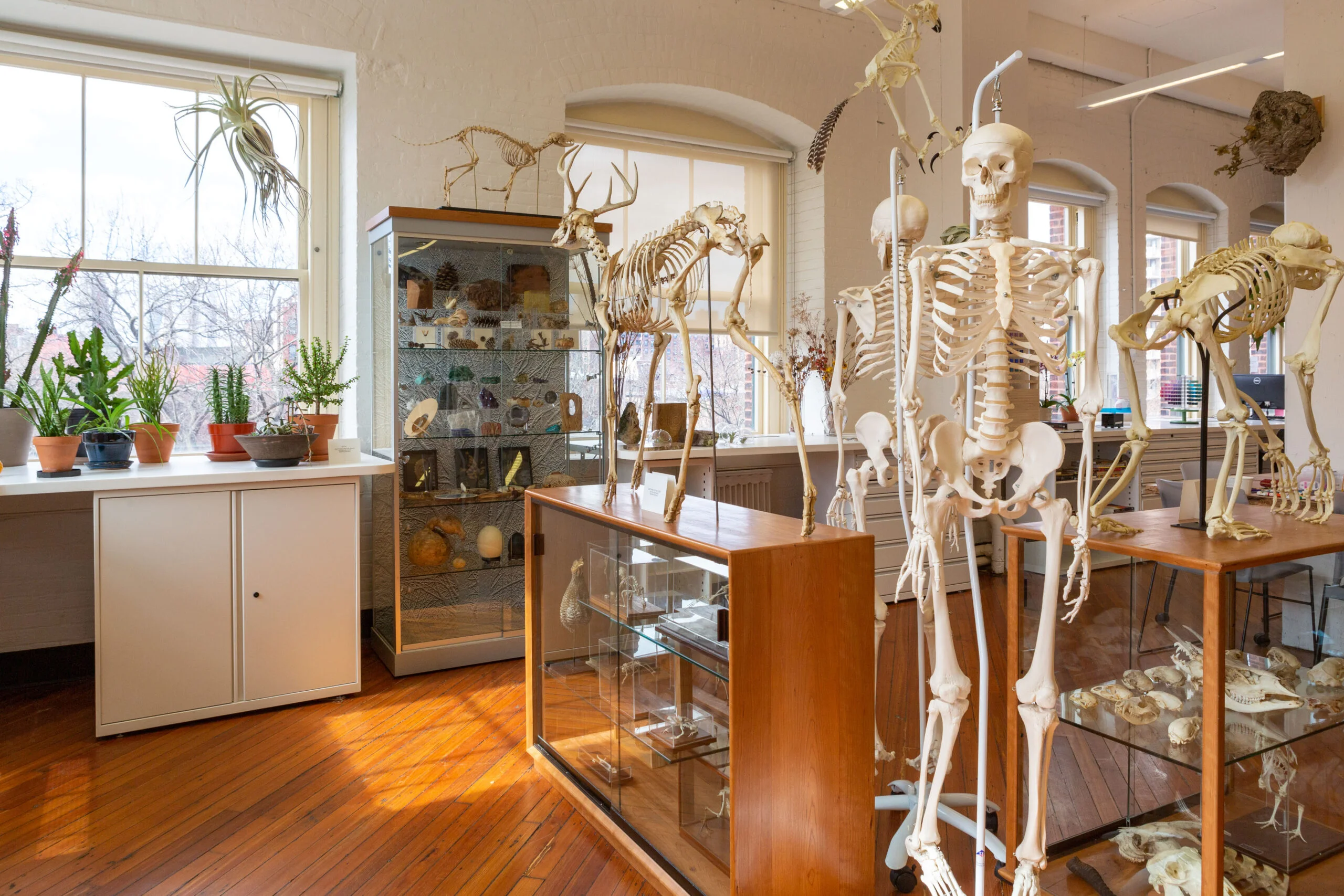
Housed on the fourth floor of Pratt Institute’s Main Building, the Foundations Lab immediately immerses visitors in the natural world. Taxidermy animals, cases of pinned butterflies, and shelves of birds’ nests—some dating to 1925—are displayed alongside live plants and thriving aquariums. This is a space where art and science intertwine, revealing the beauty and complexity of nature.
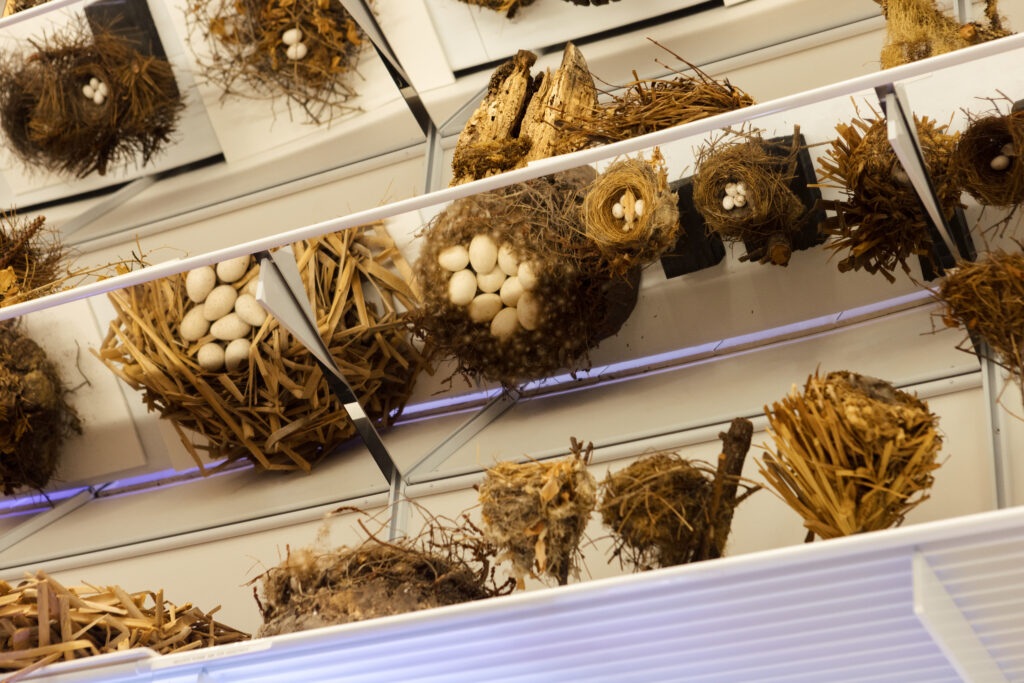
The Foundations Lab provides art and design students with the opportunity to observe a collection of more than 1,300 objects to inform their practices. Students can study archives of pigments and minerals, examine model skeletons, or peer through microscopes. A system of mirrors, designed by David Dávila, MID ’25, allows viewers to look at both the structurally complex undersides of the historic birds’ nests and the fragile eggs they were built to protect.
For students in Pratt Foundation, a yearlong program that teaches the fundamentals of the creative process, it’s an invaluable setting to connect with new concepts and materials. For others, it’s an inspiring space to explore and reflect.
“Discovering this resource that combines scientific and natural history objects with the visual arts was such a mind-blowing experience for me,” says Parker Ewen, BFA Fine Arts (Painting) ’24. Ewen, who served as a student worker, spent his free time in the lab making his own paints from raw pigments and illustrating the insect collection to better understand anatomy. This understanding of materials and anatomy continues to inform the alum’s oil-painting practice, which has evolved to focus on dogs and self-portraiture. “I think it is enriching for a lot of students,” he says.
That enrichment can lead to unexpected creative breakthroughs. Marley Kinsman, BFA Photography ’26, currently a student worker, found the lab to be a bridge back to the natural world he missed after moving to Brooklyn from the Jersey Shore. Using a microscope with a high-resolution camera, he began experimenting with photomicrography, taking images of a praying mantis and other specimens. This body of work was selected for the Photography Department’s Open Call Exhibitions—Kinsman’s first time presenting his photography in a gallery. The skills he honed in the lab later led to a job at the New York Marine Rescue Center, where he photographs sea turtles and seals for conservation research.
“We want to guide students to look more deeply at the world they are inhabiting and reflect this in their practices,” says Beca Acosta, Foundation technician and STEP instructor. “The Foundations Lab is a space where students can do deep, meaningful research. Learning as much as they can will prepare them to be out in the world and find what compels them to create a fulfilling life for themselves. We aim to be helpful in that process and also thoughtful about how they engage with their creative work.”
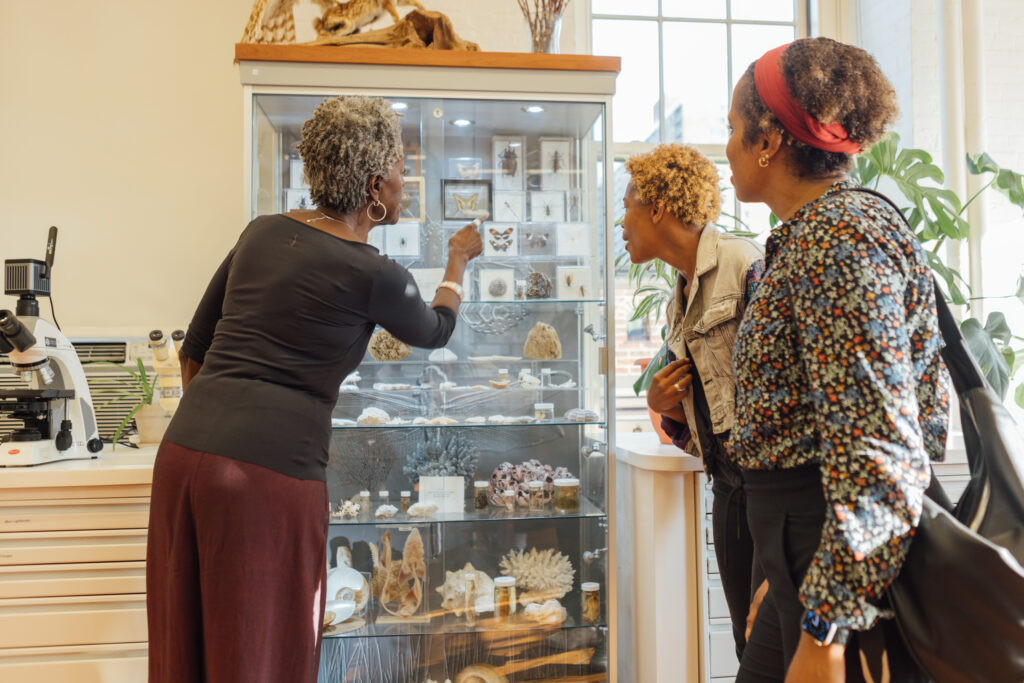
Student workers are key to the lab’s collaborative environment. “Often enough, they will find a part of the lab that they’re interested in or an aspect of the job that they really align with,” says Rochelle Voyles, BFA Fine Arts (Printmaking) ’12, who guides a team of student workers as part of her role as a Foundation technician.
For Gaby Calle, MFA Fine Arts (Painting) ’28, those aspects of the job include managing the two fish tanks—one mimicking a marshland swamp and the other swimming with bright yellow cichlids—and helping students with projects. Recently, they assisted a student in creating microscopic slides of a bean for an assignment. “We’re one of those spaces where students can come in, ask for something crazy, and we will do our best to provide it,” Calle says.
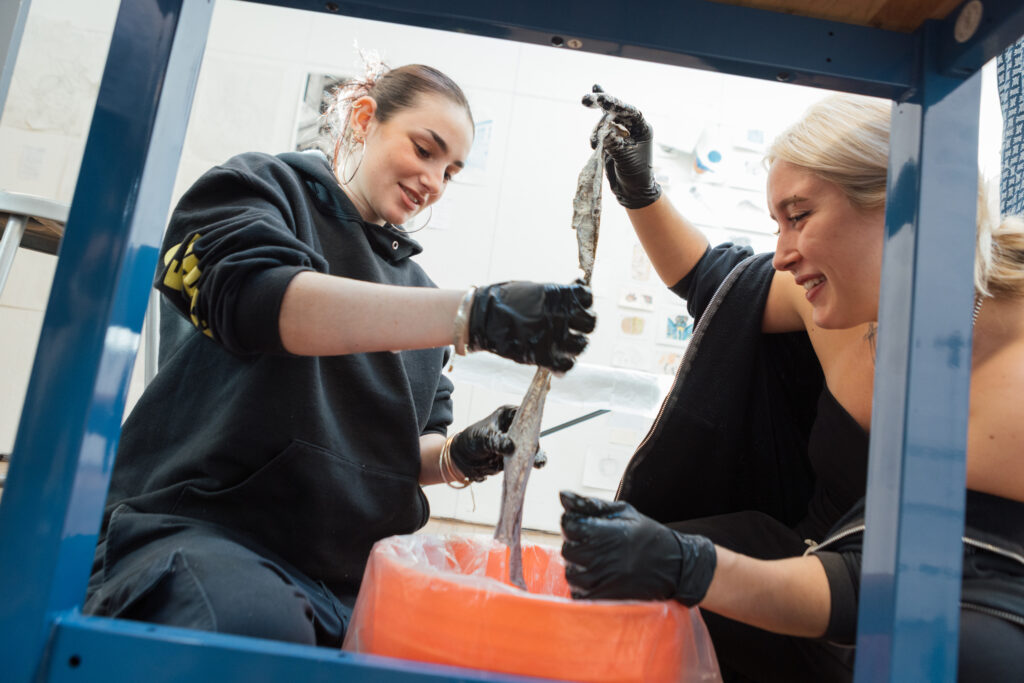
The lab also organizes workshops that introduce students to the process of creating innovative materials from fungi and animal industry byproducts—an initiative known as the BioLab. In a recent session, visiting artist Sasha Fishman guided nearly two dozen students through the process of fish skin tanning, a practice that has been important to Indigenous Alaskan communities for centuries. The technique transforms the skin into a waterproof, visually striking material that is more durable than cow leather. “Some of the skins are iridescent,” Fishman noted. “They look like jewels or sequins.”
“Students often come in and act cautious, careful, and scared to touch anything,” says Voyles. “But as they spend time in the lab, they become more comfortable. Eventually, they come to the lab and set up their own life studies or use the strange objects we have in the lab to explore their own drawing, painting, or digital media projects. What the space offers becomes a source of inspiration for them.”
Expanding the opportunities for students to learn from artists engaging with the natural world in their practices, artist Jacq Groves served as the Foundations Lab’s inaugural Foundation Fellow in Art and Science. In addition to teaching and leading workshops, Groves digitized the Foundations Lab’s collection, which anyone can explore online for free on JSTOR.
“Wonder toward nature is a fundamental drive behind both scientific and artistic endeavors,” says Yi Xin Tong, assistant professor, Foundation, who serves as the department’s sustainability coordinator. “We’re fortunate to have the lab as a place where students can bring that curiosity close—to observe, to be inspired, and to find humility in the process of research and discovery.”
The Foundations Lab has continued to evolve since its opening in early 2020. The space was initiated by Iona Fromboluti Wirls and Doug Wirls, professors emeriti, Foundation, who built its core collection from materials they used to instruct Foundation classes. With additional funding from an individual donor and the Alexander C. & Tillie S. Speyer Foundation, the lab became a hub for discovery.
This spirit of growth has continued, with the Foundations Lab expanding to adjacent spaces to include an Immersion Studio equipped for light and color exploration; the Littlest Print Shop, an intimate printmaking studio; and the Bee Garden, cared for by Pratt’s Beekeeping Club.
These additions further the lab’s mission of cross-pollinating disciplines and encouraging experimentation, providing a place for unstructured exploration that equips students with a curiosity they can carry throughout their education and creative lives.