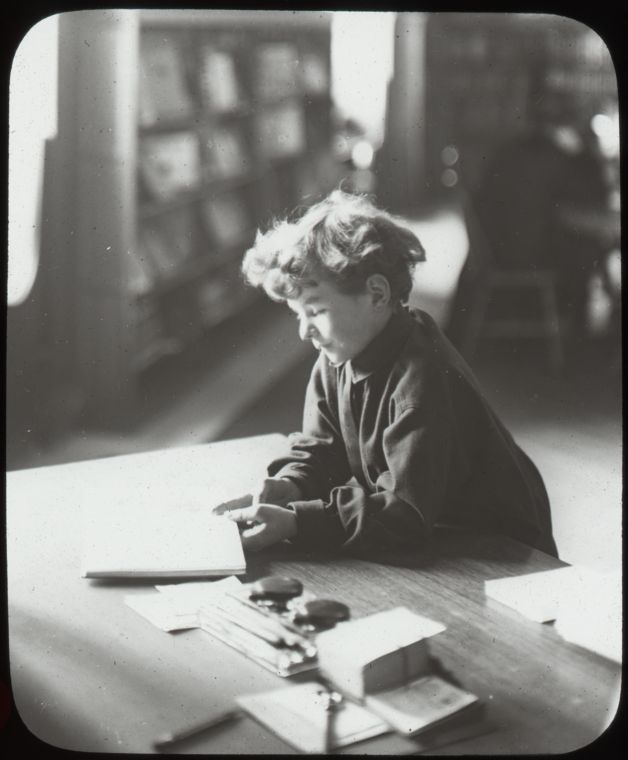
It’s hard to imagine the New York Public Library (NYPL), or any library for that matter, without a dedicated children’s section. However, this was the reality before Pratt alum Anne Carroll Moore began her groundbreaking work to transform libraries into inclusive space for all ages. In establishing children’s rooms—first at the Pratt Free Library then at NYPL—Moore reimagined the role of libraries in relation to childhood development and literacy.
Originally from Maine, Moore relocated to Brooklyn to enroll in the Library School of Pratt Institute, graduating in 1896. At the time, libraries were considered exclusively adult spaces, prohibiting all children under 14 years of age. Perhaps inspired by the paper Moore had presented two years prior proposing the creation of library spaces dedicated to children, Director Mary Wright Plummer asked her to design services for the new children’s room at Pratt Institute’s Free Library. Moore was not only instrumental in establishing this children’s room—the first of its kind anywhere in the world—but also served as its head for 10 years.
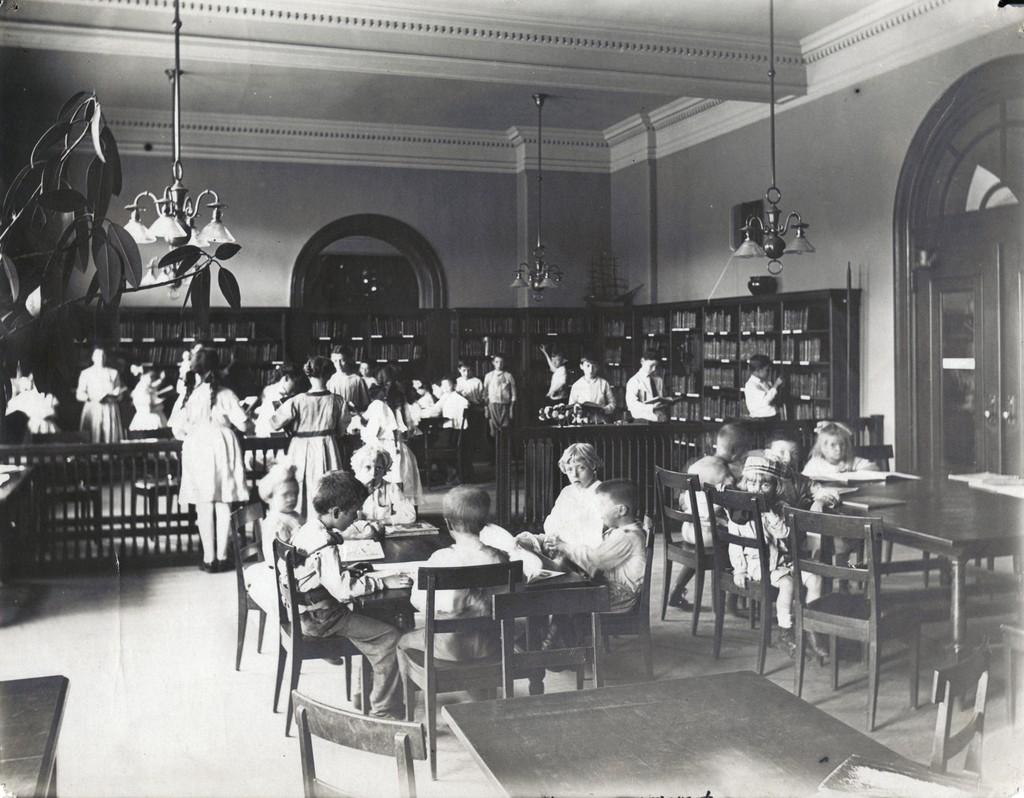
Moore’s pioneering work with the children’s room at Pratt caught the attention of Arthur Bostwick, the head of circulation at NYPL, who hired her to set up similar spaces dedicated to young readers at the main library and its branches throughout the city. Upon her hiring in 1906, Moore became the superintendent of children’s work, organizing hundreds of programs, compiling lists of recommended literature, and developing training for children’s librarians.
It was in this position that she also oversaw the Central Children’s Room, which opened in 1911 and was recognized worldwide for its innovative use of child-sized furniture and its accessible, comforting layout. The efficacy of her work was quickly apparent, with children’s books accounting for a third of all borrowed titles from NYPL by 1913.

New York Public Library
Moore herself had high standards for children’s literature and sought books in a variety of languages in order to encourage reading among New York’s newly arrived immigrant families. Furthermore, her influence as a reviewer of children’s literature led to a substantial expansion in the children’s publishing field during her lifetime. She also advocated for oral storytelling as a way to draw children to reading, inviting authors to narrate their stories at library branches, likely a precursor to storytimes we see in children’s rooms today.
By the time Moore retired from NYPL in 1941, there were children’s rooms in 47 branches throughout the city. Outside of New York, libraries nationwide established dedicated spaces for children based on her model. In choosing to respect children and their learning autonomy rather than look down on their abilities, she expanded the role of libraries in childhood development, helping to foster a love of literature from an early age that was widespread and inclusive, accounting for the lived experiences of children from a variety of backgrounds.