Think of the Industrial Revolution in 19th-century America, and you might conjure images of soot-filled skies, men and children toiling away in dangerous factories, endless train tracks, clanky machines like the telegraph, and illumination by early lightbulbs. And if you imagined that in black and white, therein lies the role that photography plays in our understanding of history.
When it comes to our narratives around industry and innovation, there’s a long photographic tradition with a range of perspectives on the human relationship with work: from Lewis Hine’s sensitive depictions of laborers dwarfed by machines in often rough conditions and Margaret Bourke-White’s soaring, heroic photographs of workers intertwined with skyscrapers, to Lynne Cohen’s long exposures in people-less offices and Lewis Baltz’s buttoned-up and orderly company labs.
People at work, and the impressions they make there, are the linchpins of photographer Cait Oppermann’s first solo photobook, IBM Research (published by Actual Source in collaboration with IBM, 2025). The photos are the result of a commission by IBM—which began in the US in 1911 as Computing-Tabulating-Recording Company, and in 1924 became International Business Machines Corporation, reflecting the company’s global ambitions and ultimately its reach in engineering, research, and design. (Side note: Pratt alum Paul Rand designed its iconic “8-bar” logo.)

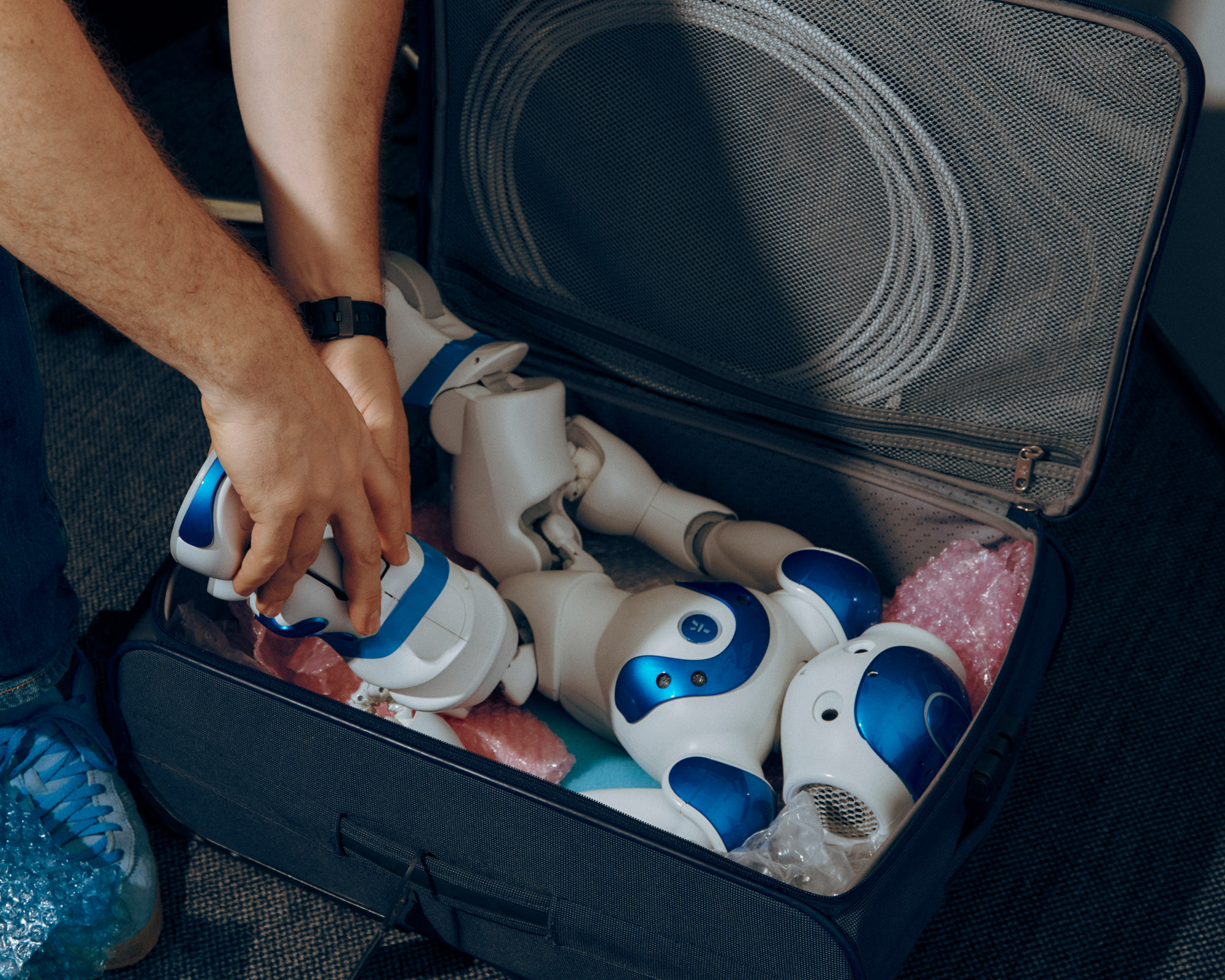
Produced between 2018 and 2024 over the course of four photoshoots at IBM campuses in Almaden, California; Yorktown, New York; and Zurich, Oppermann’s pictures show us how crucial the human hand is in even the most technologically advanced work. Oppermann joins a lineage of IBM-commissioned photographers that includes Ansel Adams and Henri Cartier-Bresson, investigating the interior architecture of active laboratories and offices, and how the workers find their places within the ecosystem. Shedding light on “the unfiltered clues,” as she says in the book’s introduction, to the human stories behind innovation, Oppermann reveals a company culture that celebrates its layered history, opting not to paint over the hand-drawn height chart on the door frame.
In this conversation, Oppermann, who has built a career in commercial and editorial photography and launched her own creative studio, FLOWERS, speaks about the project and shares an inside look at her own creative practice.
Cait Oppermann: IBM commissioned this project starting in 2018. IBM has an internal brand studio that reached out to me about photographing the people behind IBM Research, which is an innovation arm that works on all kinds of different projects, such as quantum computing, battery technology, and AI, among other things. There are scientists, physicists, mathematicians, and researchers.
IBM has a legacy of having artists re-lens the company. Ansel Adams did the same thing [in 1955].
I went into their offices and they showed me this photobook by Andri Pol (Inside CERN, 2014), and I thought, this will be so much fun.
Daniel Terna: So you’re building an image library.
CO: Yes. In Poughkeepsie there’s an IBM archive, which I visited, and that’s where I’ve held the Ansel Adams prints.
The first shoots were in 2018 at Zurich and Almaden. I could pretty much shoot anything I wanted. We had somebody escort us where we’d need security clearance, but no one told us that we had to shoot specific things. It’s the dream.
And everyone was just so in their worlds. My favorite assignments are always the ones where I get to be sucked into somebody else’s world. One of the ways that I defuse tension is by asking lots of questions. I like to pull expertise out of people.
“If it’s a photo of highly technical lab equipment, there’s also a very human mess next to it.”
DT: There are these colors you use in your work that I like so much—blue and orange. There’s so much blue on these campuses, you really bring it out. Some of these details where things [like computer screens] become abstract remind me so much of the futurism of ’80s and ’90s advertising photography.
In a way, it doesn’t matter what we’re looking at in your pictures, it’s still fascinating. Most of us won’t know what these technologies are.

CO: That’s why it was so fun to shoot. For instance, in one of these photos there’s a can of Arizona Iced Tea that they’ve modified to be part of the machine, and there’s super high-level, high-tech stuff happening. You can see the human hand in everything. If it’s a photo of highly technical lab equipment, there’s also a very human mess next to it.
One of the benefits of being a legacy brand like IBM is there are going to be labs where you can see somebody’s scribbles on the desk from the 1960s. There’s a patina that’s been left over time.
A lot of these offices have been passed down through generations and people want to get a certain person’s office because it means something to them. It’s super intergenerational.
DT: I will say, I love the cafeteria, and the landscapes, the rooftop garden. It’s crazy that you were parachuting into actual meetings. These are not discreet reportage pictures. You literally have a lighting setup going on.

CO: I do a lot of shoots commercially where I have to orchestrate a lot more. But I’m someone who loves to react. I love to be on my toes running around with the subject.
DT: Yeah, it seems like a lot of the way you present these scenarios is like a theater stage. You set up your lights; you’re the director, and you say “now go play.” I sense that you’ve created the scene and the composition and then you’re moving around within it.
CO: And if you’ve got somebody like me in the mix, I’m telling the subjects to do it again, do it harder. Then you can dial up or down the scene as much as you want. I like that balance of being swept up in the scene and also being able to orchestrate and engineer aspects of it.
DT: How do you feel about having made your first big book?
CO: It hasn’t really sunk in yet because it’s such a slow process. It took a year.
Over the years of the project, I’d been casually bringing up the idea of a book to the people who had commissioned me. IBM has a long history of making books and printed material in their archive. In fact, where my parents now live in the Hudson Valley, there used to be more IBM facilities, and you can always find IBM books or shirts in thrift stores there. So I said, we should make a book.
And finally, with IBM’s 100-year anniversary [in 2024], they said OK.

I was so grateful that they were [open to working with a designer out-of-house]. Actual Source had both the skills and the distribution. They had done the branding for my creative studio, so I asked them if they would be interested in publishing this body of work.
I had to go back and look through all of the shoots, not just what IBM had selected or what I liked, but another comb-through thinking about this as a book. Then I sent all of that to Actual Source.
DT: So you trusted them not only as designers, but also as editors.
CO: Yes, since I’d been working on this project for so long. I think if it was a shorter-term project, I might’ve been more heavy-handed. But for this I just knew I didn’t want it to be chronological.
We went through many rounds of edits, working through how the images live on the page, the sizing, and how they would breathe. But very few changes were made at all by IBM. There were only a couple of images that they took out, and it was because one of the chips was proprietary technology that hadn’t been released yet. But they were so open to pretty much everything being included.

DT: The cover design reminded me of Christopher Williams’s The Production Line of Happiness (2014), which has a formal structure to it. With your book cover, the IBM letters conjure the logo, which is so indelibly printed in my mind. And the horizontal lines make it feel like a notebook.
CO: Totally, I wanted it to feel like a report.
DT: But the most obvious parallel in your book is to Larry Sultan and Mike Mandel’s Evidence photobook (1977), the difference being of course that they were working with a preexisting archive of images, whereas here you created the archive itself.
CO: Honestly, what I would love to do one day is go and make a book from the IBM archive.
Have you seen Lars Tunbjörk’s office work? It’s my favorite. He’s a Swedish photographer. He’s in my top five, he’s so good. I have such a soft spot for pictures with all three primaries, you know? And so much of his work has yellows, blues, and reds. I think I shoot a lot of red because I just love red.
DT: I thought of you as more blue, but I see it now.
CO: I’m always trying to get primaries.
DT: I was also thinking of Darin Mickey’s Human Resources series (2008–2014). These humorous and awkward photos taken in offices.
CO: There are all these photographers throughout history who have been documenting places and things like this.

DT: I get the sense that you love working.
CO: I do. Sometimes it’s a problem. I do struggle with hobbies, because if I’m not working, my hobbies are coming up with a fun, new way to do another type of work thing. I think I have a healthier relationship with work now; it’s evolved over time.
My first semester at Pratt was in communications design. I thought, if I wanted to be in the arts, this was more like applied arts, a practical job to go into.
DT: Why did you ultimately want to focus on photography?

CO: Photography as a medium feels to me the most innate; it’s the one that I love the most. I also liked the idea of being self-sufficient. I like collaborating later on in the process, and talking to people about work. But when I’m making things, I prefer to be alone.
When I was making my own work as a student, I’d do the lighting on my own, setting up the light stands. I like the manual labor aspect. I like the process and all the little tools that I’ve packed.
DT: What was your experience like in the Photography Department?
CO: What I remember most is my cohort of students. I had such amazing, curious friends, and we all just loved photography. We had our own kind of world.
Another part of my Pratt education that shows up to me internally every day is art history—I minored in art history—in some of the thinking behind my work or how I’m visually making work in the context of the past, present, and future.

DT: You’ve been a working photographer for around 12 years now.
CO: Yeah. When I was at Pratt, my goal was to show in galleries and live a life as a working fine artist. It wasn’t until I started getting assignment work that I was like, Oh, I actually love this challenge, the puzzle of having only so many factors you can control.
I had an agent for six years, from 2017 to 2023. Long story short, I decided to leave my agent and retain a lot more control. It’s a lot more work. I also started a production company, FLOWERS, in October 2023.
DT: And you started your BaseRate website (baserate.xyz).
CO: I honestly think of myself way more as a creative entrepreneur than a photographer. I enjoy building a business in the same way that I like assignment work. Because it’s like solving a problem or a puzzle. I guess you could say actually that building things is my hobby. 
Watch Cait Oppermann’s video about the process behind her project with IBM.