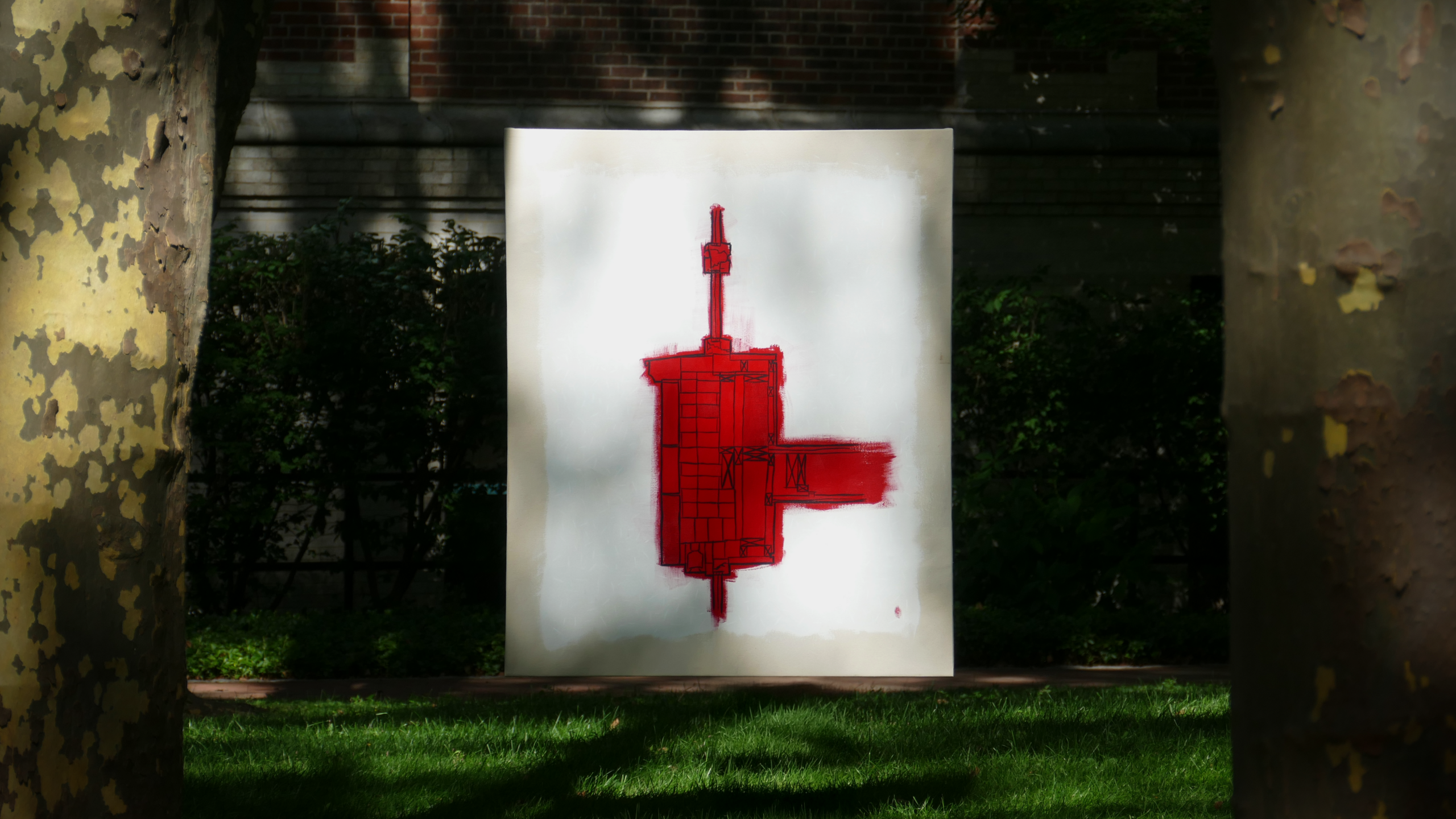
Looking at the work we highlight on the cover, Untitled 001, tell us about some of the ideas behind this project. What led you to develop it, and what were you exploring in the process?
The idea I had in mind prior to creating this piece was to try and merge the complexity and intelligence I saw in the architectural detail sections I studied in third year, with the extremely abstract ways I was led to think about architecture in fourth year. I was initially attracted to the idea of expressing this through a painting, due to my personal inherent lack of precision with the medium, which I hoped would help shed the mechanical nature of a detail section while leaving behind the underlying traits I was attracted to.
You mentioned that often your personal projects operated in parallel to the work you were doing in the architecture program. How did this project intersect with your studio work?
This project was in some ways a conceptual extension of one of my favorite studios, taught by Mark Rakatansky, in which I focused on trying to isolate the core idea within Philip Glass’s “Mad Rush” and manifest it into architecture. I looked at the creation of this painting in a similar fashion. The original technical architectural detail section, my interpretation of it, and the real built wall were all manifestations of the same core idea yet emphasized different aspects of it.
What was one valuable skill or sensibility that you fine-tuned at Pratt—something that set you up for your next professional steps?
During second year, my incredible professor Karen Bausman had a saying: “Keep it simple.” What this meant to me then was to stay focused on one core concept and practice repeatedly purging ideas that don’t strengthen it. What it means to me now is to make sure the concept permeates into every scale of the project, in order to maintain a consistent thread someone can follow throughout its entirety.

What advice would you give a student about developing their creative practice?
The first piece of advice I’d give is one that was passed on to me by another foundational professor I had, Lapshan Fong. He impressed upon me the importance of really investigating why you like or dislike something. This is crucial to being able to productively critique your own work, as well as clearly discuss your ideas with others.
The second would be to study when, how, and why your best ideas come to you. Hone the skill of attracting them, and develop a repeatable practice.
The third would be to always act on those ideas. Whether it’s just writing them down or keeping small projects going on the side, this will help maintain the purity of your main creative practice by stopping unrelated (yet exciting!) ideas from creeping in and fighting for control.