Pratt graduates are using skills learned in the Entrepreneurship Minor to build ventures throughout New York City and beyond, from Kickstarter-funded creative projects to self-directed galleries and large-scale businesses. They are raising venture capital, launching apps, growing e-commerce brands, and developing innovative service-based enterprises.
“We are focused on helping students build creative, entrepreneurial careers,” said Entrepreneurship Minor Coordinator Peter Ragonetti. “We provide a foundation in how to start and operate a business, whether that is a side project, a small personal venture, or a fully developed company. The goal is to give students agency over their careers by breaking down the perceived barriers to entrepreneurship within creative fields.”
Read on for a few stories of graduates who have benefited from the Entrepreneurship courses offered at Pratt.
Hitting the Ground Running

Anna Williams, BFA Communications Design ’19, remembers the real-world experience of faculty and the hands-on aspects of her Pratt education.
“I had an illustration course when I was a sophomore that was taught by Ping Zhu, [former visiting instructor of Communications Design], and she was, like all the other professors at Pratt, working in the field,” Williams said. “She was teaching and she was a freelance editorial illustrator, and hearing about the realities of the job was so important and inspiring.”
“Having professors who were working professionally was so valuable,” she added, naming professors such as award-winning illustrator Rudy Gutierrez. “They could be like, ‘You know, I was on a client call last week, and this is what they were looking for. What would you guys have said?’”
Another source of career inspiration came from the guest speakers series, which included artists like Nicole Rifkin, BFA Communications Design (Illustration) ’14, renowned for her New Yorker covers. For a while, Williams thought that she wanted to be a children’s book illustrator and had dreams of painting for hours in a sunlit room.
“And then I took a children’s book illustration class, and I realized very quickly that that set of skills is so different from what my strengths are,” she said. “I just realized the amount of legwork and the difficulty it involves. What was great about Pratt is I was able to try things out and fail while still being in something I knew I wanted to do. I knew I wanted to be under the umbrella of drawing and illustrating and creating. And being able to try out all of the hyper-specific ways that can happen was excellent.”
“Having professors who were working professionally was so valuable.”
Anna Williams, BFA Communications Design ’19
This professional insight was further developed by entrepreneurship classes, which allowed her to conceptualize and build products, including a box to improve lighting for photographers that could double as a reflector. Practicing how to pitch in the class helped her to think through client perspectives and, by the time she graduated, she was already securing freelance gigs.
Not long after, another Pratt graduate invited her to join a tattoo studio in Queens.
“Ever since that door opened, I just walked right through it, and I worked in that studio for a year, just really trying to get my skills up and using all of that client-facing information that I’d gotten from Pratt,” she said.
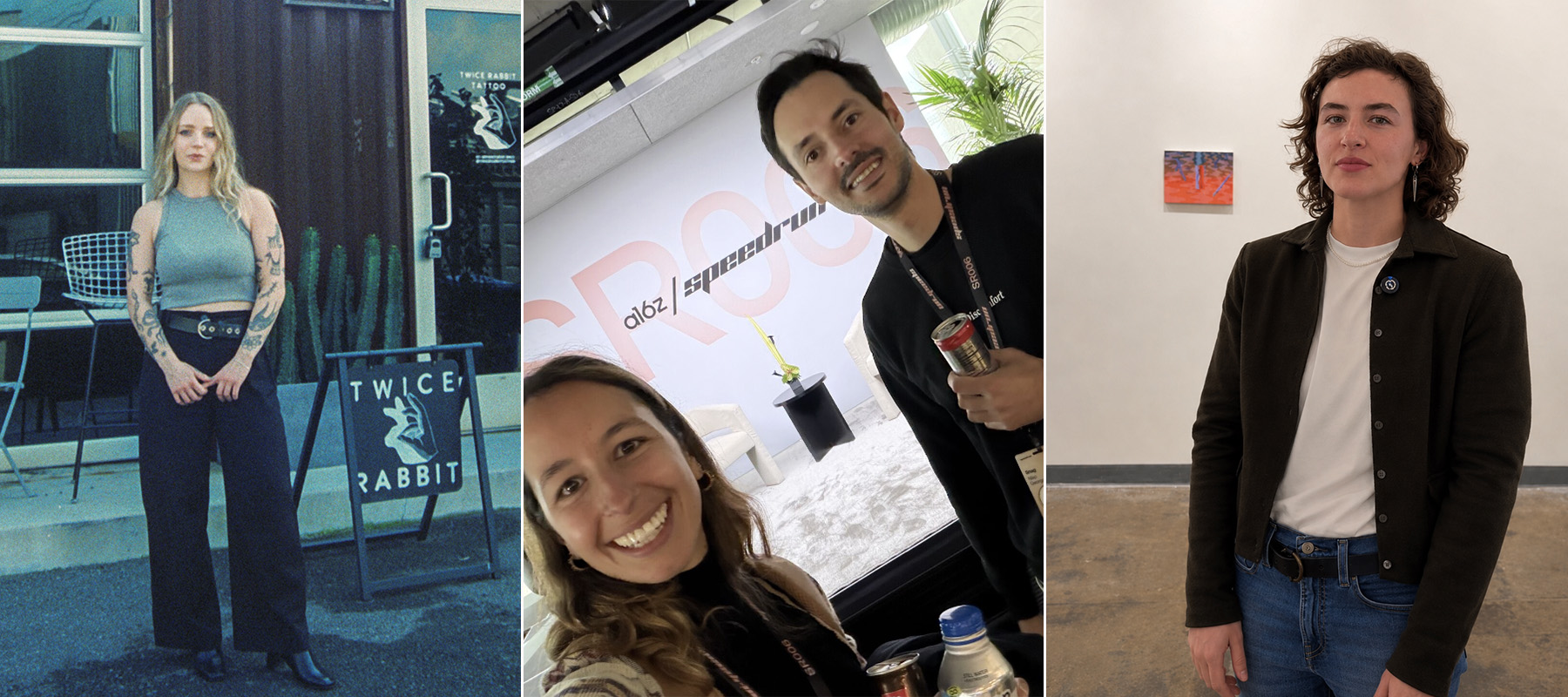
Williams began building a clientele through word of mouth and social media. She took her experience and growing reputation to Los Angeles, where she opened the tattoo shop Twice Rabbit.
“At a time where so much of the narrative we’re fed is about doom and gloom and AI is going to take your job and all of the reasons why not to do something and not to get out of bed, I think it’s so important to focus on the reasons that there are,” she said. “We make things so we can prove that art still needs to be made by people.”

The Entrepreneurial Itch

Selin Sonmez and Nikos Georgantas, both BID ’16, agree that the ongoing feedback sessions in industrial design studios were key to their shared entrepreneurial journey.
While developing a wine holder in an early studio, Sonmez presented a prototype, made from wire, that was both elegant and functional.
“And then everyone gave their feedback,” she recalled. “‘Oh, but it doesn’t feel sturdy enough.’ ‘What happens if the bottle is a different shape?’ ‘How do you rest it?’ All these things that I hadn’t thought of. And then I took all of that and brought another piece to the class and then another piece, and I just remember that project being so iterative. At every phase of the process, you’re measuring and collecting. That was so core to our education, because it’s never zero to one. It’s always zero to 0.2 and then eventually you reach one.”
Georgantas remembers realizing how much effort goes into bringing a product to market and rising to the challenge in an entrepreneurship class.
“I came up with these collapsible hangers made out of plexiglass,” he said. “And it got funded on Kickstarter, so I had to actually make the hanger, and it had so many parts that I had to laser cut tens of thousands of pieces.”
Sonmez’s project in the class, a modular hanger system, also received Kickstarter funding.
“In the class, we talked about how you bring something to market and make revenue out of it,” said Sonmez. “We thought about unit economics, distribution channels. I had to figure out how to manufacture it in China and ship it to consumers.”
“Designers are the building blocks of new societies, and it has to be done with optimism and imagination.”
Nikos Georgantas, BID ’16
After graduating, they both found jobs in different fields but retained an entrepreneurial drive, soon founding their first company, Knock Knock City, a platform that allowed travelers to store their luggage with local businesses. When the pandemic lockdown began, they recognized the impact it was having on people’s social lives and founded the platform OneRoof, a hyperlocal network for neighbors to connect.
Now they’re working on a subletting platform, snag, and recently completed a 12-week start-up accelerator program with the venture capitalist firm a16z Speedrun.
They both see artificial intelligence as removing barriers to entry for entrepreneurs.
“Designers are the building blocks of new societies, and it has to be done with optimism and imagination,” said Georgantas.
“There’s no better time to build anything than today; everything is more affordable and more accessible,” Sonmez said. “Imagination is the one thing that designers are made of, and it’s the one thing that AI really struggles to get to. In the AI I world, use your designer identity as your superpower and use all the technologies that are available to build a world you imagine.”
Finding a Groove

The School of Design’s Entrepreneurship Minor is available to all students at Pratt and attracts many outside of the School of Design.
Devon Gordon, BFA Fine Arts (Drawing) ’22, learned early in her Pratt education that artists often have to start their own businesses to handle freelance work.
“Peter [Ragonetti] really showed me that even if I were to do more of the studio art track, just because I was a fine arts major, I would still be a small business,” she said. “All artists are businesses in their own way. You have to self-promote. You have to still network, all that good stuff. So he really showed me that no matter what career path I do, there’s still that underlying current of being an entrepreneur.”
The crowdfunding class opened her eyes to the practical aspects of starting a business.
“It really made you think about how to take something from start to finish,” she said. “That class gives you really valuable life skills—just the ability to create a pitch deck, the ability to research costs, to put it together, to present it in front of other people, and to really know what goes into launching something.”
In her third year, she founded the magazine Noise Art Magazine (NAM), where she interviewed artists and musicians at Pratt and other local colleges and turned it into a self-directed internship.
“That really took off during Covid because it was still a way for me to be part of that community,” she said. “I did a live stream concert through it as well. And when I got back my senior year, I started putting on curatorial pop-ups in the city and then also put on some concerts as well.”
“Pratt gave me a place to take my ideas seriously, and mentors who helped me think more deliberately about what I wanted to build.”
Devon Gordon, BFA Fine Arts (Drawing) ’22
After graduating, she joined the Marian Goodman Gallery, where she worked alongside established artists, curators, and collectors, who provided an insider’s perspective on the vision, relationships, and long-term thinking required to build a successful gallery.
With her growing set of skills and awareness of the New York City art market, she eventually opened Zepster Gallery, which has since nurtured a vibrant community of emerging artists and has received coverage in leading art publications.
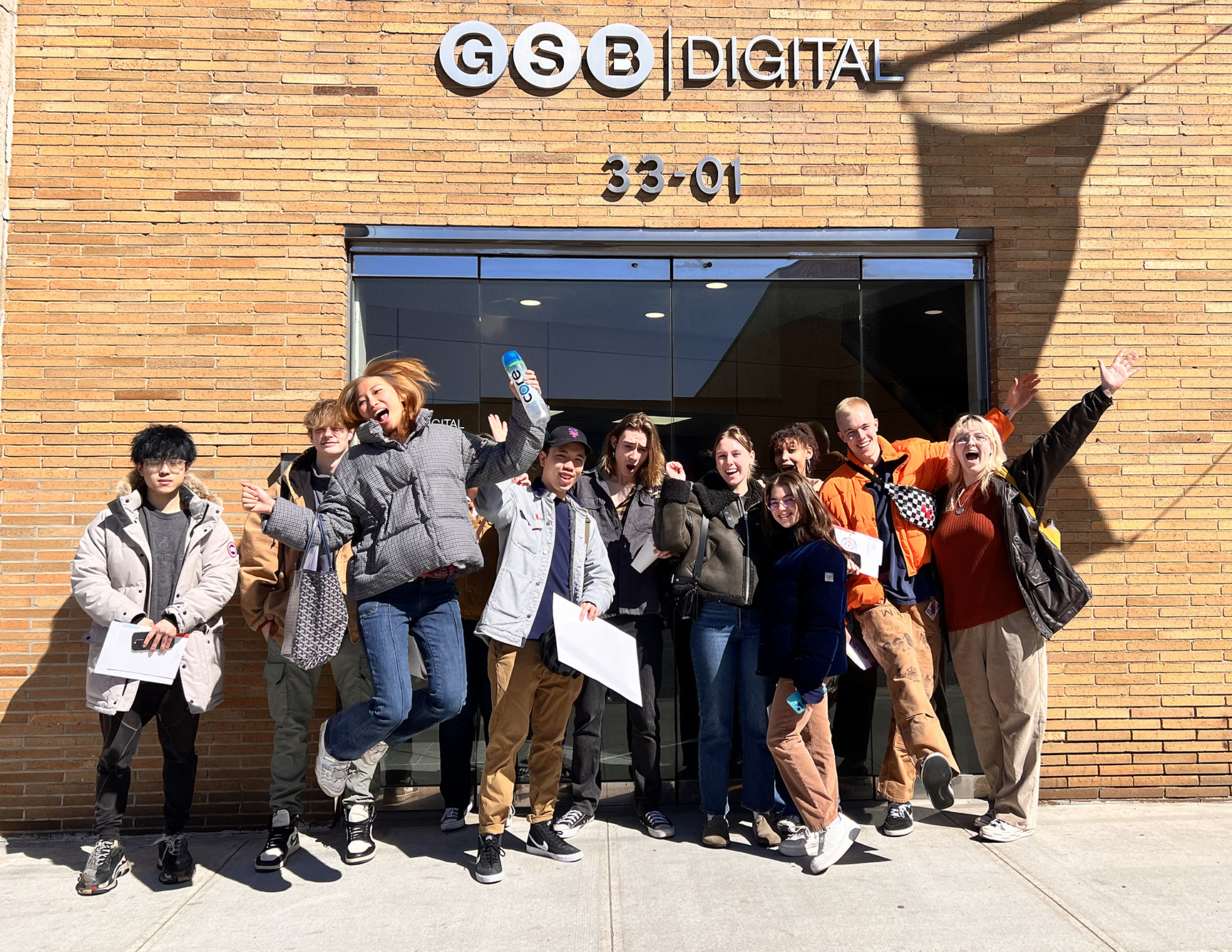
Gordon remains closely connected to Pratt despite her growing responsibilities as a gallery owner. She has welcomed students from Pratt’s Professional Practices and Entrepreneur Mindset courses to Zepster Gallery for private tours, exhibition walkthroughs, and candid conversations about entrepreneurship, helping current students better understand the realities of building a creative business in New York City.
Reflecting on her journey from Pratt student to gallery founder, Gordon credits the Institute with helping her bridge artistic practice and entrepreneurship.
“Pratt gave me a place to take my ideas seriously, and mentors who helped me think more deliberately about what I wanted to build,” Gordon says. “Zepster grew from instincts I already had, finding artists I believe in, building community around them, and creating the kind of platform I wanted to see in the art world. Pratt reinforced the idea that creativity and entrepreneurship don’t have to exist separately, and that understanding has shaped everything I’ve built since.”