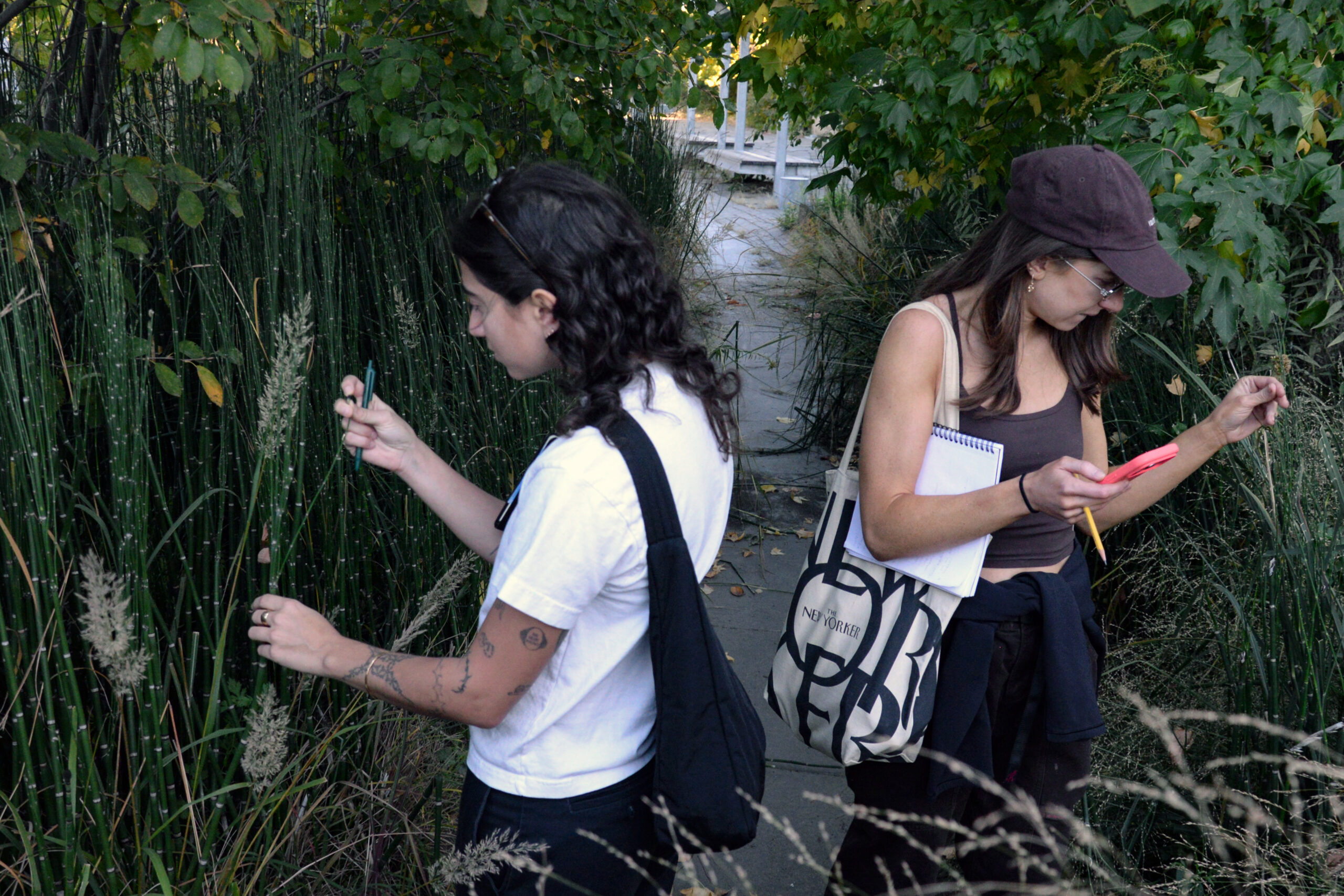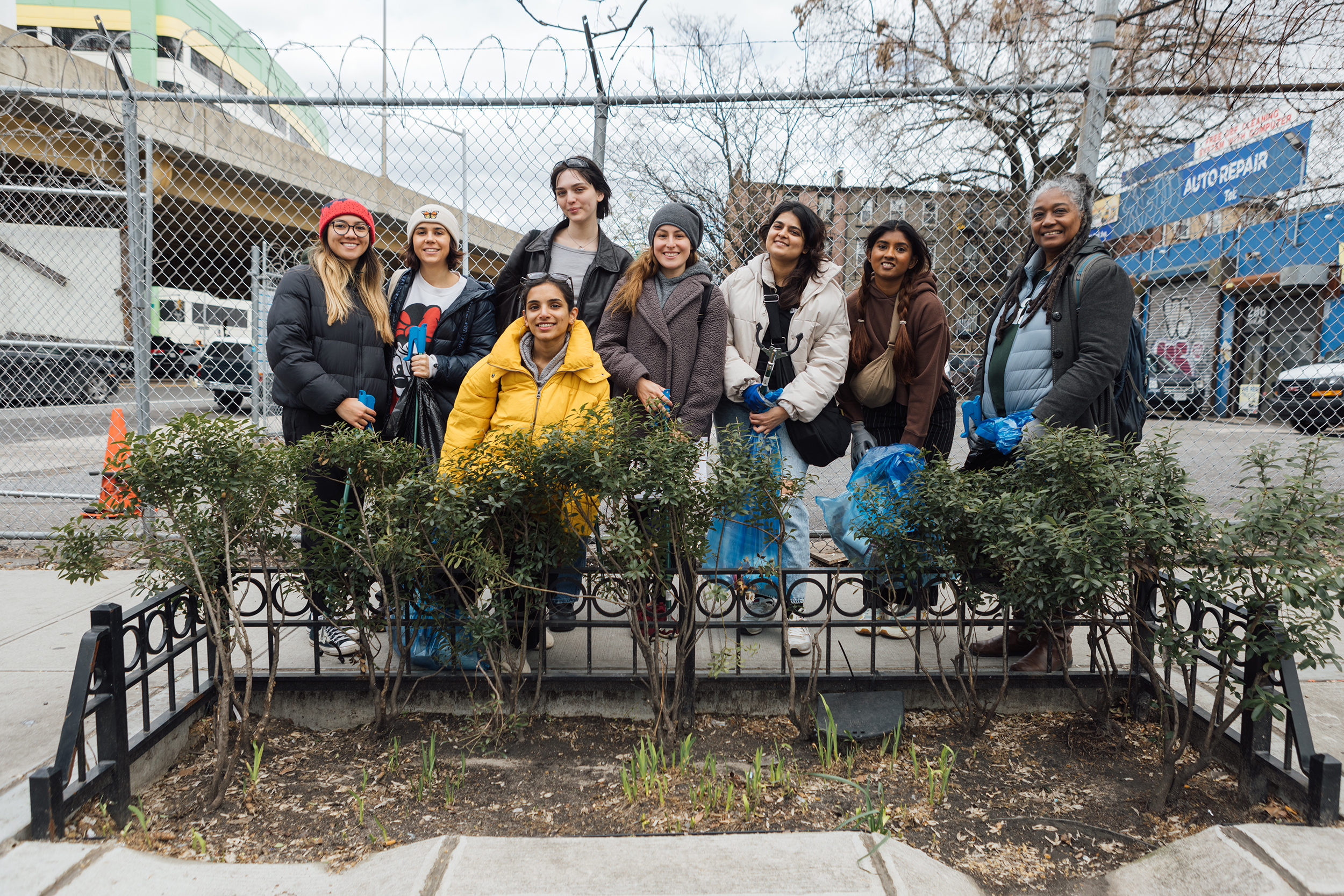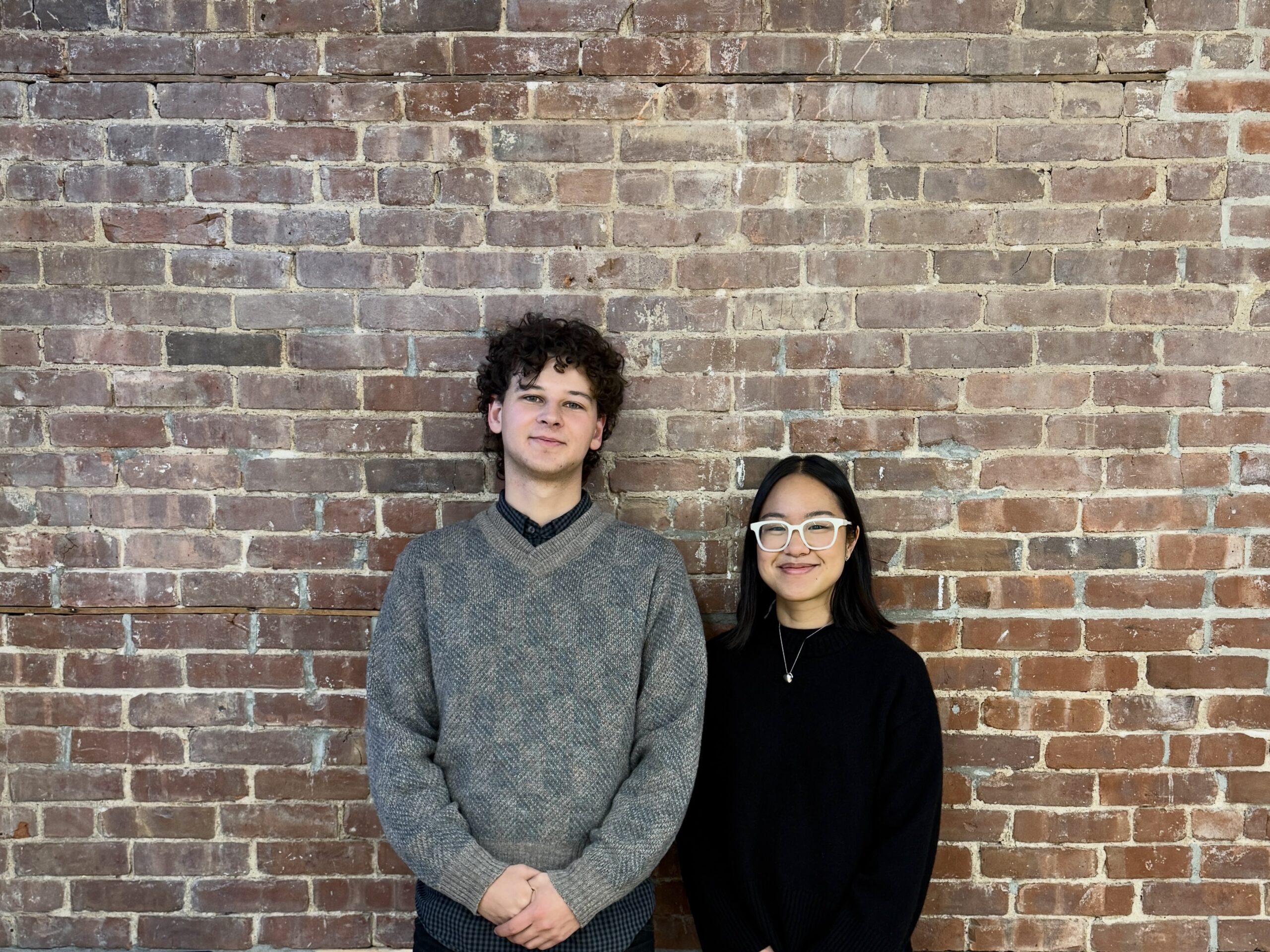
Since the start of the fall semester, Stephanie Moon and Jubal Young, both MS Urban Design ’27, have been immersed in the messy, intricate realities of New York City’s garbage problem.
Working side by side, the two students are researching the city’s waste streams and rethinking municipal sanitation garages. For Moon and Young, this is simply the next step in a yearslong professional journey. They each arrived at Pratt after completing five-year architecture degrees, and both realized that they wanted to pursue the broader field of urban design in their final year of undergraduate study.
Discovering the Urban Scale
Before coming to Brooklyn, Moon studied architecture in Buenos Aires, an education she describes as “very traditional” and shaped by regional design history. For four years, her studio work centered on small- to mid-scale residential and mixed-use projects rooted in the city fabric.
Her perspective shifted during her fifth year, when her class was assigned a master plan for an expansive public park in Buenos Aires.
“It’s a huge piece of land in the middle of the city,” she said. “We started thinking, ‘How do you bring education, how do you bring density, and start impacting the quality of life of the people around that area?’”
The experience revealed what she felt was missing from her training: an engagement with “the social behavior aspect of architecture.”
For Young, who grew up in Arkansas and set his sights on architecture after a fifth-grade classroom presentation, the pivot followed a similar trajectory. While he appreciated the rigor of his five-year undergraduate program in Arkansas, he found himself frustrated by how the profession often isolates buildings from their contexts.
He found his calling during a fifth-year housing studio focused on a 40-unit pocket neighborhood across a five-acre site. His professor pushed the class to look beyond individual building forms. As Young recalls, the professor challenged them not to get caught up in the single object: “You have to think about a bunch of buildings, how they all work together, and how this connects to the context.”
The assignment transformed the way Young viewed the discipline.
“Urban design is about establishing relationships and building upon them,” he says. “The role every building plays in that. You shouldn’t get too focused on the sacred object.”
Professional Practice and the Path to Pratt
Following graduation, both students worked in the field, gaining professional experience that clarified their desire to pursue urban design at the graduate level.
Moon worked at an interior design and residential amenity firm in Buenos Aires before landing a remote role with a Los Angeles-based practice. Working on single-family homes, commercial spaces, and competition entries for an LA memorial installation, she enjoyed the creative work but found that private practice did not align with her broader ambitions.
“My idea of going into practice was more of having a bigger impact and better understanding of the city and the context,” Moon says.

Her initial connection to Pratt dated back to her undergraduate days in Buenos Aires, when a traveling studio of Pratt undergraduate students visited her university.
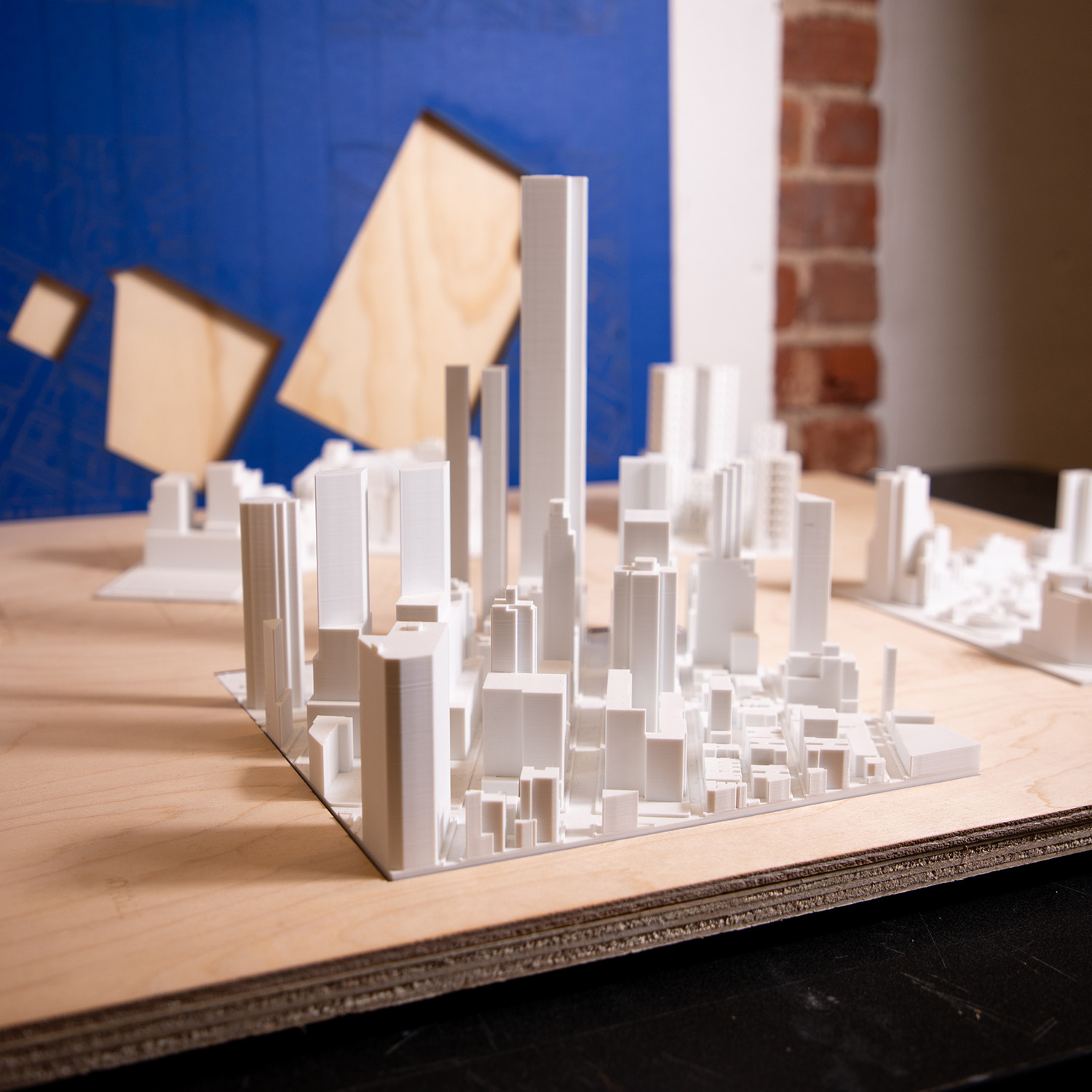
“They showed us their projects, and I could see how different it was from our own work in Buenos Aires,” she recalls, noting how their 3D-printed models, expressive renderings, and conceptual range contrasted with the concrete-focused assignments of her own school. “What was interesting to me from their experience was seeing all the possibilities that you can get from one site in different types of architecture.”
When looking at graduate programs, a conversation with Chair of Graduate Architecture, Landscape Architecture, and Urban Design Andrew Holder and her memory of undergraduate student work made Pratt stand out as “the more interesting one out of all the other schools.”
Young spent two years working directly at the University of Arkansas Community Design Center, a nationally recognized, university-affiliated public design practice. Starting as an intern and becoming a staff urban designer, he worked on sustainable streetscape retrofits and mass-timber housing prototypes developed with Weyerhaeuser, including an adult family home built with cross-laminated timber (CLT) and modular infill housing dubbed “L-Lofts.”
He also worked on the center’s exhibition on the history and urban role of the American porch, creating 132 linear feet of installation panels for the Venice Biennale. After two years, Young felt ready to broaden his horizons.
“Arkansas is pretty small, and you’re ready to maybe stretch your legs a little bit,” he says. “If I was going to be a designer in my own right, I had to get out there and learn something from other people.”
Pratt was already on his radar through his older sister, a fine artist. Looking into the School of Architecture, Young was drawn to its ethos: “On their website, I was like, ‘Oh man, it’s so community-driven. It’s so place-based. It looks like the kind of work I’d like to learn how to do.’”
With acceptance in hand, he packed up a U-Haul, left his car behind, and moved to New York.
Taking a Closer Look at Trash

At Pratt, Moon and Young form a close-knit urban design team within an accelerated two-semester Master of Science curriculum. Embedded in studio alongside Master of Science in Architecture candidates and third-year architecture students, they have spent their first semester taking on one of New York City’s most pervasive municipal challenges: waste management.
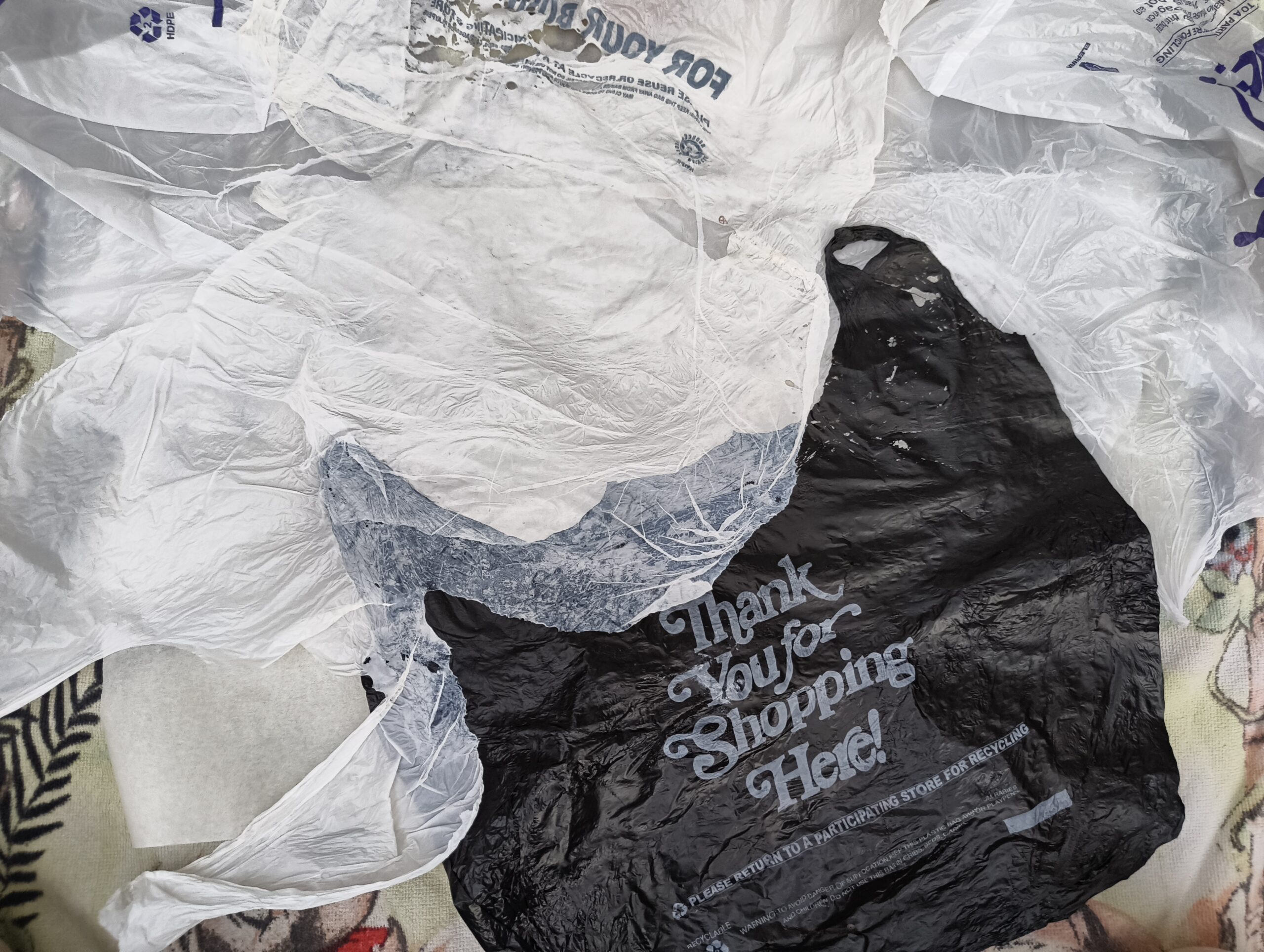
“We’ve been studying and researching New York City’s trash system,” Young says. “It’s a huge problem.”
Moon shares that intensity. “I didn’t think that my first studio in school would be about trash, but I’m really loving it. And it’s weird, but we’re very passionate about trash now,” she says. “I notice the trash bags on the streets, and I see so many things that you could do to prevent that from happening, and how it’s not being done right now.”
Their studio project centers on reimagining a municipal sanitation garage. Typically relegated to industrial and manufacturing areas where they produce noise and odors, these facilities are rarely treated as civic architecture. Moon and Young are developing a proposal that positions the garage as a community catalyst: a district hub organized around reuse, mending, composting, and circular resource management, supported by targeted policy proposals. To inform their work, they have met with leading practitioners in the field, including Clare Mifflin from the Center for Zero Waste Design.

Their studio work is complemented by rigorous seminar courses. In their History and Theory class, Moon has appreciated diving deeply into texts that frame the city through a social and philosophical lens.
“We’re just going through a lot of different thinkers, philosophers, and social thinkers beyond architects,” she says. Rereading theorists like Rem Koolhaas and analyzing his writings on Manhattan has been particularly resonant: “Sitting in class and having someone really explaining it, going through every paragraph, and really going to the history of everything that he’s talking about—I think that’s amazing.”
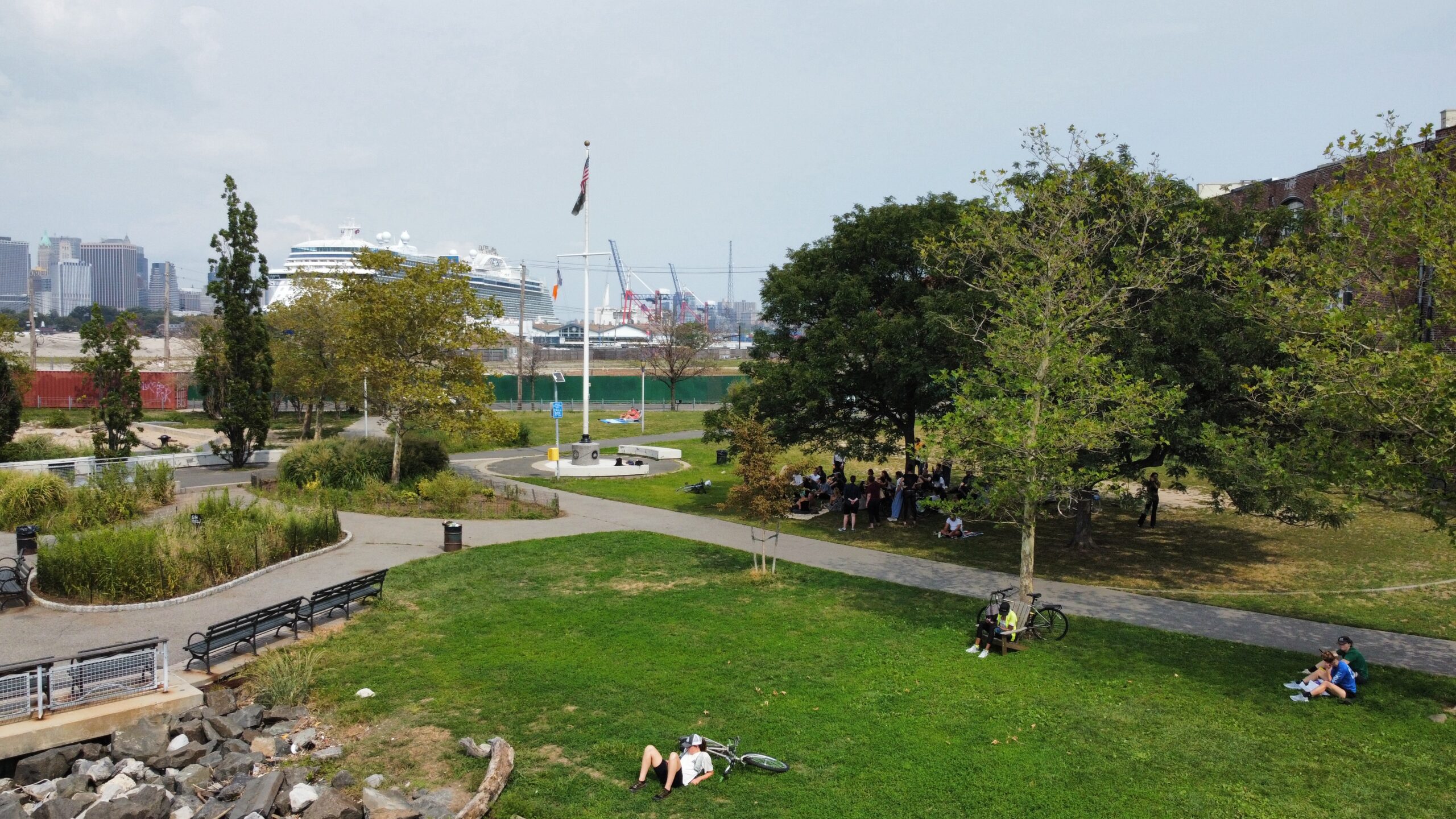
Young has connected his seminar research directly to their studio focus, developing an in-depth research paper on Fresh Kills on Staten Island, the historic landfill recently transformed into a vast public park. “I like that the research overlaps,” Young notes.
Outside class, both students take full advantage of Pratt’s public programming, attending lectures at Higgins Hall and participating in the “Made in New York” series organized by MS Program Academic Director Jaffer Kolb, which brings prominent local practitioners and advocates—including the architect Liz Diller and Gotham Park Founder Rosa Chang—into intimate conversations with students.
Moon noted that it has been rewarding to meet speakers like Farshid Moussavi outside of their lectures through networking events.
Life in Brooklyn and Looking Forward
For both students, living in Brooklyn has enriched their studies.
Moon lives a fifteen-minute walk from campus. “Clinton Hill particularly is not only a student neighborhood,” she says. “You have the brownstones and the families and the little children outside. So it feels like an actual city and not just a school campus.”
When she isn’t in the studio, Moon is exploring Brooklyn’s coffee shops. “I’ve been searching for the best flat white in Brooklyn. That’s been my mission so far,” she says.
Living in New York has also broadened Moon’s outlook on environmental design, introducing her to lectures and conversations on water resilience and coastal adaptation. “Because we’re in New York City, you hear about it a lot more,” she notes. “I’m just being exposed to new ways of practicing urban design that go beyond public space or parks.”
Young lives in nearby Bed-Stuy, about a thirty-minute walk from Higgins Hall. While giving up his car took some adjustment, he has embraced neighborhood life, going to local music venues, playing pool, and picnicking with his girlfriend.
Observing Brooklyn’s streetscapes has reinforced Young’s interest in landscape-driven urban retrofits. “The way you can make rules with trees and planting, you’re helping not only the immediate area, and that scope of thinking gets along well with urban design.”
Looking ahead, he sees this as a vital path for American cities: “A lot of urban design is going to be street retrofits. When everything’s getting hotter, trees are super important.”
With graduation approaching, both students are eager to channel their research into ambitious, self-directed final work.
“I want something that I can be really proud of,” Young said. “To actually put my pen to the trace and really design something that is led by me.”
By looking past isolated buildings to take on the living systems of the street, Moon and Young represent the core ambition of Pratt’s Urban Design program to train designers who are ready to engage the city as it truly is and shape what it can become.