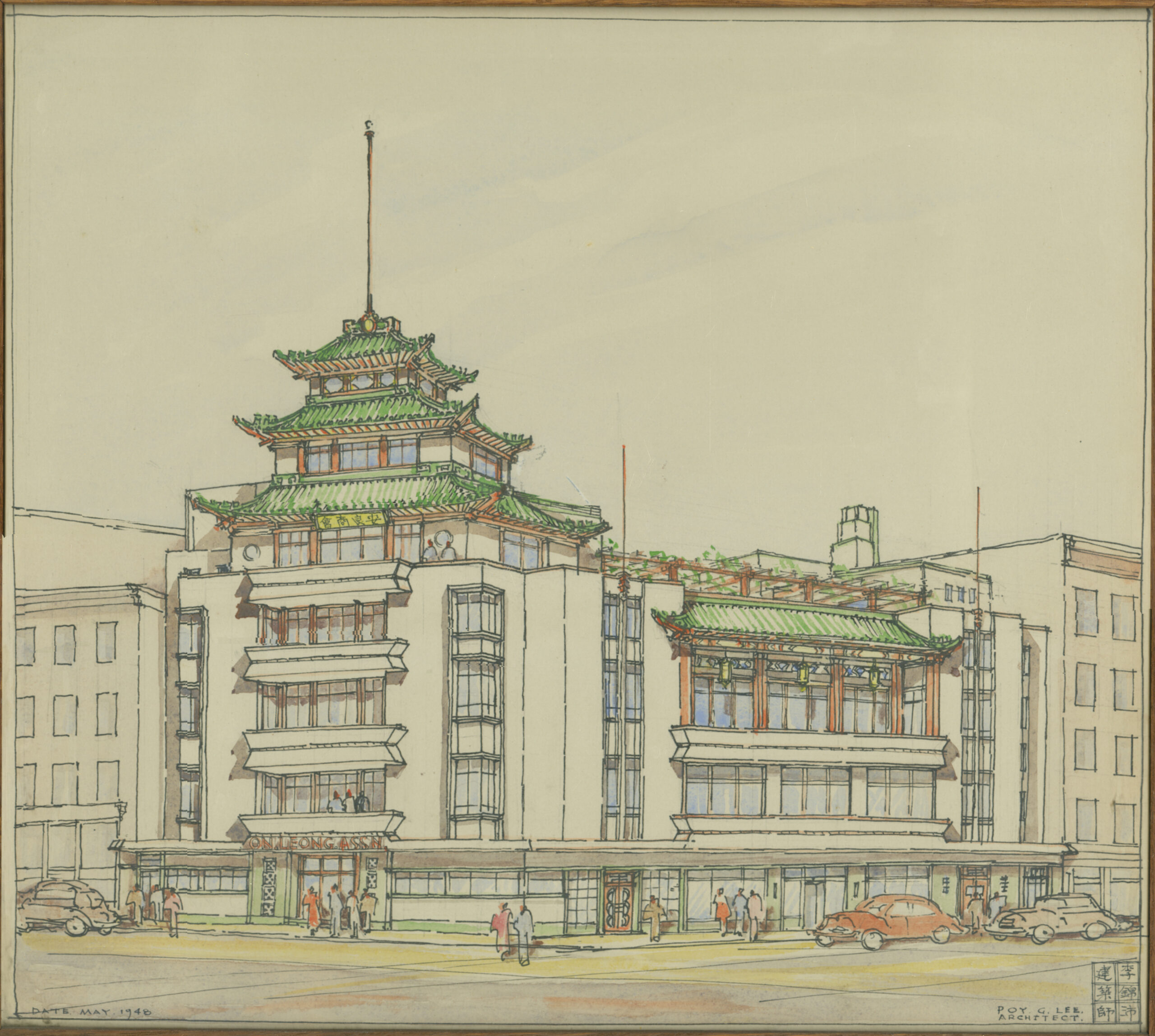
Pagoda roofs paired with modernist lines. A lightly ornamented memorial arch. Stone façades juxtaposed with decorative metal screens. Poy Gum Lee, Architectural Construction and Architectural Design 1920, undeniably left his mark on the neighborhood he was raised in. Born on Mott Street in Manhattan’s Chinatown in 1900, Lee went on to attend Pratt Institute and became a registered architect, working with firms in New York and Chicago before he was hired as the in-house architect for the YMCA in Shanghai. While living in China, Lee established his own practice there and solidified the “Chinese Deco” style he became renowned for, which combined traditional Chinese architectural features with elements of the Western Art Deco style. However, the chaos of World War II, the Japanese occupation of China, and the ongoing Chinese Civil War led Lee and his family to return to New York in 1945.
Lee worked extensively in Chinatown, and his designs can be found throughout the neighborhood. Recognizable structures include the Chinese Consolidated Benevolent Association (CCBA) headquarters, the Kimlau Memorial Arch, the (now-demolished) Pagoda Theater, and the On Leong Tong, or Chinese Merchant’s Association, building at 83 Mott Street. The On Leong Tong building—considered to be the most prominent “Chinese modern” structure in the neighborhood—combined a pagoda rooftop with mid-century modern American design. The building is also notable in that it provides an example of how Lee was not always fully credited for his work.
His detailed sketches feature a limestone façade, tiered pagoda roofs, and modern balcony railings.
Spurred by a request from the Bank of China for more “splendid landmarks” in the neighborhood, various Chinatown associations undertook remodelling efforts on their existing buildings. To this end, Lee was asked to draw up plans in 1948 for the On Leong Tong, situated at the northern gateway to Chinatown. His detailed sketches feature a limestone façade, tiered pagoda roofs, and modern balcony railings. While Lee was instrumental in the building’s concept and overall design, the final built version was attributed to architect Andrew J. Thomas, who had no previous associations with Chinese architecture or Chinatown. Explanations as to why Lee lost the final design commission of the building range from political struggles between CCBA and On Leong leadership to issues with cost. Upon taking on the project, Thomas’s firm reduced Lee’s detail and reconfigured proportions, completing the building in 1950.
Still, Lee claimed the On Leong Tong on his résumé and circulation of his sketches of the iconic structure’s design solidified his role as the visionary behind its conception. He went on to have a long career, working with business leaders in Chinatown as well as the New York City Housing Authority (NYCHA). While his “Chinese Deco” style shifted to reflect the increasingly minimal, modern designs favored by Chinese business interests in America by the 1950s and ’60s, Lee’s unique mark on Manhattan’s Chinatown was nevertheless recognizable and ubiquitous.
Further cementing his legacy, the Museum of Chinese in America (MOCA) launched a retrospective of Lee’s 50-year career in 2015 that displayed drawings and documents unearthed from his family’s archive. Upon returning to Chinatown, Lee remarked in his résumé that he worked in the community to be “of service to my Chinese people.” Amid further changes to Chinatown’s demographics and built environment in the 21st century, his works, including the On Leong Tong, serve as cultural touchstones and a testament to the vision of the architect who grew up on Mott Street.