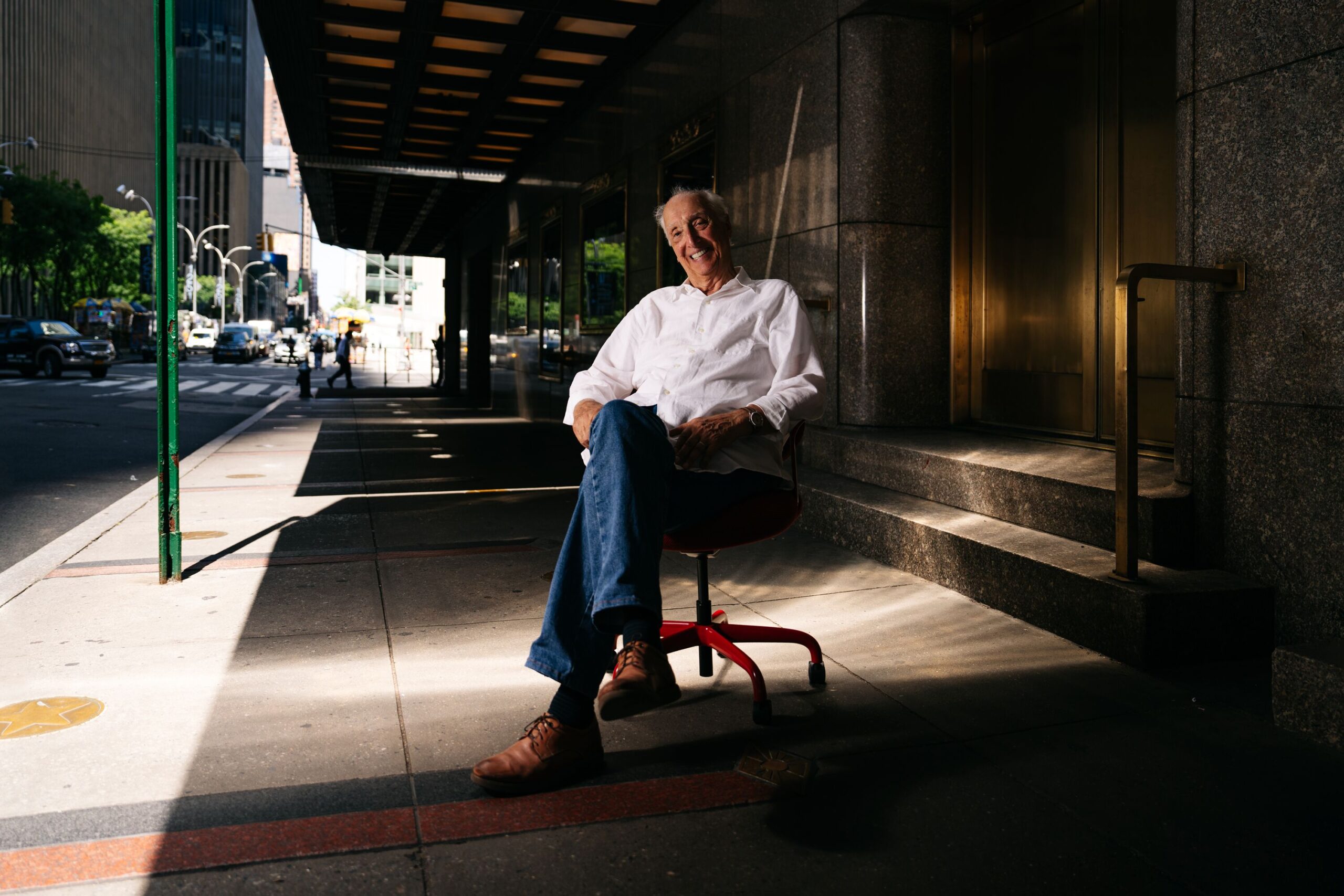
It was the late 1960s, a few years out from graduation from Pratt, and design partners Bruce Hannah and Andrew Morrison had a vision. From their studio at 27 Howard Street in SoHo, the two called Knoll to invite them to see the work of the “greatest designers in the world.”
“We really said this stuff—we were still in our 20s, our brains weren’t fully formed!” Hannah laughed in a conversation earlier this year, recalling how he and Morrison, who died in 2021, began their longstanding relationship with the renowned design company. He spoke to Prattfolio as one of his and Morrison’s groundbreaking designs, originally the “2308” office chair, was being reissued by Knoll some 50 years after its debut.
Back then, it wasn’t just youthful confidence they had on their side. The pair were determined, and in this case their objective was specific, according to Hannah: “Our goal, maybe even our philosophy, was to design a chair for Knoll and retire on the royalties. Lucky for us, Knoll took us seriously, and as they say, the rest is history.”

The two had connected with Knoll designer Jens Risom through then–industrial design department chair Joe Perry, and they worked with Risom on some of his late collections. He regularly visited them downtown, and seeing a promising project that went beyond his scope—he worked in wood, and the two were at work injection molding alumninum—Risom finally encouraged them to go directly to Knoll.
Hannah and Morrison’s invitation was compelling enough that eventually company president Cornell Dechert came down to visit their studio, which the designers had filled with working prototypes. “Everything I do as a designer, I always make it . . . You eliminate 99 percent of the questions,” Hannah said.
“New York City was a disaster in so many ways. . . . The disaster allowed us to do whatever we wanted.”
Bruce Hannah
Hannah and Morrison were making things all day, every day, in a partnership that would go on for 10 years—and New York City was the perfect proving ground. Surrounded by industrial neighbors, people barely gave a second glance to the two designers carrying 20-foot lengths of extrusion profiles down Broadway. “It was the ’60s and ’70s. New York City was a disaster in so many ways. But it was wonderful in other ways,” Hannah said. “The disaster allowed us to do whatever we wanted.”
Their first design with Knoll was an award-winning aluminum-frame collection, a precursor to their task chair. When they designed the chair, ergonomics was having a boom moment, amplified by advancements in computing and changes in the nature of office work. Nevertheless, Hannah said, ergonomic design often considered the user’s status in the office hierarchy more than how their body would interact with the environment. Hannah and Morrison wanted to do ergonomics in “a stealthy way,” Hannah said. “We’re creating an ergonomic shape, but it’s not screaming at you, I’m an ergonomic chair!”
“Its subtlety of form caused an uproar,” as Surface puts it. “With its sleek aluminum frame and plush but unobtrusive cushioning, it offered ‘ergonomics without ego,’ almost 50 years before its time.”

The dimpled buttons, for example, are positioned to eliminate pressure on the sit bones and offer lumbar support. They also give it a personality. Hannah says this was part of his and Morrison’s philosophy. “One of our intentions was, if someone walks into a room and our objects are there, will they make them smile? Will they make their day happier? We tried to animate objects, so people would say, Oh, is that smiling at me?”
They were also conscious of sustainability. “We were interested in what things weighed, what they were made out of, how you could recycle them, how you could disassemble them,” Hannah said. “All the things we designed, we designed to come apart and be sorted.” The design considerations for the reissue included a new form of fully recyclable foam.
Among the other updates are an improved tilt mechanism and gas cylinder and aesthetic details like now-customizable button color. But ultimately, “There is no revelation. If you put one of these chairs next to the ones that are 50 years old, you’d see very little difference,” Hannah said. “What I find interesting is that it still has meaning somehow in society. Our feelings and what we wanted to bring to that chair were important to us and possibly to society.”

Hannah went on to design desk accessories for Knoll, like one of the original adjustable keyboard supports and the Hannah Desk System. Morrison’s office system broke new ground for open-plan offices and became a Knoll best-seller. (Hannah also gave a nod to Knoll designs by fellow Pratt alumni Charles Pollock and Ayse Birsel, with whom he has collaborated.) The ideas that began in a SoHo studio proliferated through the city and beyond.
“We often talked about designing something that might become an antique, which I think means it’s at least 100 years old,” said Hannah. “Well, the Morrison Hannah chair for Knoll is more than halfway there.”