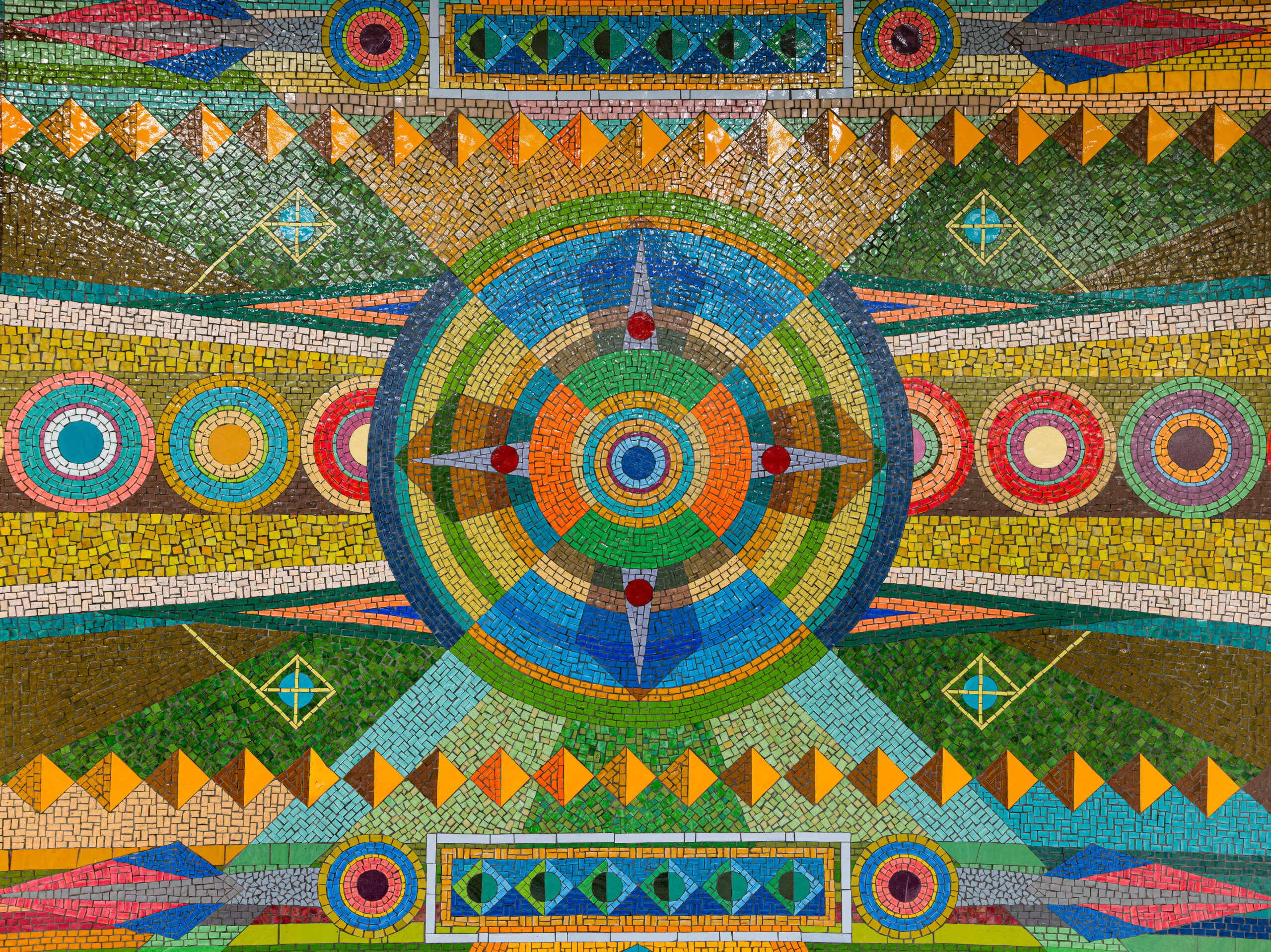
At the 42nd Street station entrance to the 7 train at Grand Central, kaleidoscopic patterns radiate over the curved walls. The palette shifts from cool blues and purples to warm greens and earth tones across the dense geometric forms, where concentric circles, sunbursts of lines, and moonlike slivers overlap and intersect. “Abstract Futures,” a 600-square-foot glass mosaic mural commissioned by MTA Arts & Design, was unveiled in May 2025 as the first permanent installation by the feminist art collective Hilma’s Ghost, cofounded by Dannielle Tegeder and Sharmistha Ray, MFA Fine Arts, Painting; MS Theory, Criticism, and History of Art, Design, and Architecture ’05. The duo was inspired by the divinatory practices of Tarot cards as they relate to the constant arrivals and departures happening in the station and around New York City.
“The major arcana of the Tarot are really archetypal themes of the cycle of life,” Ray said. “We thought that was such a fantastic metaphor for New York and its kind of cyclical loop. The archetypes we drew upon were the Fool, the Wheel of Fortune, and the celestial elements—the moon, the stars, the sun—to tell that almost epic tale of human searching and the journey.”

Hilma’s Ghost previously created the Abstract Futures Tarot deck. It was informed by Western and non-Western symbolic usages of shape and color, as well as the legacy of women artists illustrating Tarot, particularly the Pratt-trained Pamela Colman Smith, who worked on the popular Rider–Waite–Smith deck. Tegeder and Ray began collaborating in 2020 amidst the shutdowns of the COVID-19 pandemic, taking their name and inspiration from Hilma af Klint. The Swedish artist participated in séances and used abstraction to express sacred concepts. Despite af Klint being a modernist pioneer, those esoteric aspects of her practice pushed her to art historical margins along with other women artists whose beliefs did not align with mainstream spirituality.
“The feminist sacred spiritual abstraction that we are working with also comes under the umbrella of the occult,” Ray said. “When you look at artists like Hilma af Klint, Ithell Colquhoun, and Agnes Pelton, they were also spiritualists, and they had practices of their own which are still to this day considered taboo. I think what Hilma af Klint did was really open up this portal for us to think about it in much more open ways and as raw material for art making.”

Ray (who uses they/them pronouns) was born in Kolkata to Bengali parents and arrived in New York in 2001 as a Pratt graduate student. Their art was mostly figurative until the upheaval in the city following the September 11 terrorist attacks. Ray called it a “cataclysmic moment,” including how they saw identity politics being used and Arab and South Asian people being targeted. They were already interested in the local legacy of the New York School of the 1950s and ’60s and its abstract expressionists who had broken with realist traditions, and saw an opportunity to bring a different approach to abstraction that could engage with themes of queer identity and immigration.
“I use color, shape, pattern, and geometries in really maximalist ways that relate to South Asian textiles and mosque architecture,” Ray said. “I grew up between Kuwait and India, and so those are many of my foundational influences. It certainly started the process for me thinking about sacred abstraction and non-Western abstraction.”
“I think of abstraction as being inclusive . . . I also think of abstraction as having certain fugitive qualities.”
Sharmistha Ray
Ray is now based in Pittsburgh and is an associate professor of art at Carnegie Mellon University. Their recent work has ranged across media, from a glass art installation that debuted at the Pittsburgh International Airport in 2025 with geometric forms evoking cosmic energy, to murals referencing mandalas painted in 2026 on the grounds of pickleball courts at the city’s downtown Arts Landing.

“I think of abstraction as being inclusive,” Ray said. “I also think of abstraction as having certain fugitive qualities, in how symbolism can encode secret messages within the work that can be read, but most of the time fly under the radar.”
As the Grand Central mural is now embedded in the daily life of one of the busiest parts of New York City, Ray hopes that its visual symbolism is not just something people will pass by, but will be a point of connection and pause. “We tell people to whisper their female ancestors or artists that they’ve loved who have passed or any role models that they’ve had into the wall to keep activating and charging it.”