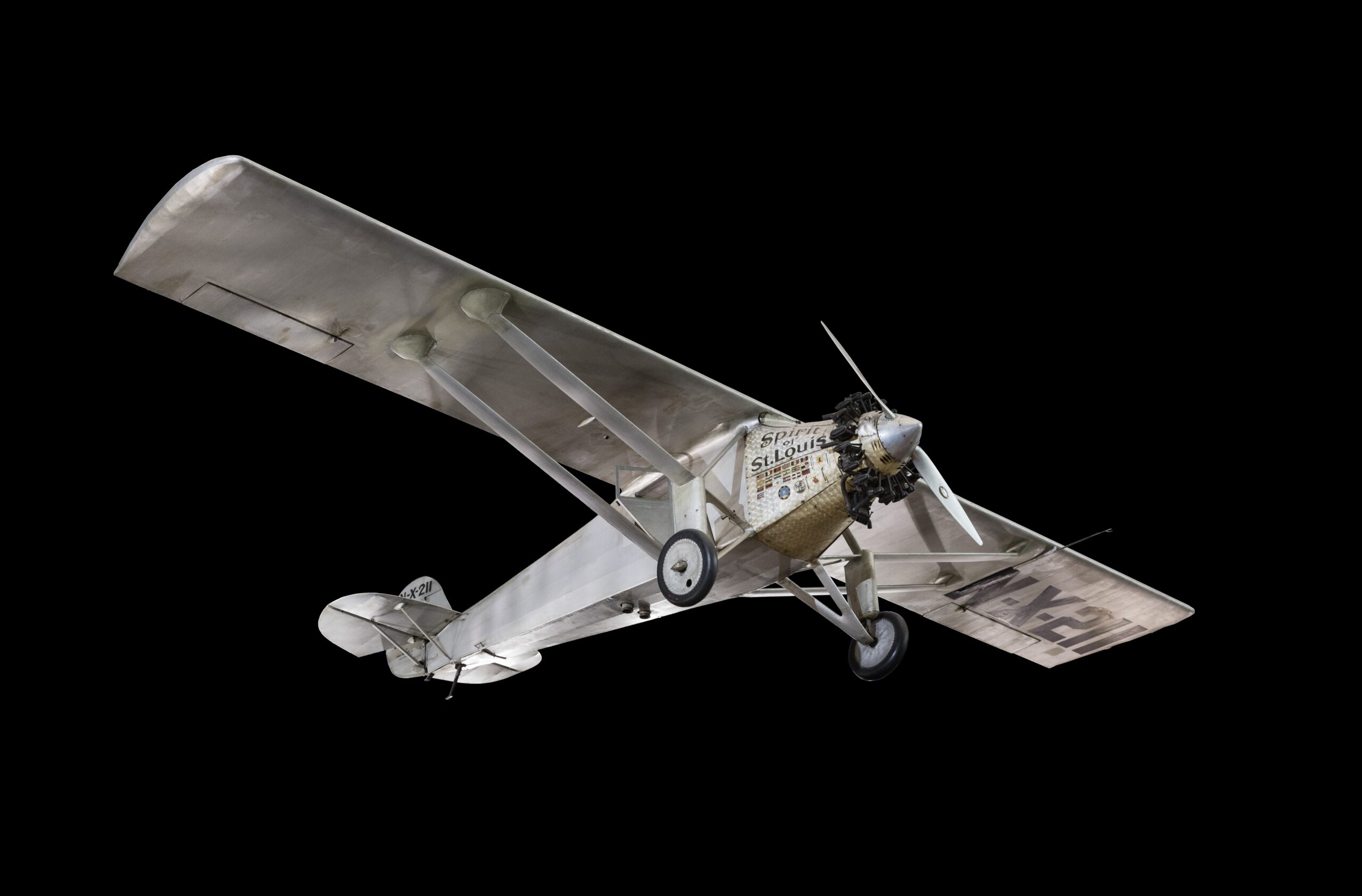
When Charles Lindbergh landed in Paris in 1927, having flown across the Atlantic alone, the world celebrated the daring young pilot whose achievement made the world suddenly feel more connected. But what many didn’t know was that the machine that had crossed the ocean was the work of another young man, a Pratt Institute alumnus. Donald A. Hall, Certificate in Industrial Mechanical Engineering 1919 (1898–1968), was 27 years old when he engineered Lindbergh’s plane, the Ryan NYP, popularly known as the Spirit of St. Louis.
Hall grew up in a working-class family in Brooklyn, fascinated by the science and industrial innovations remaking the city around him. High-rise buildings shaped the New York skyline, electricity replaced gaslight, the Williamsburg Bridge connected Brooklyn and the Lower East Side, and the first subway linked City Hall and Harlem.
In September 1917, as World War I raged in Europe, Hall enrolled in Pratt Institute’s School of Science and Technology, a precursor to the School of Engineering, with plans to pursue a career in automotive design.

The war’s impact on campus was profound. When Hall returned for his final year, he found that many members of his class had enlisted rather than complete the two-year program. A memorial in Pratt’s Rose Garden, dedicated in 1926, honors the students, faculty, and staff who died in the war. Hall’s classmates noted in the 1919 edition of Prattonia that those students who remained on campus “went valiantly onward” with their education despite the uncertainty in the world around them. Hall and his fellow engineering students received an education that was both theoretical and practical. They studied steam and gas engines, designed power plants, learned how to operate lathes and milling machines, and mastered advanced mathematics.
Hall graduated from Pratt in 1919, the same year in which Raymond Orteig first offered a $25,000 prize to any pilot who could cross the Atlantic nonstop from New York to Paris or vice versa. If Hall had been aware of the prize, it didn’t influence him as he worked his way up in the burgeoning aircraft industry, eventually relocating from New York to Southern California.

After several years working as an aircraft engineer, Hall decided to train to become a pilot. He enrolled at a program at Brooks Field in Texas, where he was given a topography manual. It bore the signature of a student from the previous class. “Hall crossed out the name ‘C.A. Lindbergh’ and signed his own. Little did he know that his path and that of Cadet Charles Lindbergh would soon cross again,” wrote Hall’s grandson, Nova Hall, in the biography Spirit and Creator.
Hall did not pass the rigorous exam required to earn his wings. For all his brilliance, Hall “didn’t have the quick, intuitive reactions necessary to become a fighter pilot,” according to Nova Hall. He returned to engineering, and when Lindbergh approached Ryan Airlines about building a plane capable of crossing the Atlantic, Hall became the chief engineer. With several famous, well-resourced pilots also vying for the Orteig Prize, Lindbergh wanted the plane completed in a mere 60 days.
Hall and Lindbergh wasted no time. Hall squeezed another desk into his small office to double his workspace. He was living at the YMCA, and Lindbergh took a room there so they could collaborate at all hours. According to Nova Hall, his grandfather “worked tirelessly, week after week, at one point staying on task for 36 hours straight without sleep.”

The stakes were high. As Bob van der Linden, Curator of Air Transportation and Special Purpose Aircraft at the Smithsonian’s National Air and Space Museum, explained in an interview, “Lindbergh wanted an airplane that would be, more than anything else on the planet, reliable. Because his life depended on it.”
This meant that the Spirit of St. Louis was “a pretty conventional design, and that was on purpose,” according to van der Linden. Rather than innovate recklessly, Hall and Lindbergh combined elements of existing Ryan aircraft and modified them for the transatlantic challenge: their plane featured elongated wings to create the extra lift needed to carry the weight of 451 gallons of gasoline.
Hall and Lindbergh were practical and shared an understanding of what the mission required. As van der Linden explained, “They worked very well together, in part because they were about the same age, but they also understood one another. Hall understood the task that they were facing and didn’t come in with any preconceived notions.” Lindbergh, meanwhile, had carefully studied the failures of his competitors—some of whom had died or disappeared in the effort to claim the Orteig Prize—and knew exactly what he wanted to avoid.

The rushed 60-day timeline meant that they had to take some shortcuts, and this led to at least one disagreement. Hall determined that the fin and rudder design of the Ryan M-2—which served as the basis for the Spirit—was too small for the modified aircraft, with its significantly longer wings and heavier fuel load. Hall calculated that the Spirit needed a larger tail for proper stability and control. But Lindbergh made the case that he wanted a plane that was less stable so that he would remain constantly engaged in controlling it, preventing him from falling asleep and plummeting into the ocean. Hall relented, a choice that ultimately was revealed as a critical judgment call: the night before he launched from Long Island, New York, Lindbergh was so nervous that he couldn’t fall asleep; he then had to stay awake for 33 more hours to complete his mission.

Despite the pressures, Hall remained orderly and rational. He produced the designs for each component in an order that allowed them to be built and assembled while he designed the next. He also accepted suggestions from his colleagues. Since one of the Spirit’s five fuel tanks blocked Lindbergh’s view, a worker named Albert Clyde Randolph proposed adding a periscope for forward visibility. Hall verified that the periscope wouldn’t make the Spirit less aerodynamic, then approved the addition. In fact, during test flights, the plane’s speed peaked at 128 miles per hour, 3.5 miles per hour faster than Hall had calculated.
Lindbergh landed in Paris on May 21, 1927. More than a personal achievement, Lindbergh’s flight shifted how the world saw itself. With proof that an airplane could traverse a vast ocean, interest in commercial flight exploded; the globe felt smaller.
Amidst international fanfare, Lindbergh returned to New York City, where he received the Orteig Prize at a gala dinner. During his acceptance speech, he asked Hall to stand so the attendees could recognize the engineer who made the Spirit’s flight possible.

After a national tour, the Spirit was donated to the Smithsonian Institution. Today, it remains on view at the National Air and Space Museum in Washington, DC, where visitors witness the enduring legacy of Hall’s engineering brilliance.
Lindbergh spent the following decades mired in notoriety, earning the condemnation of President Roosevelt for pro-isolationist political positions that ran counter to his world-expanding accomplishment. Meanwhile, Hall led a quiet life outside the limelight. Hall continued his aviation career in San Diego, California, where he founded the Hall Aeronautical Development Company. When the Great Depression brought financial hardship, he was forced to close the business and joined Consolidated in 1936. In 1949, Hall went to work for the US Navy at Naval Air Station North Island, where he started as an engineer before rising to head of the helicopter branch and, later, head of the structures branch. In 1958, he was part of a three-person team that debunked a long-standing myth about the bullwhip’s crack. The sound, they proved, came not from leather slapping leather but from the whip’s tip breaking the sound barrier. He retired in 1963 and died in 1968.

Hall was hardly the only Pratt graduate captivated by flight. The pull was strong enough that, through the 1950s, aerospace firms including Boeing, Northrop, and Hamilton Standard ran recruiting ads in the Prattler, promising students who were about to graduate the opportunity to work on “top-secret programs that probe beyond the frontiers of the known,” as Boeing boasted in one such ad.
The fascination with flight not only inspired engineers but also artists. No one captured that better than Michael Maniatis, MFA Fine Arts ’80, who built a human-powered airplane from Styrofoam, balsa, plywood, and aluminum for his thesis. “I’m bridging the gap between sculpture and technology,” he said at the time. “It’s a battle of aesthetics and function.”

Pratt’s engineers, meanwhile, kept reshaping the field that Hall helped establish. Thomas J. R. Hughes, BEME ’65; MEME ’67, for one, worked at Grumman and General Dynamics before developing the computational mechanics algorithms now embedded in the software used to design safer, more efficient planes. V. W. Lee, BME ’63; MEME ’67, was on the forefront of adopting cutting-edge analytical tools in his work as a stress analyst at Fairchild Republic and Grumman. Lee was responsible for ensuring the structural flight safety of the A-10 Thunderbolt, a ground support aircraft known as “The Warthog.”
On the cusp of the 100th anniversary of the Spirit of St. Louis’s flight, both Pratt Institute and the aerospace industry look much different than they did in Hall’s time. Pratt’s engineering school closed in 1993, and increasingly sophisticated designs and stringent safety standards mean that certifying a new aircraft type can take up to nine years alone, according to the FAA. Nonetheless, with his workhorse ethos and spirit of creative pragmatism, Hall is recognizably a model for the generations of Pratt students who followed in his footsteps and continue to soar to great heights.