Leda Tsoutreli, MFA Fine Arts ’25, turned her thesis show into a launchpad for representation with Palo Gallery and her first US solo exhibition. Despite arriving at Pratt without formal painting training, she relied on rigorous critique and studio time to prepare for this career-making opportunity. In the following Q&A, Tsoutreli discusses her transition from aspiring painter to professional artist.
Could you tell us about the body of work you presented at your recent solo exhibition and what your studio practice is like day-to-day?
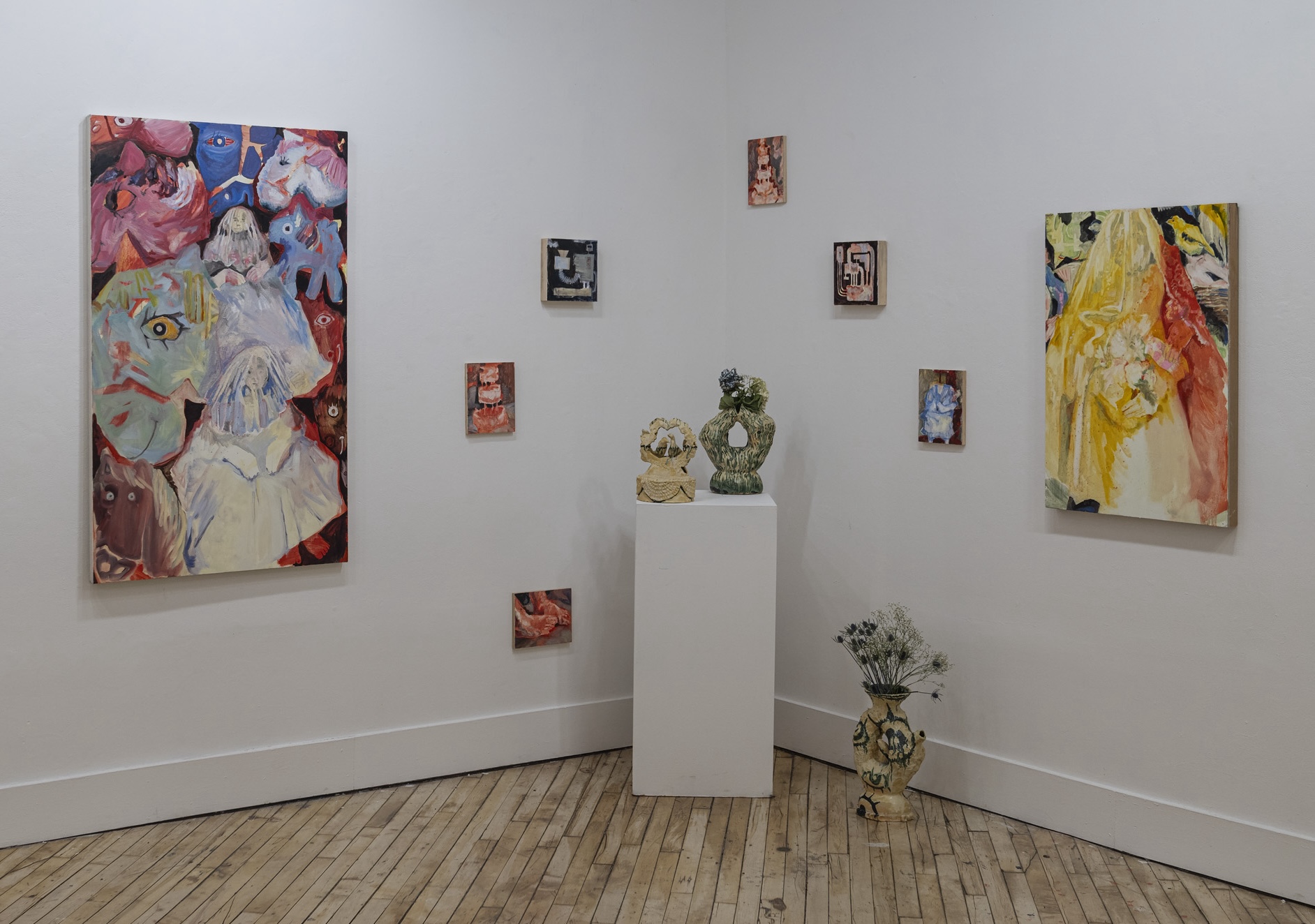
We named the show The Interstice, meaning a very small, intervening space. The idea came from one of Rilke’s books, where he describes a tiny space between midnight and the next day where someone can become free of time. That is how painting feels for me.
My work explores the tension between excess space and the canvas’s limits, drawing inspiration from biblical, baroque, rococo, and surrealist ideas to create large oil compositions. I try to push the boundaries of mark-making to create unconventional spaces.
I find it more difficult not to go to the studio than to go every day. I make sure to touch a paintbrush six days a week, even if it’s just to be in the company of my paintings.

Looking back at your MFA experience, what was one of the most valuable aspects of your Pratt education?
I started my MFA program at 21 with no prior painting education, which was scary. I wanted to be treated like everyone else, so in my first week, I nailed a large piece of canvas to my studio wall and began working around it, treating the space like a white cube.
I had my ups and downs, but I believe in making lemonade when life gives you lemons. I appreciate Professor Joe Fyfe the most. He had specific ideas about painting, but when I finally got a “congratulations” from him, I knew I had done something right.
Beyond the studio, what’s a practical skill you honed at Pratt that you now rely on as a professional artist?
I learned most of what I know now at Pratt. I learned how to write an artist statement, critique work, and talk about painting. I also learned how important it is to document my art. Most importantly, I met people who shaped me, taught me what I know, and pushed me to create some of my best work.
You had a solo exhibition just a few months after graduating. Can you walk us through how that opportunity came about?
It all happened through Pratt. During my thesis exhibition, I was selected for a one-on-one visit with Lisette Tucker, the former director of Palo Gallery. Lisette loved the work and shared it with the Palo team. A few days later, the founder, Paul Henkel, came to see my work in person.
I remember him walking in and saying, “These are marvelous!” About 10 minutes into his visit, he offered me a solo show. I held myself together really well, but I was screaming on the inside.

What has been one of the biggest challenges for you in transitioning from an MFA student to a professional artist?
The biggest challenge for me is still the solitude. I miss having people to talk to frequently and getting constant critiques of my work. I am trying to learn more about how that feeling of solitude fits within my painting practice.
Is there a specific piece or series of works from your time at Pratt that you consider a turning point?
I had a painting titled Playing with Cy that was a turning point. It was a 66-by-64-inch painting that I completed in one six-hour sitting, and it felt like a solution to my lifelong questions about painting.

What is the most important piece of advice you would give to a current Pratt student who hopes to build a career as a practicing artist?
The most important advice I can give is to just paint and make things. Be eager to learn and take everything that is given to you. Nothing will come to you if you do not want it. The more you give to your work, the more it gives back. Most of what you hear might not make sense at the time, but if you keep it, it will surprise you later. Keep your work alive!