Mapping Learning: Using Generative AI to Visualize Evidence of Student Learning Outcomes
By Gaia Hwang
Creative education is grounded in pedagogical traditions that emphasize divergent thinking, iterative inquiry, and the development of individual voice and professional identity. These are not incidental features of art and design programs but central learning objectives. Program-level assessment, however, typically relies on rubrics that organize learning outcomes through criteria and descriptors associated with a linear progression toward expert performance. These structures support consistency and comparability but are poorly equipped to capture the non-linear, cumulative, and often diffuse ways in which learning manifests across a body of creative work.
This project investigates whether generative AI can support a different approach: identifying semantic relationships between student work and faculty-generated descriptions of how program learning outcomes may appear in practice. Rather than scoring performance against a rubric, the model estimates proximity between passages of student work and a reference set of possible outcome manifestations articulated by faculty across courses and assignments.
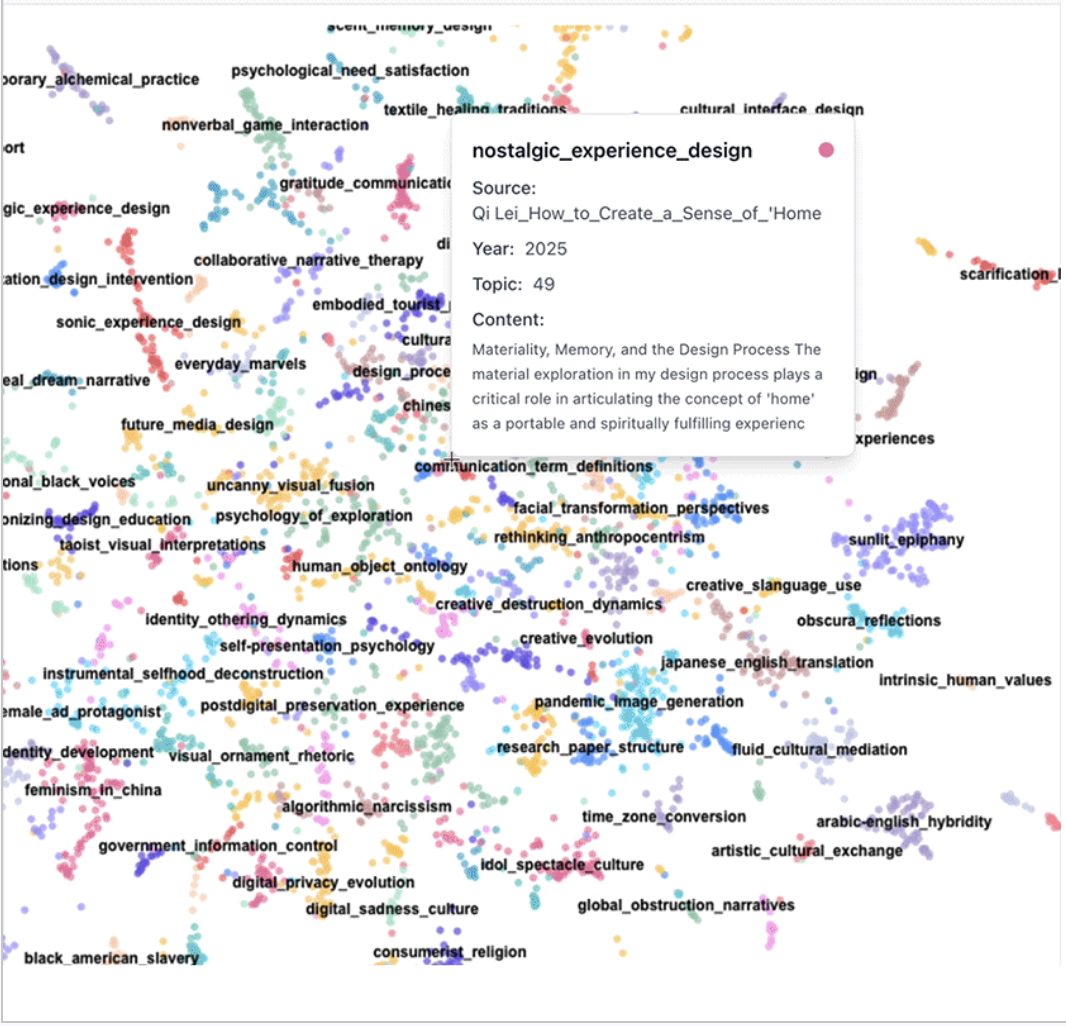
The process begins with a faculty task force that generates detailed descriptions of how each program learning outcome might appear in student work, including conceptual framings, methodological approaches, and ways students describe the intentions or implications of their work. These descriptions serve as interpretive anchors. The model then estimates semantic proximity between student work and these anchors, and the relationships are visualized in a two-dimensional semantic plot. Each point in the plot represents a detected relationship between a passage of student work and a potential manifestation of an outcome, positioned according to its proximity to different outcome areas.
The resulting visualization allows assessment professionals to examine how engagements with particular outcomes are distributed across a student population, where certain outcomes appear frequently, where they emerge in unexpected contexts, and where they are less visible. Learning is treated not as a score but as a distributional pattern across a body of work, one that reflects the complexity and plurality of creative education.
-
Dr. Gaia Scagnetti is the Chairperson of the Graduate Communications Design department at Pratt Institute. Her current research projects discuss new pedagogies, strategies, and approaches for higher education in design.…