HyperTILES, HyperBRICKS
By Haresh Lalvani, Robinson Strong, Hongsheng (Ronan) Chen, Krishna Goyal, Michael Kraeim, Brynn Lucky, Betye Arrastia Nowak, Anna Payne, Ethan Peng, Natalia Rossi, Sara Su, Shreya Singhal, Weihang (John) Wang, and Zixun (Bell) Wang
Brick construction, among the oldest in architecture, and its relatives – tiles, blocks, grilles – exemplify a powerful atomic approach to building technology. Throughout its millennia of use, the shape of brick has remained practically unchanged despite improvements in size, proportions, materials and methods of manufacture. With the availability of digital fabrication combined with new discoveries in geometry (mathematics) in recent decades, brick design is primed for a shape revolution.
In the 1980’s-90’s, the PI developed an infinite class of 2D shapes for tiles/bricks/blocks projected from higher dimensions. These flat hypertiles (hyperbricks, hyperblocks) have equal edges, are convex or non-convex and symmetric or asymmetric, widely expanding the shape repertory of tiles. Based on the infinite number series: 2, 3, 4, 5, 6, 7, …, hypertiles come in distinct families of shapes for each number which represents the number of directions (dimension) of tile edges. However, hypertiles are restricted to making flat surfaces. It is mathematically impossible to build compound curved surfaces with more than 120 identical tiles making gaps between tiles unavoidable for large number of tiles. For architecture, gaps are a non-issue; filler materials like adhesives (glue, mortar) can enable physical structure. This makes hypertiles/hyperbricks with gaps viable for building.
The multi-directional orientation of hypertiles enables connecting with other tiles in many more ways, increasing design options. Multi-directionality of shapes also leads to greater structural engagement and increased surface contact between tiles. We expect these important features to impact their environmental performance (structural, thermal, etc.) favorably, something we are keen to test.
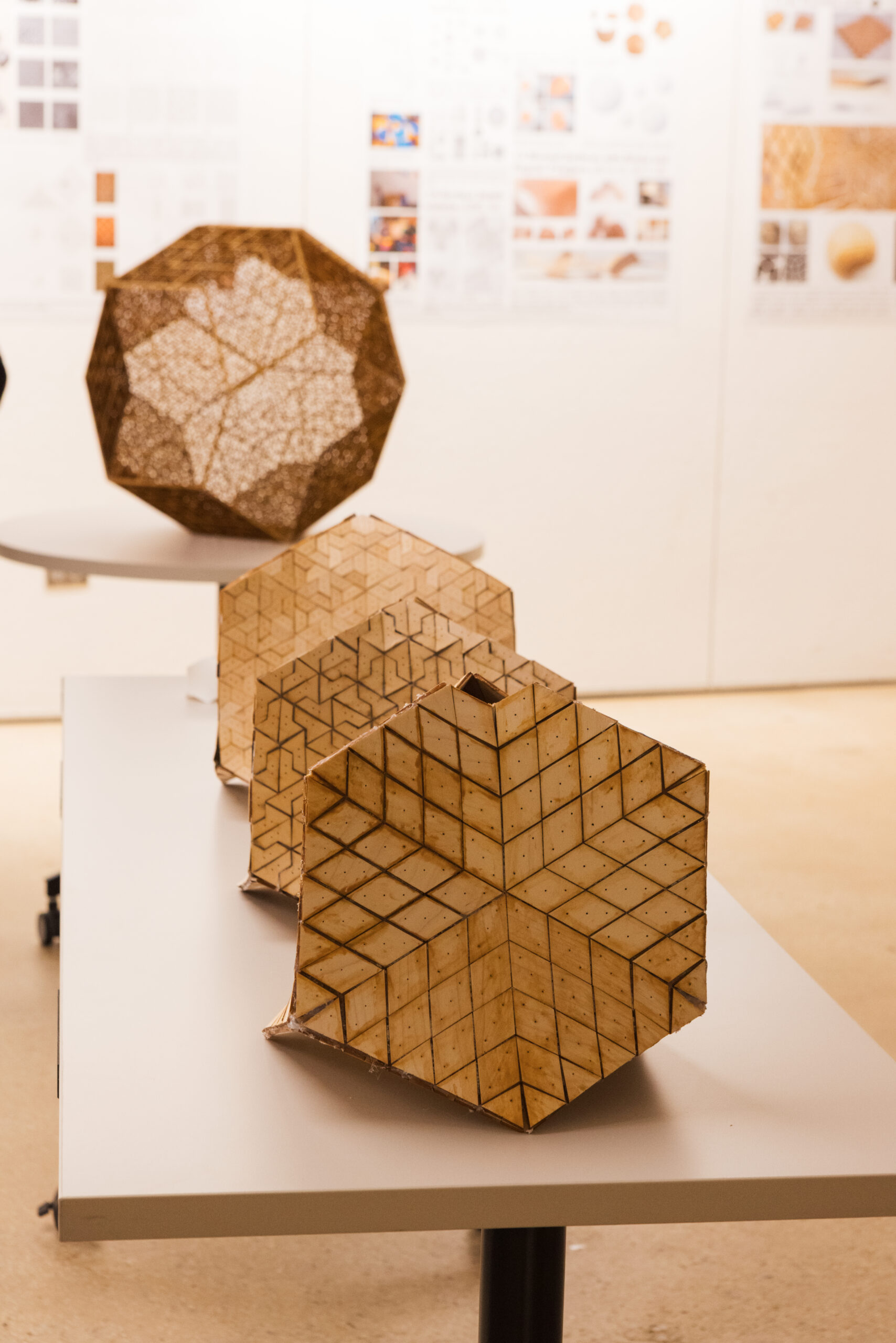
The models show hypertiles built as a sphere, polyhedra and curved minimal surfaces. Visible gaps between tiles/bricks are digitally precise and require inventive methods of installation – formwork, robotic construction or use of drones. Machine learning algorithms should enable more uniform gaps, providing a practical solution for any brick mason.
-
-
 Robinson is a Visiting Assistant Professor at Pratt Institute’s Undergraduate School of Architecture where he teaches in the Morphology Program and also a Research Associate at Pratt’s Center for Experimental…