FLOW: Energy Autonomy and Regenerative Infrastructure for Floating Communities
By Christopher Brokaw, Zehra Kuz, Elizabeth Lynch, and Devanshi Lodha
FLOW: Energy Autonomy and Regenerative Infrastructure for Floating Communities
Developed in tandem with undergraduate architectural design studios exploring intertidal urbanism, this research addresses the technical intersection of buoyant structural integrity and decentralized, blue-energy microgrids.
Part 1: Hi-Performance Marine Stable Biogenic Façade Panels: (Construction in Progress)
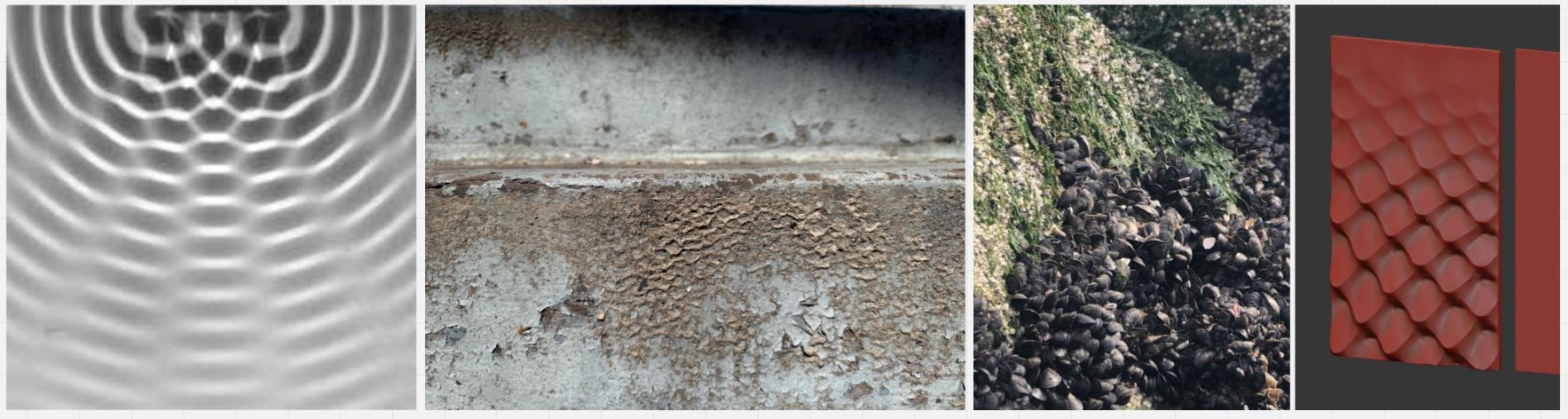
These "Marine-Stable" panels utilize a composite of foam glass and an oyster/mollusk shell concrete top coat impregnated with macroalgae—a system designed to "grow stronger together" over time. Engineered to meet Passive House standards for Climate Zone 4A, these assemblies are lightweight, thermally stable, and resistant to high-humidity, salt-wash environments. Designed as a substrate for micro-organisms, the panels prioritize ecological health by avoiding petrochemicals and legacy contaminants. Formally, the surface textures are derived from wave interference patterns; these bio-receptive dunes and tide pools slow water flow to induce particle deposition and encourage colonization by local microflora and fauna.
Part 2: The Unit & the Commons: Two Schematics for onsite Plant-based wastewater treatment for a 40-unit floating community (Design/Visualization in Progress)
The Commons investigates the Head-House—a centralized infrastructure and amenity that facilitates closed-loop resource management. We present two alternative systems for decentralized district energy and food production/value creation.
A: Waste-to-Food
This system reimagines the Head-House as a high-performance greenhouse and nutrient-recovery center. Utilizing a series of engineered ecological tanks—the system treats community wastewater and converts it into usable biomass. This is paired with secondary aquaponic and tidal farming operations to create a resilient local food economy.
Programs: Public market, sea-to-table communal dining, aquaculture processing, and storage operations.
B: Waste-to-Energy
This configuration focuses on carbon-neutral energy production through a Biomethane Digester Plant. By collecting organic waste from individual floating units, the plant generates biomethane to fuel a Combined Heat and Power (CHP) system. This provides a constant baseline of electricity and thermal energy for the community.
Programs: Synergetic "High-Heat" programs that utilize excess thermal output, such as a community bakery, a brewery/distillery, or a public thermal spa and pool.
-
As a founding partner of VUW, Chris has twenty years of professional architecturalexperience working on commercial, institutional and mixed-use projects with aconcentration on hi-performance enclosures and sustainable building technologies.He is…
-
 Zehra Kuz is a registered architect (NYS, CT) and Adjunct Professor-CCE at the Pratt Institute’s School of Architecture. Influenced by how the changing climate and prevailing environmental pressures affect urban…