Acupuncture Architecture: Small Interventions for Social Mobility
The attitude this project upholds is rooted in slow fieldwork, where unveiling deep layers surrounding an infrastructure is deemed to be crucial for generating a sensible design proposal. Places and buildings hold ghosts of culture and history, and their detailing and wear traces a dialogue with their environment.
This observational exercise is a slow paced research project for a non profit organization that manages public and subsidized schools in Santiago, Chile. It started as a vast proposal of acupuncture like interventions in the fourteen schools. The project stems from a need to thread all the schools at the urban scale, visibilizing this network of educational establishments that exist in vulnerable neighborhoods within the city. These projects intend to act as pinpoints within a large community of institutions, showcasing the non-profits investment in social mobility as their educational ethos.
The schools have been built with a wide array of construction techniques and represent a point in time: socially, politically, and aesthetically. The goal of the fieldwork was to document and categorize the need for infrastructure in each school, and determine a toolkit of materialities and tectonics that can be deployed in all of the case studies.
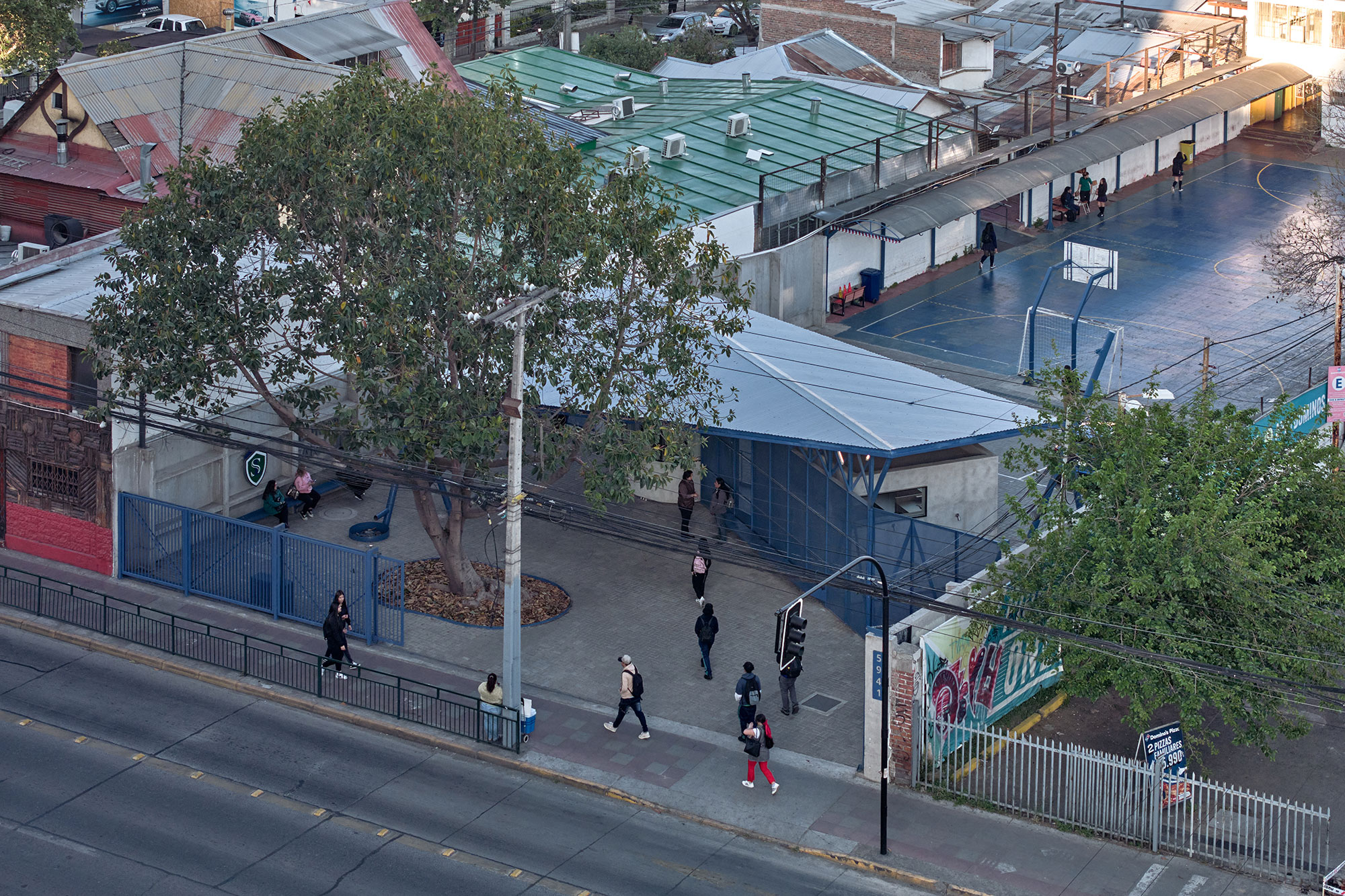
The first of these interventions was the Entrance of Politécnico San Luis completed in 2025, and it is materialized as an entrance that donates a public plaza in one of the main arteries of the city. Designing a new meeting point between the city and the high school created opportunities for interaction, increased activity, and greater visibility, where architecture plays a role as a social, political, and urban catalyst.
The project was developed with an ethos of low-maintenance and bare tectonics, where the color blue calls attention to the Non-profit’s new identity’s color. With an attitude of small renovations, the schools engage in a cost-effective and plausible strategy for long-term progress, where the schools position themselves as stakeholders within the urban fabric by sharing their public space with the city.