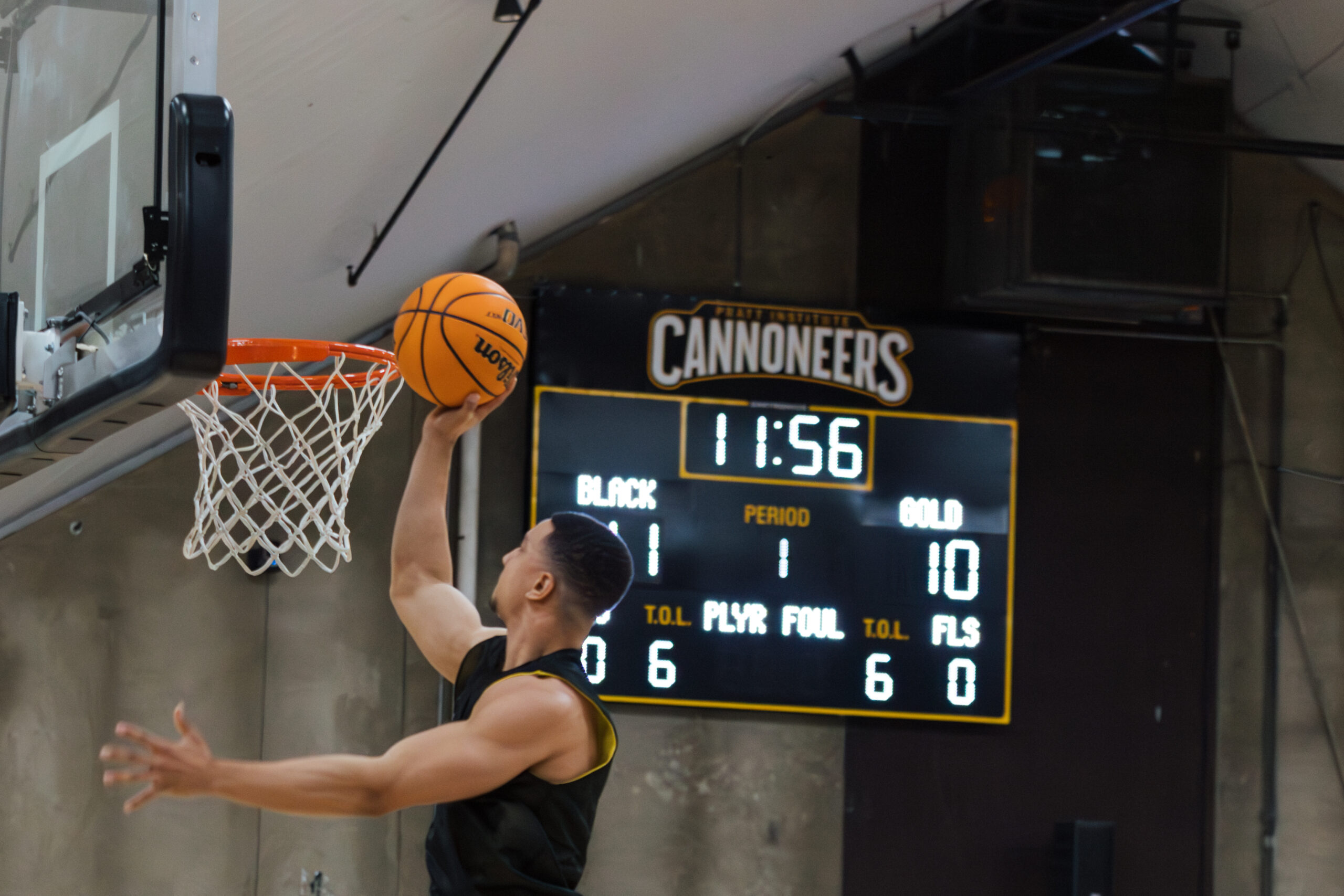
At halftime of the 2026 Pratt Alumni Basketball Game, the announcer tells Kadir Nelson, BFA Communications Design ’96, that the crowd wants to see him dunk. Nelson, who is best known for his Caldecott-winning books, New Yorker covers, and album art for artists like Drake and Michael Jackson, laughs at the suggestion. Leaning into the mic, he says, “I haven’t done that in 30 years.”
Not quite that long ago, in 2005, Nelson and his former Pratt teammate Bernard Chang, BArch ’95, helped revive the annual alumni game, which records show started in 1974, by organizing an impromptu scrimmage. At the 2026 game—now organized by Athletics and Alumni Engagement, with friends and family filling the freshly renovated ARC’s bleachers—Nelson and Chang are being honored for over 20 years of fostering Pratt’s basketball community, whose history is a testament to a vibrant, if unexpected, connection between creative people and the game of basketball.

Photo by Dahlia Dandashi
“People don’t normally associate artists with sports,” says Rich Lebenson, BFA Graphic Arts ’66. “But there were always people [at Pratt] who were nuts about basketball.”
It’s hard to imagine someone who’s seen more of Pratt’s basketball history than Lebenson, who has coached on and off at Pratt since the ’70s and played as a student in the ’60s. Lebenson was also key in restarting the alumni game tradition following that 2005 scrimmage.
“You know when you get hot in a game, and you can’t miss? That’s the same stream of consciousness you get [when making art].”
Rich Lebenson, BFA Graphic Arts ’66; MFA Fine Arts ’68
When he was a student, the school was gym-less—the team played only away games and practiced at an armory in Bed-Stuy. In the years since, basketball at Pratt has ebbed and flowed—Lebenson’s seen years where Pratt players have led the nation in scoring and rebounds, and others where coaches couldn’t find five players to even try out. Still, Lebenson says, among the students who have come to Pratt for art, design, engineering, and other creative disciplines, there have always been those who seemed nearly equally dedicated to basketball.
“I enjoyed the teamwork, the players . . . Architecture is a lot of work, and you need to have a release. I was playing basketball.”
Karl Schulz, BArch ’81, who also fenced and played soccer at Pratt
One such student was Ed Mazria, BArch ’63. Today, Mazria is a world-renowned architect, but Mazria saw a different future ahead of him as a senior at Pratt, when he was drafted into the NBA by his hometown team, the New York Knicks. In fact, basketball was at the forefront of Mazria’s mind from the very beginning of his Pratt journey—he was offered a scholarship on the spot after Pratt’s coaches saw him play in an NYC high school showcase. When the coaches asked him to choose a major, he picked architecture on a whim.
“I entered not knowing what I was getting into,” says Mazria of Pratt’s architecture program. Now, Mazria sees a connection between the sport he’s loved since he was a child and the creative practice that became his life’s work.
“Once you get into it, you definitely start to see the connections between basketball and architecture, and a lot of other fields too,” says Mazria. “There’s a lot of strategy involved —when you’re on the court, you’re adapting quickly to different things, so you’re trying to be as creative as possible. You’ve got to be able to see patterns, which is really important in architecture. You essentially design your way into making baskets.”

Photo by Dahlia Dandashi
Two generations later, Kylie Grant, BArch ’26, a star player on the current women’s team, sees the same connections.
“I like doing everything [on the court], and that ties into architecture because an architect does everything!” says Grant with a laugh. “I can’t just draw something up and be like, ‘Oh, this is cute,’ and pass it to the next person. I have to follow it all the way until the day it’s built. Architecture is about problem solving . . . and there’s always a problem to solve. I use that same vibe in basketball—when I’m on the court and someone stops me, I’m immediately thinking, ‘OK, how do I counteract how they stopped me?’”
“More so than in other sports, there’s a lot of room in basketball to find your own swag—to create your own style of playing.”
Kylie Grant, BArch ’26
In more ways than one, Grant follows in the footsteps of Cyndi Meserve-Bona, BFA Fashion ’78. There was no women’s team at Pratt during Meserve-Bona’s first year, but due to a then-recent Title IX ruling, it was required that she be allowed to try out for the men’s team. She made the team and then made history as the first woman to play NCAA basketball.
“While playing basketball, you can be so creative,” says Meserve-Bona, who led her high school team in Maine to four straight state championships and then came to Pratt to study fashion. Meserve-Bona says she thought coming to art school in New York would mean leaving her basketball days behind. She was happy to be wrong.
“In basketball, you can affect the game in such a bodily and exuberant way that you can’t do regularly in the other sports.”
Bradley Ward, MFA Fine Arts ’19
For other Pratt alumni, basketball is more than just an analog to their creative work—it’s visible in the work itself.
Sam Peterson, AAS Graphic Design/Illustration ’12; BFA Communications Design ’14, now uses his design skills for Project Backboard, a nonprofit that refurbishes and beautifies outdoor courts across the nation with vibrantly colored art.
Bradley Ward, MFA Fine Arts ’19, made prints during his time at Pratt that collaged photos of basketball icons like LeBron James alongside images of centuries-old European masterpieces. Ward found it especially meaningful to make this work at Pratt alongside the four other Black students in his MFA cohort—a group Ward says “felt like a team.”

And then there’s Nelson, whose new book Basket Ball—an illustrated history of the sport from its invention to now—feels like a culmination of a lifetime of making basketball-related art. For Nelson, that work is assisted by a lifetime of playing the game itself. “When I would see, say, a photograph of Michael Jordan or Dominique Wilkins jumping through the air or twisting or making a slam dunk,” Nelson says, “I could translate that into a drawing or painting, because I know what it feels like to do it in real space. Then, I know what it feels like when I look at it on the page. If those two match, then I’ve had success with creating the artwork.”
To preserve a legacy of people whose creative lives have been touched by basketball, and vice versa, was one of the reasons Nelson and Chang revived the alumni game in 2005. “When I played at Pratt,” says Chang, who has since built an award-winning career in illustration, particularly of comics for publishers like DC and Marvel, “a lot of the older alumni would come by and practice with us and teach us this folklore about the history of the program. I kind of feel like it’s incumbent upon me to pass along this knowledge.”
“While playing basketball, you can be extremely creative, and it’s getting more and more amazing watching today.”
Cyndi Meserve-Bona, BFA Fashion ’78
Near the end of the 2026 game, Nelson and Chang’s team is pulling away. Patrick O’Gorman, BPS Construction Management ’24 (or @pattyoghoops to the nearly 300,000 followers of his basketball-coaching TikTok account), has hit a second three from nearly half court. Lebenson sits courtside like a celebrity, and is approached frequently like one, as friends and fans shake his hand. Meserve-Bona, who made the drive from Maine, where she was inducted into the Maine Basketball Hall of Fame last summer, cheers on from the stands—later, Carlos Acevedo, head coach of Pratt’s women’s team, will tell her what an honor it is to meet her. Grant watches from the sidelines, in preparation for her senior day game later that afternoon.
The clock is winding down, but there’s an air of anticipation here that feels right. “There’s a huge creative element to being a basketball player,” says Mazria. Each moment can feel full of possibility—the court ready to be electrified by a player’s ideas and a team’s collaborative energy. It’s no wonder so many players carry that creativity off the court, too. 