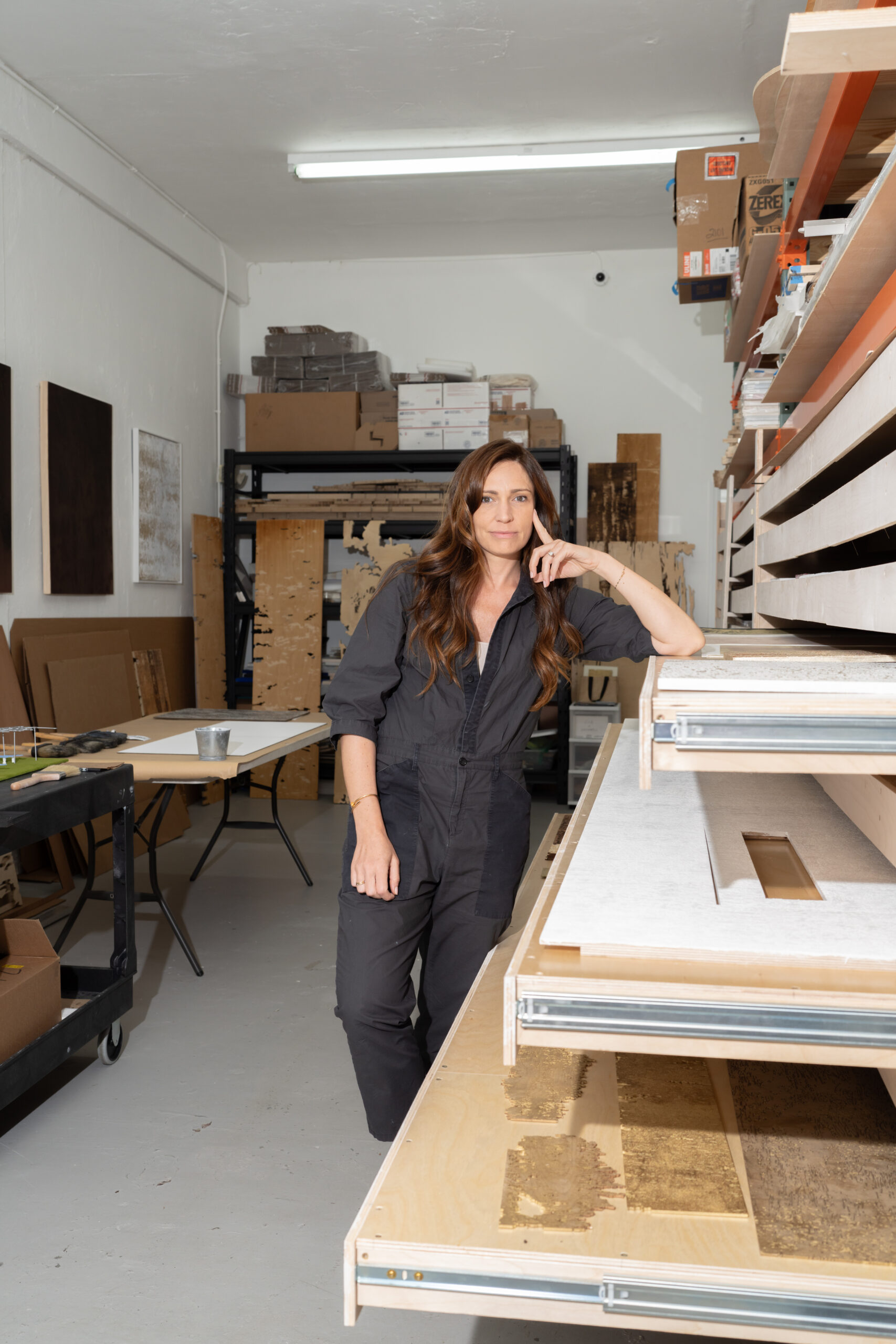
A Paris-born, French-American creator based in Miami, Joyce Billet began experimenting with material and texture as an architecture student at Pratt Institute. Today, she captures organic patterns through photography and hand-painted brushstrokes, then translates them into digital files. These become machine-cut and etched plywood installations that straddle painting, sculpture, and design.
Since 2024, Billet has been in residence at Miami’s Design District, debuting sculptural benches and canopies commissioned by Miami Art in Public Places. She was selected by architect Peter Marino to produce a large-scale permanent installation for Dior’s New York flagship. Her work also appeared as a special project presented by Villa Albertine at Design Miami, and she mentors emerging artists at Florida International University’s Art and Design Incubator.
In this Q&A, she reflects on what fuels her category-defying creative life.
What’s a daily practice that prepares you for your work?
I always begin my day with meditation. It helps me focus and keep my goals in mind throughout the day, because as a creative person, I can get very distracted.
What’s a tool you can’t live without?
A camera. In my work, photography has become a way to transform something that’s physical into something digital. It’s a way for me to translate my hand paintings into something digital that I can manipulate, work on, and play with.
When you hit a roadblock, what’s your tactic for getting unstuck?
Going to friends’ studios. It’s nice to see how other people approach their work, and there’s always something that sparks a new idea or a way to get back into my space.
Where do you creatively recharge?
There are two spaces. One is nature—walking where I can be exposed to natural elements. The other is a busy city like New York. Being in an energetic environment with access to museums and galleries allows me to recharge.
What’s the most inspiring place in New York City for you?
In New York City, I like the MoMA. It’s a classic, but I like that they have the design collection as well as art.
And in Miami?
I love Fairchild Garden, which has all different types of plant life, and the Design District, where I have a studio residency.

Did living and studying in NYC influence your work?
Definitely. New York is one of the best cities to engage with ideas and culture. There’s an international crowd and an energy where people are very ambitious. It drives you in that direction.
How has living and working in Miami changed your work?
My work already had this sort of connection to nature, but it became physically possible to actually integrate nature into my work because of the landscape of Miami.
Who’s the first artist, designer, or architect you saw yourself in or felt a connection with?
An architect I appreciate is Daniel Libeskind, whose studio is where I had my first job. An artist I admire is Rudolf Stingel. I have always been enamored by his carpet paintings because of their dimensionality and texture, and also the fact that he researches different techniques to create that texture.
Who or what is a major influence for you today in your work?
I like technology and new tools. I try to stay up to date with whatever tools are available, but I want to approach them in a way that mixes the hand and the machine—where it’s not used in an obvious way. I’m experimenting with laser cutting, etching, and 3D printing.
Is there a “failure” that turned into a breakthrough?
Moments when materials did not behave as expected often led to breakthroughs. Those experiences taught me to embrace unpredictability as an essential part of the process.
What’s your favorite part of the work you do today?
I think it’s having conversations with people when a piece is done and seeing their curiosity. The most rewarding part is seeing people interact with the larger installations and actually use the work. When a piece becomes functional, it’s the best feeling.

What’s energizing you right now?
I have my first large-scale public art project coming to life. It’s going to be a permanent installation in a new public park in South Miami, hopefully opening in early 2026. I also recently became a mentor at Florida International University’s art and design incubator program.
As a mentor, is there a question you always ask your mentees?
If you had no boundaries and you could dream big—not thinking about budget, process, or limitations—what would be your dream company, artwork, or piece?
What’s something you learned at Pratt that you’d want to pass along to a student today?
At Pratt, I felt I could be as creative as I wanted, even in an architecture program. It’s nice to have projects with no boundaries. As a student, that’s the only time in your life you can do that. Listen to your professors who are pushing you in that direction and think outside the box. 