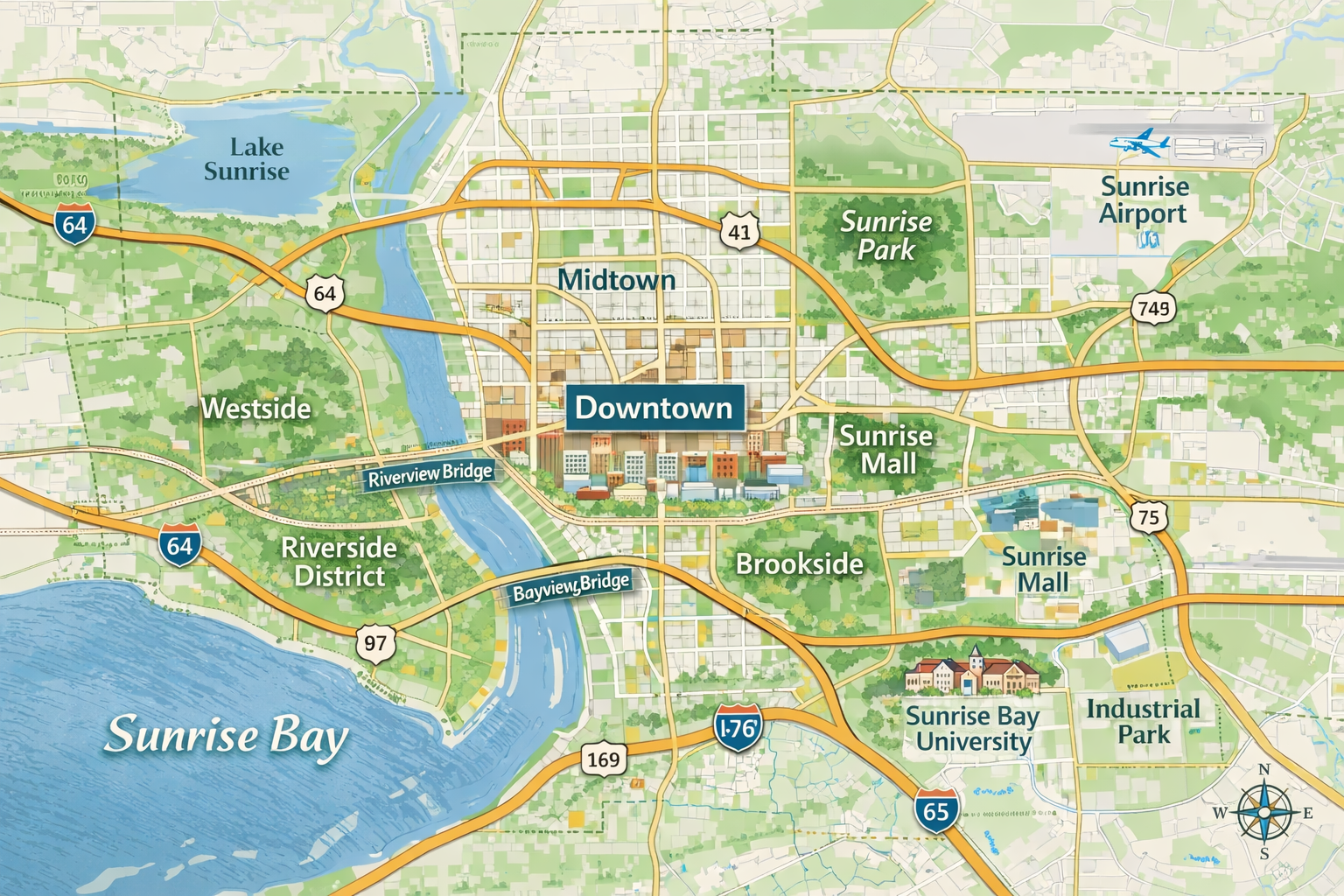
Sunrise Bay: Immersive Experiential Learning of Scenario Planning
This presentation highlights the use of weekly scenario planning exercises as a central pedagogical strategy in a graduate urban science course designed to integrate project management, design thinking, community science, and future-oriented decision-making. The course uses structured weekly exercises to help students progressively build confidence in interpreting complex urban challenges while developing both analytical and personal capacities, including adaptability, collaboration, communication, and reflective judgment. Each exercise requires students to engage mixed methods research by combining qualitative reasoning with quantitative interpretation, drawing from policy analysis, spatial thinking, urban data, and institutional context to evaluate alternative futures.
The scenario planning framework directly connects course learning objectives and student learning outcomes by moving students through increasingly advanced levels of cognitive engagement aligned with Bloom’s Taxonomy, from comprehension of assigned readings and foundational concepts to application, analysis, evaluation, and creation. Students regularly apply ideas drawn from scholarly literature, policy documents, and case studies to practical urban challenges, testing assumptions, identifying uncertainty, and proposing strategic responses. These exercises are intentionally iterative, allowing students to strengthen research design, systems thinking, stakeholder awareness, and evidence-based reasoning over time.
Particular emphasis is placed on transferable skills that extend beyond the classroom: framing problems, defining scope, managing uncertainty, synthesizing interdisciplinary evidence, and communicating recommendations clearly to diverse audiences. By combining data analysis, policy reasoning, spatial interpretation, and collaborative inquiry, the course prepares students to approach urban issues with greater rigor and creativity. The result is a learning environment where students not only understand urban systems more deeply but also develop the practical habits and intellectual flexibility needed for effective professional practice in urban science