Academics
Admissions & Aid
Life at Pratt
Works
Visiting Assistant Professor
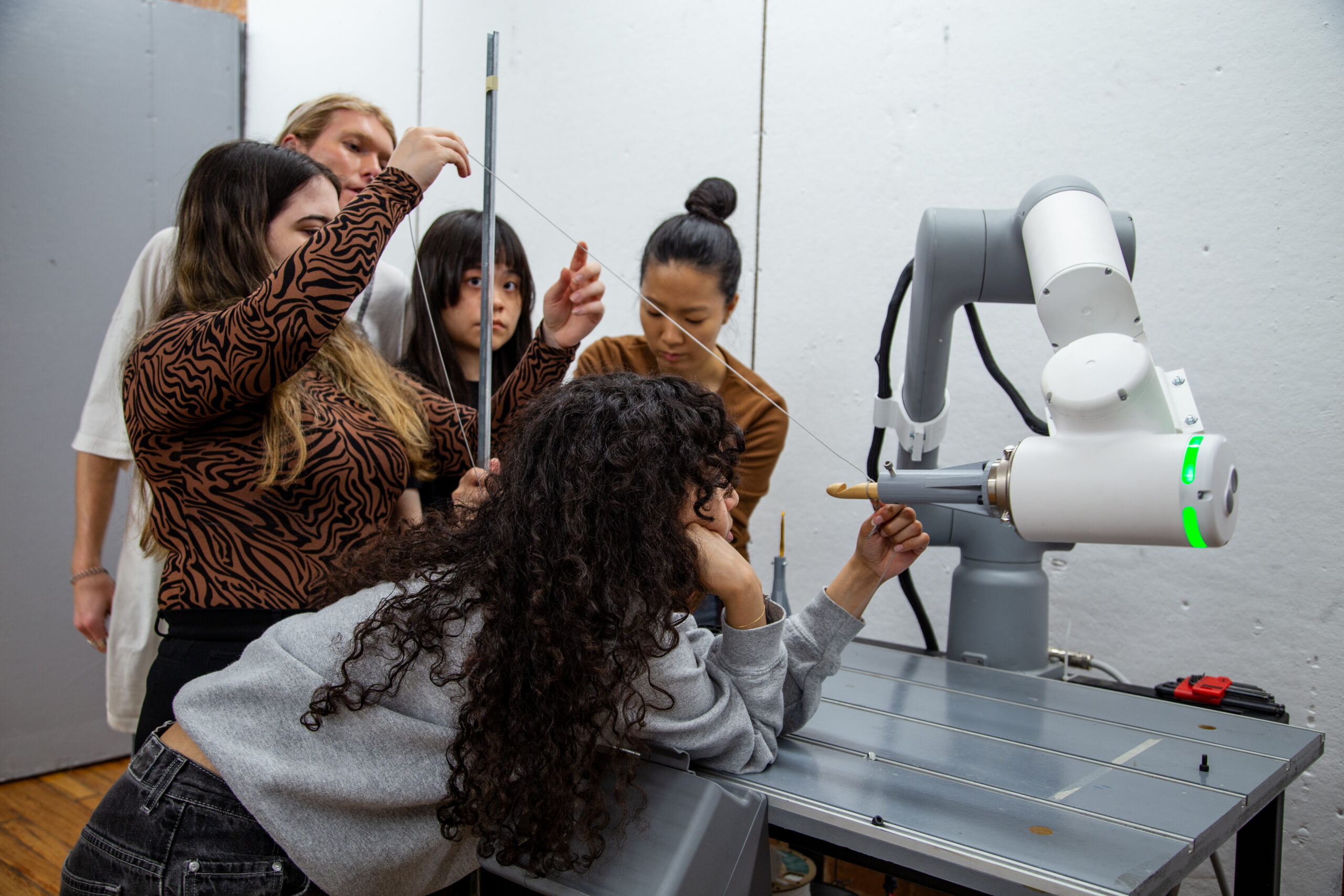
Hyperstitch: The Architectonic Potential of Robotic Crochet
Hyperstitch explores crochet-based fabrication as a method for creating dynamic, climate-adaptive and self-supporting architectural forms by crocheting with a robotic arm. It examines the craft’s topological traits and ductility simultaneously through design research and fabrication. Examining the potential of “weak” structures to flexibly perform in volatile environments, material and scalar shifts in production test crochet stitching at an architectural scale. Engaging with a robotic arm as collaborator allows to scale the construction up and employ industrial grade materials.
The aims of the project are: 1) To examine the nimble performance of soft structures and their ability to rebound from deformation without breaking; and 2) Set up a workflow for rigorous experimentation of robotic crochet fabrication, as well as its quantitative and qualitative assessments.
In its capacity to create ruffles and folds, crochet holds an under-explored potential to form intricate crevices and enclosures. This happens when the number of stitches increases so dramatically that they start to displace one another in space, forming cavities which close in on themselves. Crochet thereby offers a powerful construction method in producing form-active structures: flexible, adaptable forms that gain their strength from knot-tying and geometry, rather than through cross-sectional stiffness. Crochet’s logic is also analogous to coding, in that both execute patterns written in symbolic languages with unique syntaxes.
Their constructions thereby hold a similar potential to create output through pre-determined programming, and crochet’s meta-scale impacts formed by meso-scale changes are easily transcribed via computing.
By collaboratively fabricating with a robotic arm, the production workflow combines computational design for initial toolpath generation with machine learning to generate responsive toolpaths, enabling iterative human-machine collaboration. This method supports real-time adjustments and feedback loops during construction, establishing a routine of emergence and material self-organization, positioning Hyperstitch as a post-parametric project.