Designing for Conscious Digital Consumption
The average person unlocks their phone 96 times a day — not by choice, but by design. Persuasive technology, infinite scroll, and always-on work culture have systematically eroded the boundary between intentional and habitual use, driving measurable rises in digital-induced stress, cognitive fatigue, and anxiety among young professionals. Despite a decade of screen-time tools and growing public awareness, problematic smartphone use has continued to increase globally (Olson et al., 2022).
Awareness alone is not enough.
Current interventions fail not because users lack motivation, but because the tools are structurally limited. App blockers and alert-based reminders disrupt behavior momentarily without building the capacity to self-regulate. Drawing on Kahneman's (2011) dual-process theory, these tools interrupt System 1 (automatic, habitual behavior) without ever activating System 2 (deliberate, reflective decision-making) — producing temporary friction, not meaningful shift.
What is missing is not restriction, but the infrastructure for conscious choice.
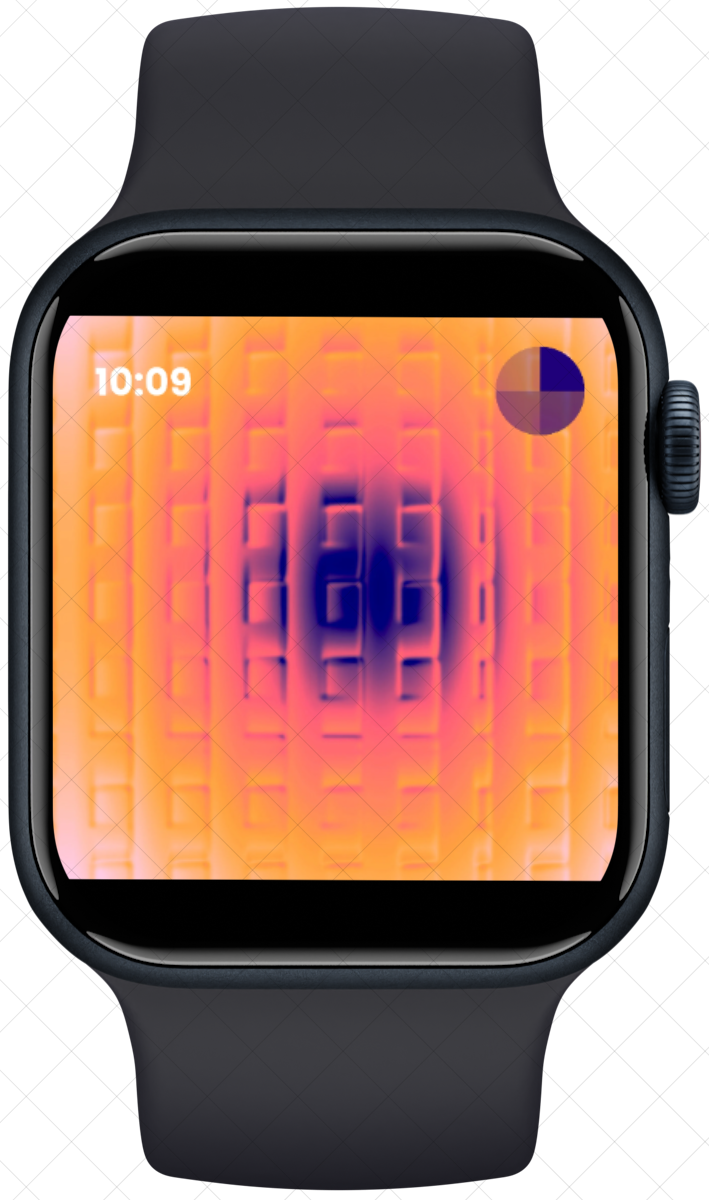
This project investigates whether ambient wearable cues can bridge that gap. Wearables are already trusted by wellness-oriented young professionals for peripheral health feedback — sleep, recovery, heart rate. Through user research and iterative concept development, we extend that established behavior into an overlooked domain: digital vitals — subtle haptic and visual cues that signal compulsive scrolling before it takes hold.
Our intervention framework draws on Hertwig & Grüne-Yanoff's (2017) nudge-boost distinction and Amber Case's Calm Technology principles — pairing these peripheral nudges with reflective boosts that build self-regulation capacity over time. Research by Hiniker et al. (2016) confirms that nudges become significantly more effective when paired with reflective prompts, yet no existing tool combines both.
The goal is not less technology — it is conscious consumption, and the design foundation to understand whether ambient, awareness-first interaction can credibly support that shift.