Cosmopolitan Plants: Fiber, Fabrication, and Ecological Design
By Mariel Collard Arias
This project explores how cosmopolitan plants—a term borrowed from ecologist Peter Del Tredici to describe plants that thrive in urbanized environments—can be repurposed and reintegrated into design projects. The work investigates the potential of these species to create fibers and textiles for erosion control and other ecological design applications. Natural fibers typically used for these purposes—like coconut and jute—grow in tropical environments far from New York City. This project explores local alternatives, placing particular emphasis on harvest, processing, and installation as hands-on processes. The research aims to challenge dominant resource-intensive building systems and narratives and contribute to more sustainable design practices, with a focus on circular material flows.
The central artifact of the installation is an erosion mat made with common reed—one of the most widely distributed plants on the planet. Phragmites australis is thought to have been introduced to North America in the nineteenth century through ballast and the horticultural trade. It colonizes human-disturbed wetlands while landscape managers invest millions in its eradication. These parallel systems of disruption and elimination reveal an enduring inability to work with landscapes as we encounter them, demanding instead that plants conform to categories of value shaped by colonial logics. This project speculates on how creative practice can interrupt this cycle and cultivate different relations with already abundant plants.
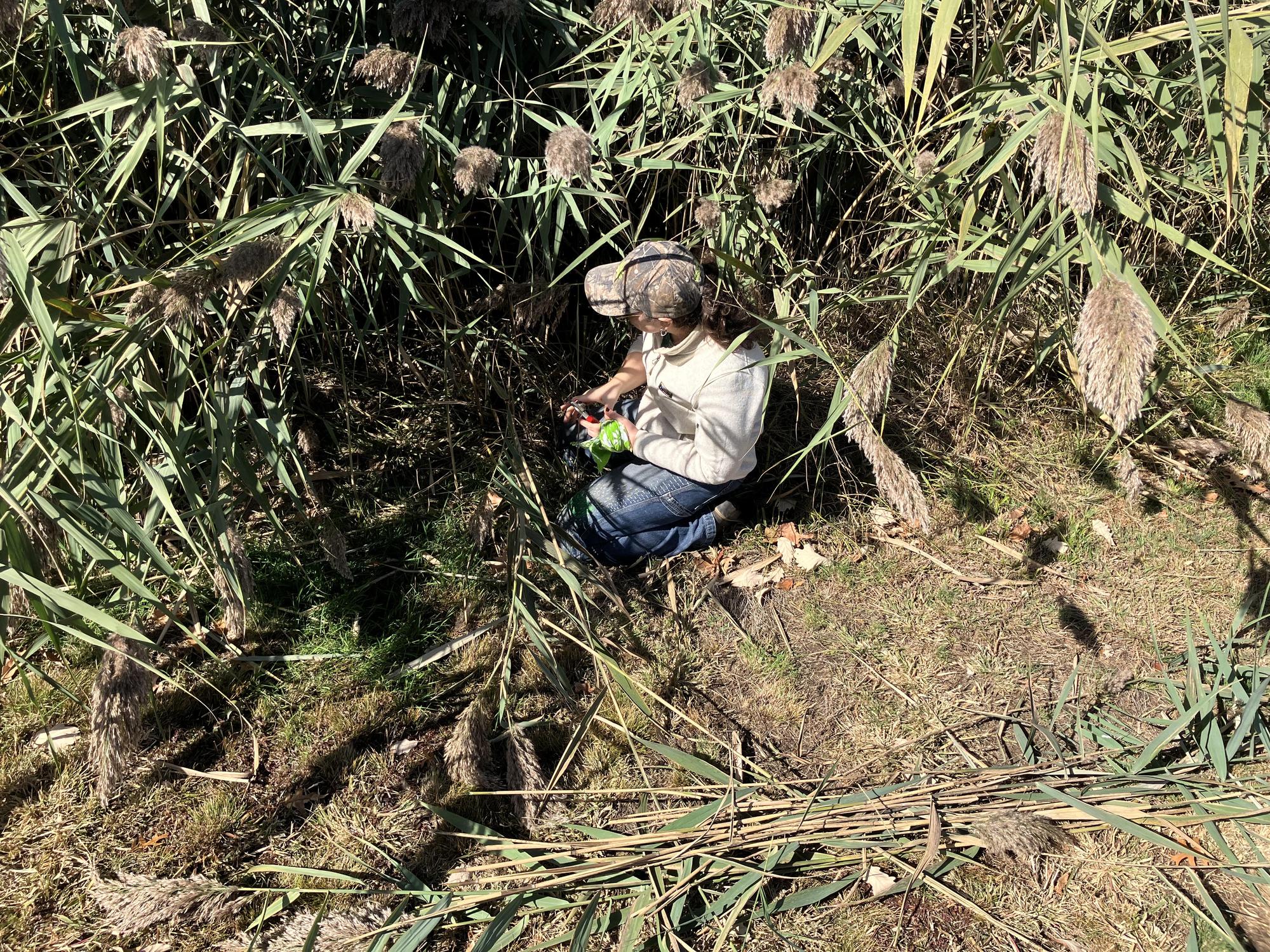
The mat was developed in Fall 2025 as part of my research accelerator and alongside a Landscape Research course I taught in the MLA program. It is a first prototype for a Phragmites "fascine mattress"—a hand-woven willow twig mat used by the Dutch for centuries to reinforce coastal structures. We harvested Phragmites at Losen Slote in the New Jersey Meadowlands, through my ongoing collaboration with the Meadowlands Research and Restoration Institute. Future research includes fabricating a full-scale mat for installation and monitoring at the Meadowlands.
Moving beyond landscape architecture's contradictions requires practices of making where care is enacted physically and materially, rather than deferred as an ethical ideal.
-
Mariel Collard Arias