The Unbearable Heaviness of the Light Frame Exhibition
October 27 – November 21, 2026 9:00 AM – 8:00 PM
Higgins Hall, Siegel Gallery, 61 St. James Place, Brooklyn 11238
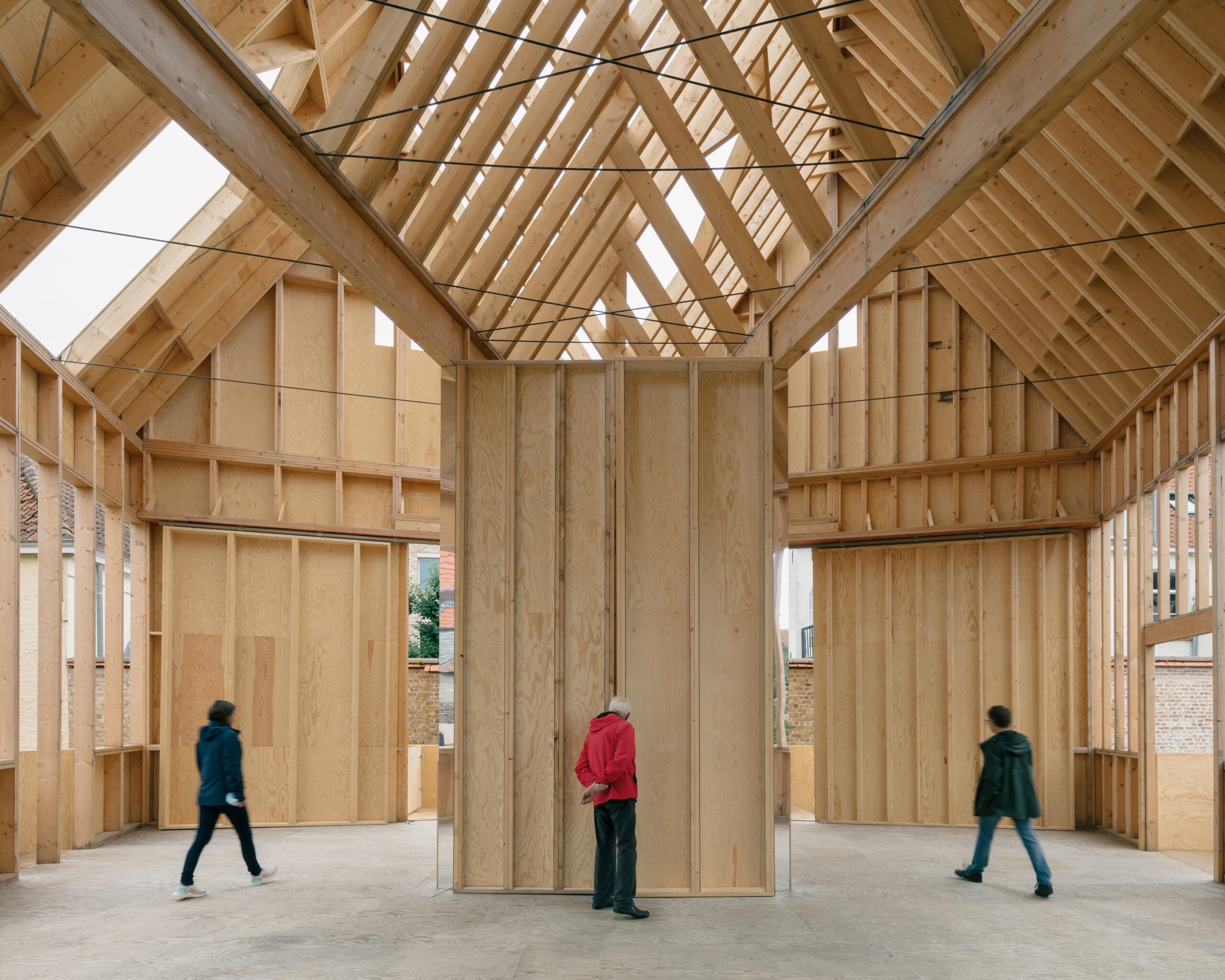
Recently, we have been fascinated to see that architecture’s least substantial material system is being called to bear the discipline’s greatest social, environmental, and theoretical weights.
This system is the light frame, and its calling cards are everywhere in the work of progressive architects. There are studs, sticks, tubes, and poles, almost always in large numbers and standard industrial dimensions. Members are arranged in cubes or rectangles of fixed measure. Their volumes are most often stripped of cladding or covered in a way that undermines solidity, detailed with wide seams, a one-sided finish, or angle of rotation so that anything opaque looks detachable, temporary, secondary to a matrix of support that is nonetheless almost nonexistent.
The ubiquity of the light frame might seem to imply an easy continuity, as though certain givens were being maintained and repeated. Its current uses, however, are new. Thinking through this distinction requires a look back. From the cast iron skeletons of Eugène Viollet-le-Duc, to the distributed mass constructions made possible by the balloon frame, to the structural utopian fantasies of Constant or Yona Friedman, it was the lightness of the light frame that underwrote its use. It was understood as cheap, materially frugal, high-tech, and low-labor. This lightness of substance was paralleled intellectually. The static principles of the light frame were well-understood to the point of being somatic. Structures were didactic, with each stick in the assembly demonstrating its contribution to the whole. This alliance of the physical and intellectual properties in turn sponsored a system of values. There was a satisfaction in the ratio of material to volume. Confirmation that static laws were in constant effect. The goodness of visual demonstration of truth. Visual lightness came to signify all of the foregoing.
By contrast, today’s light frames are tasked with heavy things. To prop is the verb that best captures the nature of contact between the frame and its assignments, the two being distinct but contingent, not organically related but nonetheless made necessary to one another. Sometimes this weight is static, with frames propping up rocks or rolls of steel. On other occasions it is social, where the light frame serves as props for a rally of crowds at long tables or around a festival gathering point. In still others the frame props up the weight of theory, called upon to evidence an interspecies architecture or an architecture of queer cohabitation. The economy of the frame remains, but is decoupled from the metaphysics of lightness as material truth. It is valued instead for its capacities as a structural convenience both ambivalent and necessary to its purpose.
The Unbearable Heaviness of the Light Frame asks, how is the light frame being put to such heavy ends? What mechanisms have architects invented to conscript the frame in service of this new work? What are the differences between tactics used by different designers? The apparent ubiquity of this trope yields to more subtle distinctions which reveal new axes along which designers are positioning themselves. Connections may be pinned or rigid. Members may be crafted, bought, or rescued from other building sites. Parts may be rigidly repeated, or given some modicum of individuality. The frame itself variously takes on roles as protagonist, supporting cast, or a chorus of witnesses. As we catalogue this phenomenon, which is operating across the discipline, we ask if this superficial convergence hides new species of differentiation.