Internal Event
Reactivating Tradition: Indigenous Genealogies in the Minjung Art Movement
November 3, 2026 5:30 PM – 7:00 PM
Alumni Reading Room, 200 Willoughby Ave, Brooklyn, NY 11205
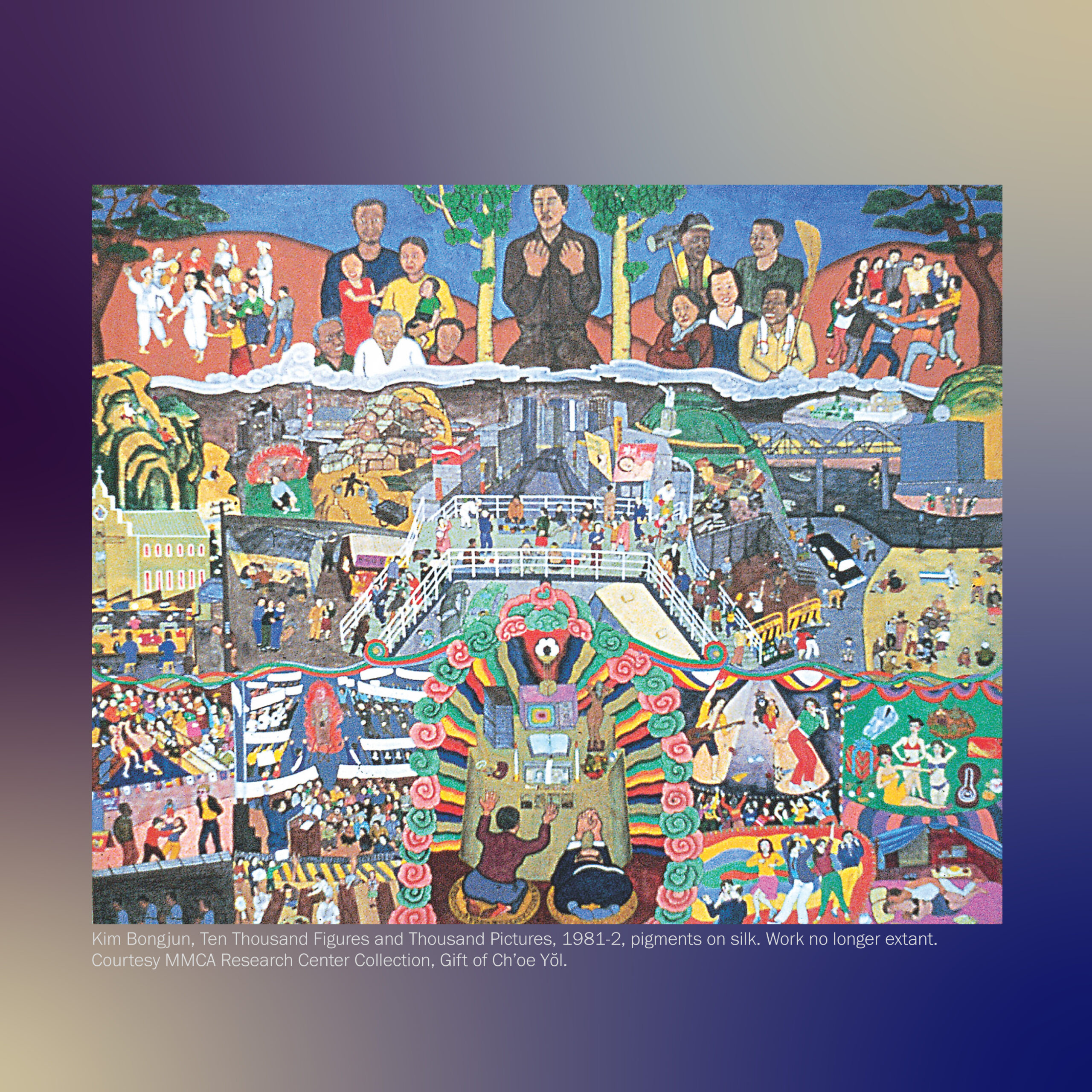
In the 1970s and 1980s, dissident artists associated with South Korea’s minjung (people’s) art movement rejected both state-sponsored modernism and imported Cold War formalism. Yet their opposition to authoritarian rule did not entail a rejection of tradition. Instead, they turned to precolonial vernacular practices—Buddhist narrative painting, folk imagery, communal performance, and ritual forms—as critical resources for political expression. This talk argues that minjung artists did not simply revive “tradition,” but strategically reactivated it. By reworking visual and performative genealogies fractured by Japanese colonialism and Cold War developmentalism, they transformed inherited forms into vehicles for contemporary political struggle. Tradition became not a static inheritance but a method: a means of repairing historical rupture while asserting cultural sovereignty in the present.
Through close analysis of protest prints, banners (kŏlgae kŭrim), murals, and performance-oriented practices, I demonstrate how these artists mobilized vernacular and indigenous aesthetic languages to embody what I call the conjoined aspirations of decolonization and democracy. In doing so, the minjung art movement unsettles dominant art historical narratives structured around rupture. It offers instead a model of politically activated continuity, expanding the meaning of liberal democracy and proposing an alternative genealogy for global contemporary art.
Sohl Lee is Associate Professor of Art History at Stony Brook University (SUNY), specializing in modern and contemporary Asian art, decolonial visual culture, socially engaged art, and ecological art history, with a particular interest in oceanic and transpacific frameworks. Her first book, The Minjung Art Movement: Decolonization and Democracy in South Korea (Duke University Press, 2026), historicizes an influential movement of activist art from the 1970s and 1980s. Her current book project, “Seaweed as Method: Art History with Oceans, Multispecies Life, and Empire,” examines the global visual cultures of seaweeds through the intertwined lenses of ecology, decolonization, food sovereignty, and Indigenous onto-epistemologies. She is a recipient of the SUNY Chancellor’s Award for Excellence in Teaching (2020) and has received grants and fellowships from the Social Sciences Research Council (SSRC), the Korea Foundation, the Korean Ministry of Culture, the Academy of Korean Studies, the Getty Research Institute, and the Andy Warhol Foundation, among others.